301 posters, 50 videos, 13 topics, 13 sessions, 734 authors, 193 institutions
ePostersLive by SciGen Technologies S.A. All rights reserved.
ISMICS 2026 Annual Meeting
10 - 13 June, 2026 | Miami, Florida

D160
Combining Resect And Respect Techniques To Manage The Tall Posterior Leaflet In Robotic Mitral Valve Repair
Poster Presenter
Part of Topic
Valve � Surgical Valves
Video
Combining Resect and Respect Techniques To Manage the Tall Posterior Leaflet in Robotic Mitral Valve Repair
Objective:
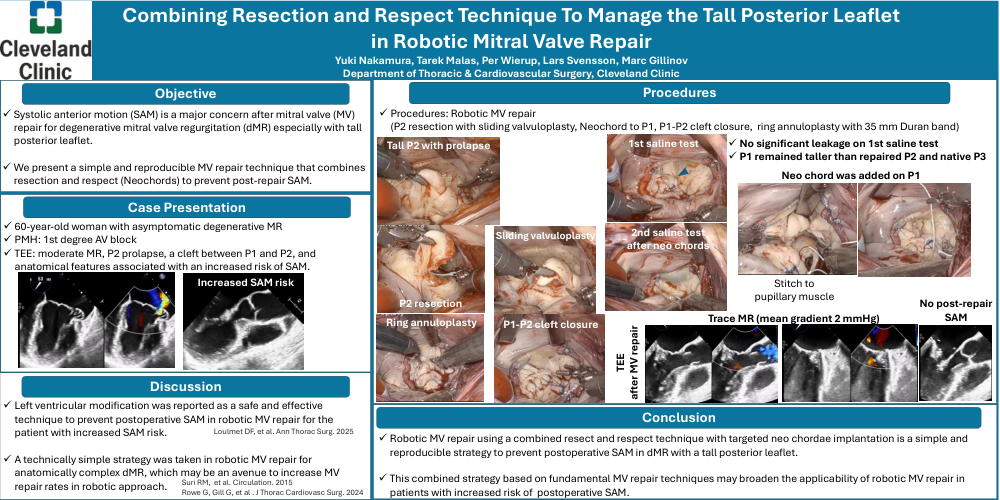
Systolic anterior motion (SAM) is a major concern after mitral valve (MV) repair for degenerative mitral regurgitation (MR), especially in patients with a tall posterior leaflet. We describe a simple and reproducible robotic MV repair technique that combines resect and respect approaches to prevent post-repair SAM.
Methods:
A 60-year-old woman with asymptomatic degenerative MR underwent robotic MV repair. Preoperative transesophageal echocardiography (TEE) revealed P2 prolapse, a cleft between P1 and P2, and anatomical features associated with an increased risk of SAM. Intraoperative findings showed P2 prolapse and excessive posterior leaflet height at P1 without prolapse. P2 resection with sliding valvuloplasty, P1–P2 cleft closure, and ring annuloplasty were performed. P1 remained taller than the repaired P2 and native P3 segments, raising concern for post-repair SAM. To further reduce posterior leaflet height and posteriorly displace the coaptation point, short neo-chordae were implanted on the P1 segment.
Results:
Post-repair TEE demonstrated a posterior coaptation line with no residual MR. No systolic anterior motion or left ventricular outflow tract obstruction was observed.
Conclusions:
Robotic MV repair using a combined resect and respect technique with targeted neo-chordae implantation is a simple and reproducible strategy to prevent SAM in degenerative MR with a tall posterior leaflet. This strategy may broaden the applicability of robotic MV repair in anatomically complex cases.