301 posters, 50 videos, 13 topics, 13 sessions, 734 authors, 193 institutions
ePostersLive by SciGen Technologies S.A. All rights reserved.
ISMICS 2026 Annual Meeting
10 - 13 June, 2026 | Miami, Florida

D157
Robot-assisted Transitional Atrioventricular Septal Defect Repair
Poster Presenter
Authors
Kenichi Okamura, Matteo Trezzi, Minoo Kavarana, Lloyd Felmly
Affiliations
Part of Topic
Pediatric - Cardiac, Cardiovascular & Thoracic
Video
Robotic Repair of Adult Transitional Atrioventricular Septal Defect With Apparent Spontaneous Closure of the Ventricular Component
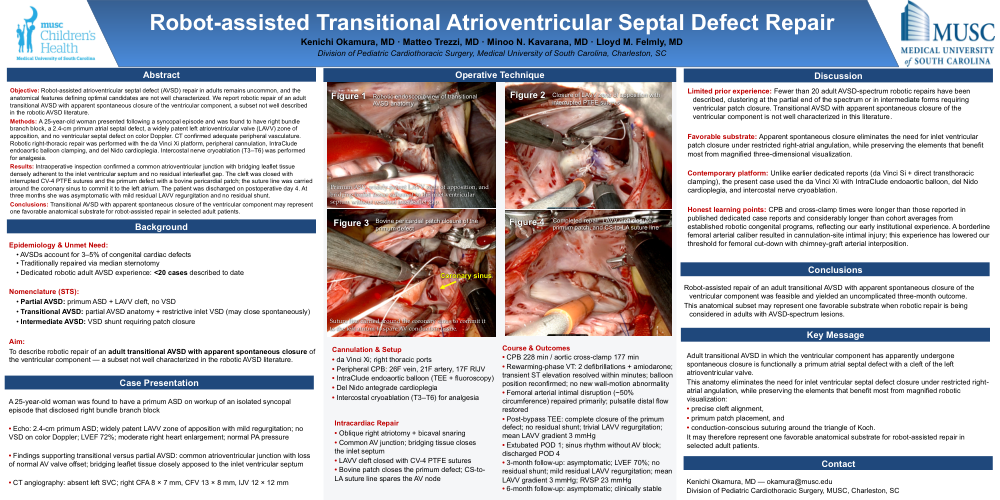
Robot-assisted repair of atrioventricular septal defect (AVSD) in adults remains uncommon, and optimal anatomical selection has not been clearly defined. We present a 25-year-old woman with transitional AVSD, a primum atrial septal defect, a widely patent left atrioventricular valve zone of apposition, and apparent spontaneous closure of the ventricular component without residual ventricular-level shunting. Robotic right-thoracic repair was performed using the da Vinci Xi platform, peripheral cardiopulmonary bypass, and endoaortic balloon occlusion. The repair included left atrioventricular valve cleft closure and patch closure of the primum atrial septal defect with careful attention to the atrioventricular conduction tissue. The patient was discharged on postoperative day 4 without residual shunt or more than mild atrioventricular valve regurgitation. This case highlights transitional AVSD with apparent ventricular component closure as a potentially favorable anatomical substrate for robotic repair in selected adult congenital heart disease patients.
Keywords: robotic cardiac surgery, robot-assisted surgery, congenital heart surgery, adult congenital heart disease, atrioventricular septal defect, AVSD, transitional AVSD, partial AV canal, primum atrial septal defect, left atrioventricular valve cleft, minimally invasive cardiac surgery, endoaortic balloon, da Vinci Xi