301 posters, 50 videos, 13 topics, 13 sessions, 734 authors, 193 institutions
ePostersLive by SciGen Technologies S.A. All rights reserved.
ISMICS 2026 Annual Meeting
10 - 13 June, 2026 | Miami, Florida

D154
Hybrid Revascularization Reduces Morbidity And Hospital Length Of Stay: A Risk-stratified Single Center Analysis
Part of Topic
Coronary Revascularization
Objective:
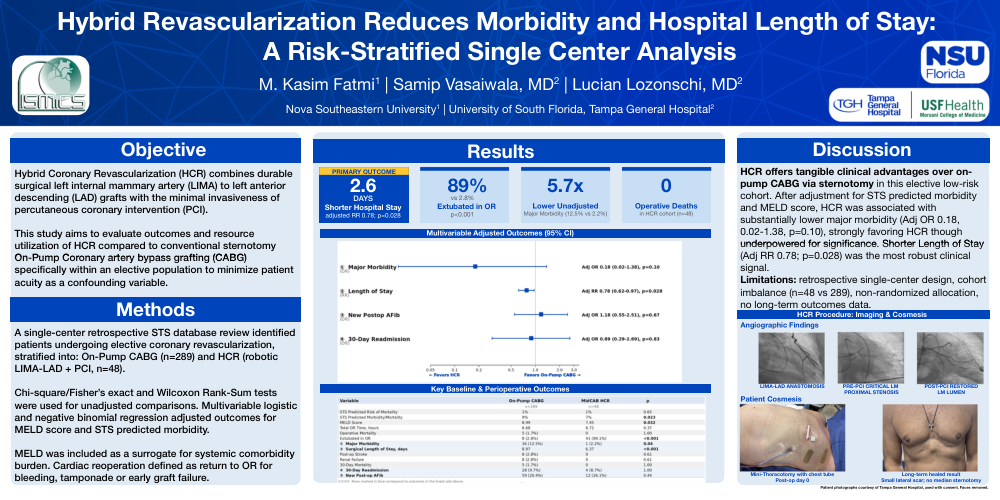
Hybrid Coronary Revascularization (HCR) combines durable surgical left internal mammary artery (LIMA) to left anterior descending (LAD) grafts with the minimal invasiveness of percutaneous coronary intervention (PCI). This study aims to evaluate outcomes and resource utilization of HCR compared to conventional sternotomy On-Pump Coronary artery bypass grafting (CABG) specifically within an elective population to minimize patient acuity as a confounding variable.
Methods:
A single-center retrospective STS database review identified patients undergoing elective coronary revascularization, stratified into: On-Pump CABG (n=289) and HCR (robotic LIMA-LAD + PCI, n=48). Chi-square/Fisher’s exact and Wilcoxon Rank-Sum tests were used for unadjusted comparisons. Multivariable logistic and negative binomial regression adjusted outcomes for MELD score and STS predicted morbidity. MELD was included as a surrogate for systemic comorbidity burden. Cardiac reoperation defined as return to OR for bleeding, tamponade or early graft failure.
Discussion:
HCR offers tangible clinical advantages over on- pump CABG via sternotomy in this elective low-risk cohort. After adjustment for STS predicted morbidity and MELD score, HCR was associated with substantially lower major morbidity (Adj OR 0.18, 0.02-1.38, p=0.10), strongly favoring HCR though underpowered for significance. Shorter Length of Stay (Adj RR 0.78; p=0.028) was the most robust clinical signal. Limitations: retrospective single-center design, cohort imbalance (n=48 vs 289), non-randomized allocation, no long-term outcomes data.