301 posters, 50 videos, 13 topics, 13 sessions, 734 authors, 193 institutions
ePostersLive by SciGen Technologies S.A. All rights reserved.
ISMICS 2026 Annual Meeting
10 - 13 June, 2026 | Miami, Florida

D140
Open Conversions Following Total Endovascular Aortic Arch Repair
Poster Presenter
Authors
Part of Topic
Aortic and Endovascular Therapies
Video
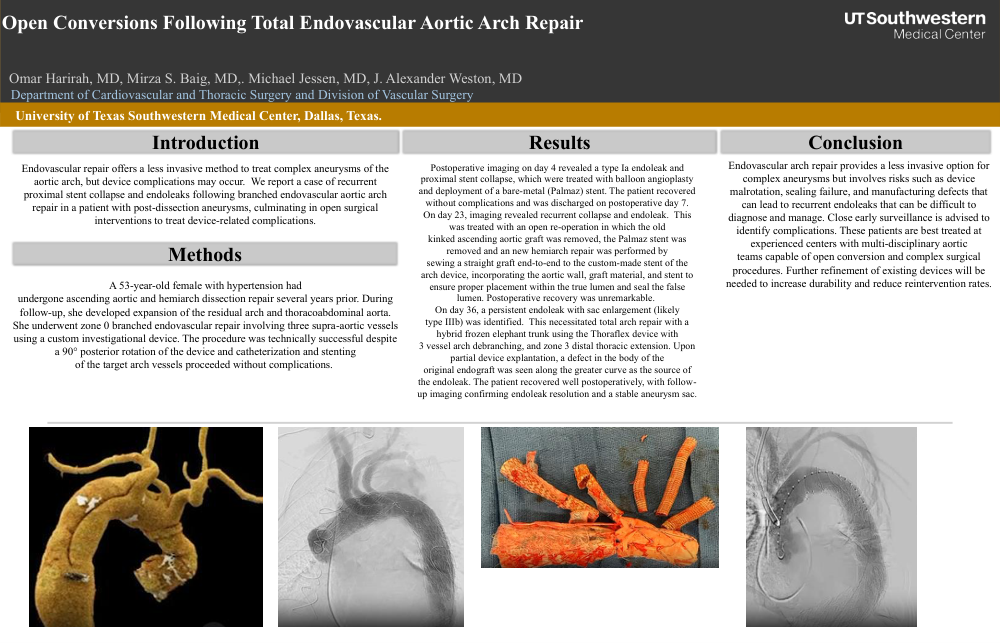
Endovascular repair offers a less invasive method to treat complex aneurysms of the Results Conclusion aortic arch, but device complications may occur. We report a case of recurrent proximal stent collapse and endoleaks following branched endovascular aortic arch repair in a patient with post-dissection aneurysms, culminating in open surgical interventions to treat device-related complications. Methods A 53-year-old female with hypertension had undergone ascending aortic and hemiarch dissection repair several years prior. During follow-up, she developed expansion of the residual arch and thoracoabdominal aorta. She underwent zone 0 branched endovascular repair involving three supra-aortic vessels using a custom investigational device. The procedure was technically successful despite a 90° posterior rotation of the device and catheterization and stenting of the target arch vessels proceeded without complications. Postoperative imaging on day 4 revealed a type Ia endoleak and proximal stent collapse, which were treated with balloon angioplasty and deployment of a bare-metal (Palmaz) stent. The patient recovered without complications and was discharged on postoperative day 7. On day 23, imaging revealed recurrent collapse and endoleak. This was treated with an open re-operation in which the old kinked ascending aortic graft was removed, the Palmaz stent was removed and an new hemiarch repair was performed by sewing a straight graft end-to-end to the custom-made stent of the arch device, incorporating the aortic wall, graft material, and stent to ensure proper placement within the true lumen and seal the false lumen. Postoperative recovery was unremarkable. On day 36, a persistent endoleak with sac enlargement (likely type IIIb) was identified. This necessitated total arch repair with a hybrid frozen elephant trunk using the Thoraflex device with 3 vessel arch debranching, and zone 3 distal thoracic extension. Upon partial device explantation, a defect in the body of the original endograft was seen along the greater curve as the source of the endoleak. The patient recovered well postoperatively, with follow up imaging confirming endoleak resolution and a stable aneurysm sac. Endovascular arch repair provides a less invasive option for complex aneurysms but involves risks such as device malrotation, sealing failure, and manufacturing defects that can lead to recurrent endoleaks that can be difficult to diagnose and manage. Close early surveillance is advised to identify complications. These patients are best treated at experienced centers with multi-disciplinary aortic teams capable of open conversion and complex surgical procedures. Further refinement of existing devices will be needed to increase durability and reduce reintervention rates