301 posters, 50 videos, 13 topics, 13 sessions, 734 authors, 193 institutions
ePostersLive by SciGen Technologies S.A. All rights reserved.
ISMICS 2026 Annual Meeting
10 - 13 June, 2026 | Miami, Florida

D116
Factors Influencing Return To Driving After Robotically Assisted Cardiac Surgery
Part of Topic
Education, Imaging and Facilitating Technologies
Introduction
Patients undergoing median sternotomy are restricted from driving for at least four weeks.
Robotically assisted cardiac surgery preserves sternal integrity and may enable earlier return; however, data on timing and predictors remain limited.
This study examined factors associated with earlier driving resumption following robotic cardiac procedures.
Methodology
Between July 2021 and December 2024, 232 patients underwent robotically assisted mitral or coronary surgery and had follow-up data available at four weeks.
The cohort included 124 patients (53.4%) who underwent robotic mitral valve repair and 108 patients (46.6%) who underwent robotic coronary revascularization (either minimally invasive direct coronary artery bypass [MIDCAB, N=29] or totally endoscopic coronary artery bypass [TECAB, N=79]).
The median age was 64 [range 24–85] years; 71.6% were male and 28.4% were female.
According to our institutional protocol, patients were cleared to resume driving once they were independently mobile and no longer required narcotic analgesia.
Postoperative follow-up occurred at approximately 4 weeks, at which point driving status was retrospectively assessed.
Clinical, procedural, and recovery-related variables were analyzed to identify predictors of early return to driving.
Results
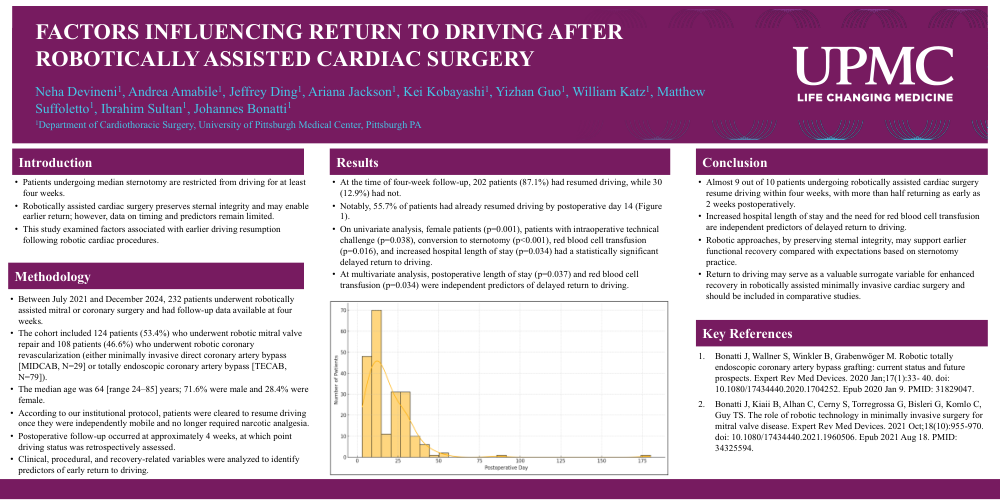
At the time of four-week follow-up, 202 patients (87.1%) had resumed driving, while 30 (12.9%) had not.
Notably, 55.7% of patients had already resumed driving by postoperative day 14 (Figure 1).
On univariate analysis, female patients (p=0.001), patients with intraoperative technical challenge (p=0.038), conversion to sternotomy (p<0.001), red blood cell transfusion (p=0.016), and increased hospital length of stay (p=0.034) had a statistically significant delayed return to driving.
At multivariate analysis, postoperative length of stay (p=0.037) and red blood cell transfusion (p=0.034) were independent predictors of delayed return to driving.
Conclusion
Almost 9 out of 10 patients undergoing robotically assisted cardiac surgery resume driving within four weeks, with more than half returning as early as 2 weeks postoperatively.
Increased hospital length of stay and the need for red blood cell transfusion are independent predictors of delayed return to driving.
Robotic approaches, by preserving sternal integrity, may support earlier functional recovery compared with expectations based on sternotomy practice.
Return to driving may serve as a valuable surrogate variable for enhanced recovery in robotically assisted minimally invasive cardiac surgery and should be included in comparative studies.
Key References
- Bonatti J, Wallner S, Winkler B, Grabenwöger M. Robotic totally endoscopic coronary artery bypass grafting: current status and future prospects. Expert Rev Med Devices. 2020 Jan;17(1):33- 40. doi: 10.1080/17434440.2020.1704252. Epub 2020 Jan 9. PMID: 31829047.
- Bonatti J, Kiaii B, Alhan C, Cerny S, Torregrossa G, Bisleri G, Komlo C, Guy TS. The role of robotic technology in minimally invasive surgery for mitral valve disease. Expert Rev Med Devices. 2021 Oct;18(10):955-970. doi: 10.1080/17434440.2021.1960506. Epub 2021 Aug 18. PMID: 34325594.