301 posters, 50 videos, 13 topics, 13 sessions, 734 authors, 193 institutions
ePostersLive by SciGen Technologies S.A. All rights reserved.
ISMICS 2026 Annual Meeting
10 - 13 June, 2026 | Miami, Florida

D62
Clinical Outcomes After Intensive Care Unit Avoidance In Patients Undergoing The Wolf Procedure
Poster Presenter
Part of Topic
ERAS
Title: Clinical Outcomes After Intensive Care Unit Avoidance in Patients Undergoing the Wolf Procedure
Authors: Marcell Székely1,2, Imre I. Gecse1, Maria G. Lopez-Trevino1, Michael J. Reardon1 , Randall K. Wolf1
Institutions:
Department of Cardiovascular Surgery, Houston Methodist Hospital, 6565 Fannin St, Houston, TX, 77030, USA1, Department of Cardiothoracic and Vascular Surgery, Central Hospital of Northern Pest- Military Hospital, 44 Róbert Károly blvd, Budapest 1134, Hungary2,
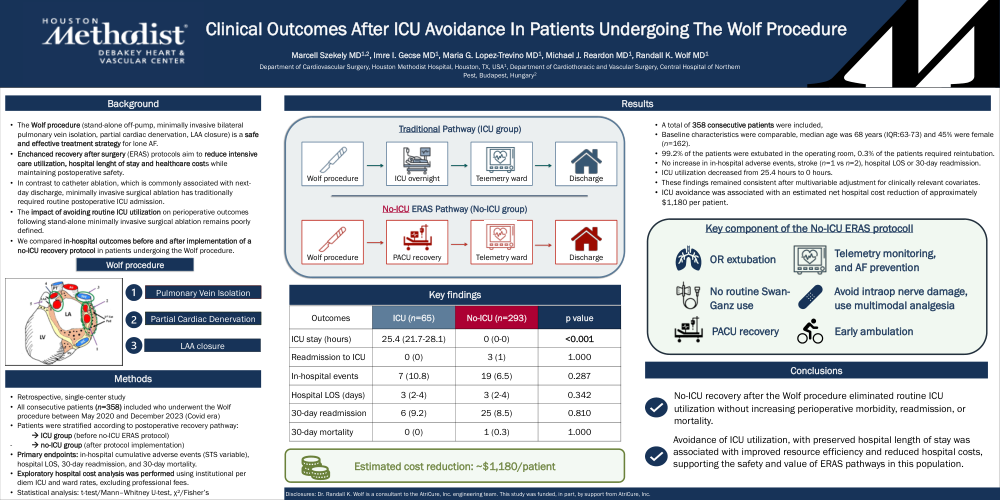
Background: Enhanced recovery after surgery (ERAS) protocols in minimally invasive cardiac surgery aim to reduce intensive care utilization and hospital length of stay without compromising patient safety. The impact of a no-intensive care unit (ICU) stay on post-operative outcomes in minimally invasive surgical ablation remains unclear.
Methods: We retrospectively analyzed consecutive patients undergoing the Wolf procedure between May 2020 and December 2023 before and after implementation of a No-ICU ERAS protocol. Patients were stratified into conventional ICU care and No-ICU groups. Primary endpoints included in-hospital cumulative adverse events, hospital length of stay, 30-day hospital readmission and 30-day mortality. Baseline characteristics and outcomes were compared using appropriate statistical methods, with additional regression analyses adjusting for relevant clinical covariates. An explanatory hospital cost analysis was performed using institution-specific per diem ICU and ward rates, reflecting inpatient resource utilization and excluding professional fees.
Results: A total of 358 patients were included (No-ICU: n=293; ICU: n=65). Baseline characteristics were comparable. No significant differences were observed in in-hospital adverse events (No-ICU: 6.8% vs ICU: 10.8%, p=0.29) and there was no increase in major adverse events, including stroke or ICU readmission. Median hospital length of stay was 3 days in both groups (IQR:2-4, p=0.34). ICU utilization differed markedly with a median ICU stay of 25.4 hours (IQR:21.7-28.1) in the ICU group versus 0 hours (IQR:0-0) in the No-ICU group. Thirty-day readmission rates (No-ICU: 8.5% vs ICU: 9.2%, p=0.81) and 30-day mortality (1 vs 0, p=1.00) were similar. These findings remained consistent after multivariable adjustment. ICU avoidance was associated with an estimated net hospital cost reduction of approximately $1,180 per patient.
Conclusions: Implementation of a No-ICU protocol in patients undergoing the Wolf procedure did not adversely affect in-hospital or 30-day outcomes. Avoidance of ICU utilization, with preserved hospital length of stay was associated with improved resource efficiency and reduced hospital costs, supporting the safety and value of ERAS pathways in this population.