301 posters, 50 videos, 13 topics, 13 sessions, 734 authors, 193 institutions
ePostersLive by SciGen Technologies S.A. All rights reserved.
ISMICS 2026 Annual Meeting
10 - 13 June, 2026 | Miami, Florida

D49
The Experience Of A Single-center Conversion To Fully Percutaneous Cannulation In Minimally Invasive Cardiac Surgery
Part of Topic
Valve � Surgical Valves
Background
Percutaneous cannulation in minimally invasive cardiac surgery (MICS) has gained increasing acceptance due to fewer access-related complications compared with surgical cutdown. Advances in imaging have enabled safe ultrasound and echocardiography-guided percutaneous cannulation. This study describes our single-center experience during the transition to a fully percutaneous cannulation strategy in MICS, focusing on cannula selection, hemodynamic performance, and clinical outcomes.
Methods
This retrospective, single-center study included patients who underwent percutaneous femoral cannulation for MICS. Collected data included patient demographics, body surface area (BSA), femoral artery and vein diameters, cannula sizes, maximum cardiopulmonary bypass (CPB) flow, and maximum arterial line pressure. All patients underwent preoperative computed tomography to assess femoral vessel anatomy. Cannula size selection was individualized and indexed to vessel diameter and BSA. Femoral arterial and venous cannulation was performed under ultrasound and transoesophageal echocardiography guidance. Arterial closure was achieved using two ProGlide devices, and venous closure using one ProGlide device. Distal pulses were marked preoperatively and reassessed postoperatively.
Results
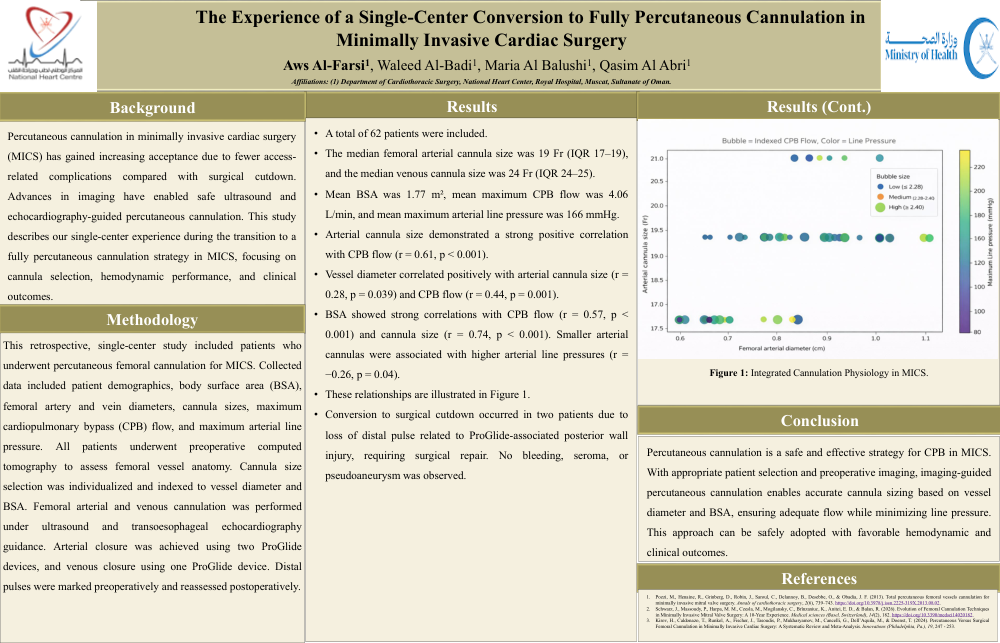
A total of 62 patients were included. The median femoral arterial cannula size was 19 Fr (IQR 17–19), and the median venous cannula size was 24 Fr (IQR 24–25). Mean BSA was 1.77 m², mean maximum CPB flow was 4.06 L/min, and mean maximum arterial line pressure was 166 mmHg. Arterial cannula size demonstrated a strong positive correlation with CPB flow (r = 0.61, p < 0.001). Vessel diameter correlated positively with arterial cannula size (r = 0.28, p = 0.039) and CPB flow (r = 0.44, p = 0.001). BSA showed strong correlations with CPB flow (r = 0.57, p < 0.001) and cannula size (r = 0.74, p < 0.001). Smaller arterial cannulas were associated with higher arterial line pressures (r = −0.26, p = 0.04). These relationships are illustrated in Figure 1. Conversion to surgical cutdown occurred in two patients due to loss of distal pulse related to ProGlide-associated posterior wall injury, requiring surgical repair. No bleeding, seroma, or pseudoaneurysm was observed.
Conclusion
Percutaneous cannulation is a safe and effective strategy for CPB in MICS. With appropriate patient selection and preoperative imaging, imaging-guided percutaneous cannulation enables accurate cannula sizing based on vessel diameter and BSA, ensuring adequate flow while minimizing line pressure. This approach can be safely adopted with favorable hemodynamic and clinical outcomes.