301 posters, 50 videos, 13 topics, 13 sessions, 734 authors, 193 institutions
ePostersLive by SciGen Technologies S.A. All rights reserved.
ISMICS 2026 Annual Meeting
10 - 13 June, 2026 | Miami, Florida

D44
The Thumbs-up Method: A Novel Technique For Extracorporeal Knot Tying In Minimally Invasive And Robotic Cardiac Surgery
Poster Presenter
Part of Topic
Education, Imaging and Facilitating Technologies
Video
Background
Extracorporeal knot-tying during minimally invasive and robotic cardiac surgery is technically challenging because the patient-side working space is restricted. In robotic procedures, the anterior–superior extracorporeal workspace is frequently obstructed by robotic instrument arms and access ports, increasing the difficulty of knot advancement and procedural stress for surgeons. Conventional two-operator and single-operator techniques have inherent limitations under these spatial constraints.
Methods / Technique
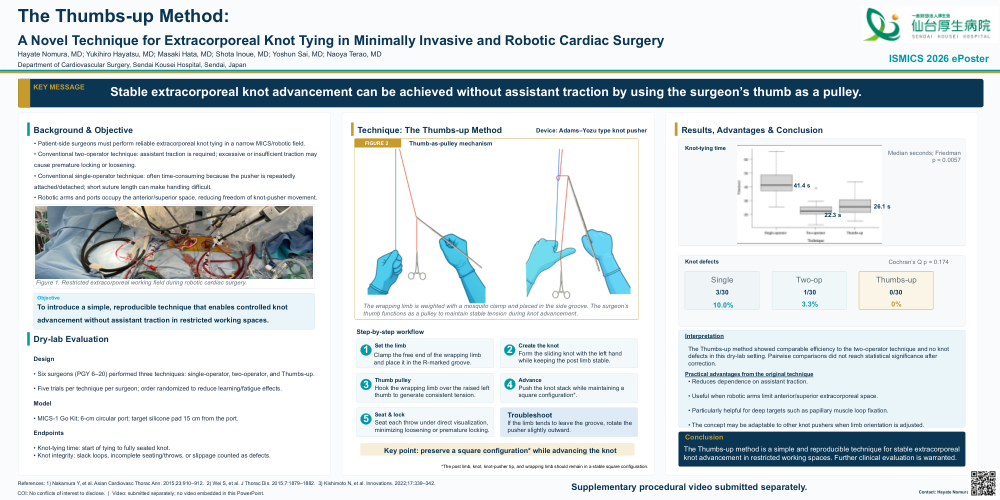
We developed a novel extracorporeal knot-tying maneuver, termed the Thumbs-up method, specifically designed for constrained robotic environments. The technique employs a thumb-guided pulley mechanism combined with gravity-assisted suture control using the Adams–Yozu knot-pusher. The wrapping limb is stabilized by gravity and guided over the surgeon’s thumb, allowing controlled advancement of sliding knots without premature locking or suture loosening.
Evaluation
A standardized dry-lab study was performed involving six surgeons with varying levels of experience. The Thumbs-up method was compared with conventional two-operator and single-operator techniques using identical sutures and standardized working depth conditions. Knot-tying time and knot quality were evaluated. The Thumbs-up method demonstrated a tendency toward faster performance compared with the single-operator technique and achieved efficiency comparable to the two-operator approach. Knot integrity did not differ significantly among the techniques, and no defective knots were observed with the Thumbs-up method.
Conclusions
The Thumbs-up method provides a simple, reproducible, and reliable approach to extracorporeal knot-tying in robotic cardiac surgery. By specifically addressing anterior–superior workspace restrictions, this technique offers a practical alternative to existing methods and may reduce technical difficulty for patient-side surgeons in robotic procedures.