301 posters, 50 videos, 13 topics, 13 sessions, 734 authors, 193 institutions
ePostersLive by SciGen Technologies S.A. All rights reserved.
ISMICS 2026 Annual Meeting
10 - 13 June, 2026 | Miami, Florida

D35
Robotic Single-Port Thymectomy
Part of Topic
Thoracic Surgery � Mediastinum
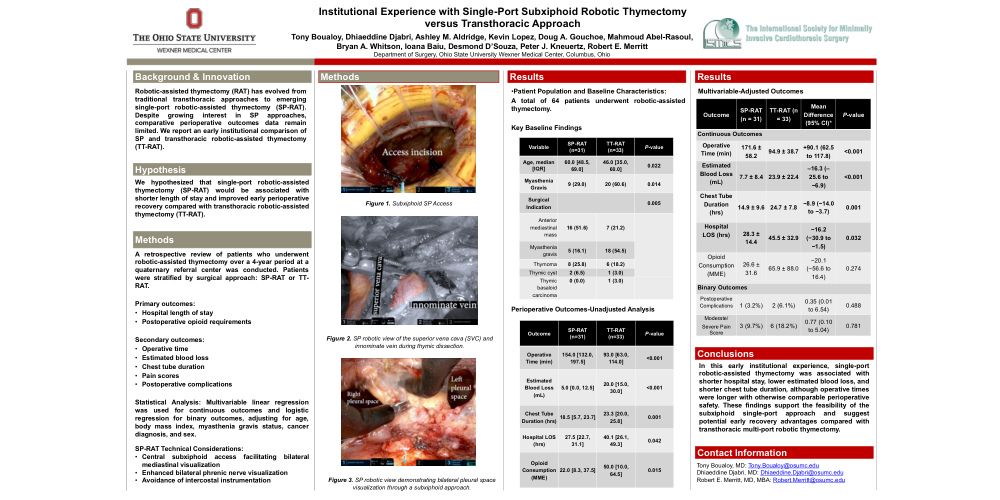
Robotic-assisted thymectomy (RAT) has evolved from traditional transthoracic approaches to emerging single-port robotic-assisted thymectomy (SP-RAT). Despite growing interest in SP approaches, comparative perioperative outcomes data remain limited. We report an early institutional comparison of SP and transthoracic robotic-assisted thymectomy (TT-RAT).
We hypothesized that single-port robotic-assisted thymectomy (SP-RAT) would be associated with shorter length of stay and improved early perioperative recovery compared with transthoracic robotic-assisted thymectomy (TT-RAT).
A retrospective review of patients who underwent robotic-assisted thymectomy over a 4-year period at a quaternary referral center was conducted. Patients were stratifiedby surgical approach: SP-RAT or TT-RAT.
Primary outcomes:
Hospital length of stay
Postoperative opioid requirements
Secondary outcomes:
Operative time
Estimated blood loss
Chest tube duration
Pain scores
Postoperative complications
Statistical Analysis: Multivariable linear regression was used for continuous outcomes and logistic regression for binary outcomes, adjusting for age, body mass index, myasthenia gravis status, cancer diagnosis, and sex.
SP-RAT Technical Considerations:
Central subxiphoid access facilitating bilateral mediastinal visualization
Enhanced bilateral phrenic nerve visualization
Avoidance of intercostal instrumentation
In this early institutional experience, single-port robotic-assisted thymectomy was associated with shorter hospital stay, lower estimated blood loss, and shorter chest tube duration, although operative times were longer with otherwise comparable perioperative safety. These findingssupport the feasibility of thesubxiphoid single-port approachand suggest potential early recovery advantages compared with transthoracic multi-port robotic thymectomy.