301 posters, 50 videos, 13 topics, 13 sessions, 734 authors, 193 institutions
ePostersLive by SciGen Technologies S.A. All rights reserved.
ISMICS 2026 Annual Meeting
10 - 13 June, 2026 | Miami, Florida

P135
Baseline Risk Stratification In Tmvr And Mitral Repair
Poster Presenter
Part of Topic
Valve - Transcatheter Therapies
BACKGROUND:
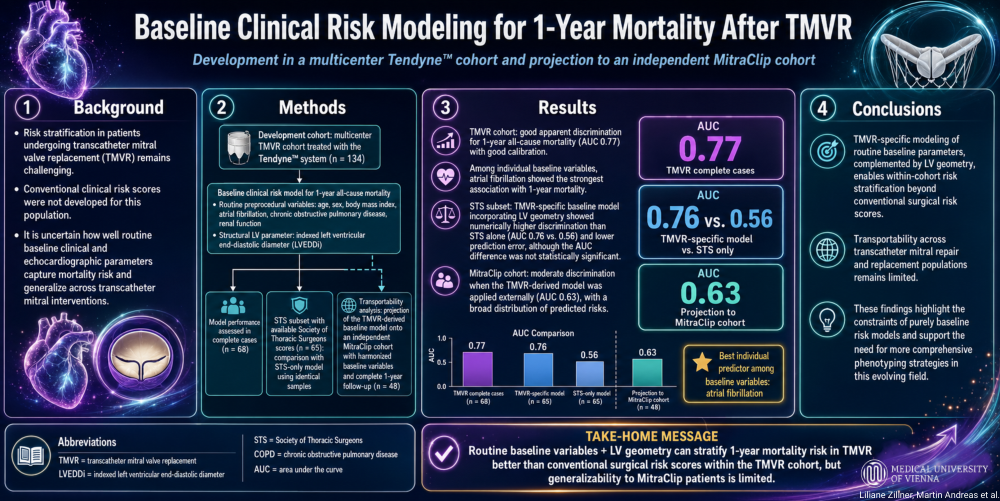
Risk stratification in patients undergoing transcatheter mitral valve replacement (TMVR) remains challenging. Conventional clinical risk scores were not developed for this population, and it is uncertain how well routine baseline clinical and echocardiographic parameters capture mortality risk and generalize across transcatheter mitral interventions.
METHODS:
A baseline clinical risk model for 1-year all-cause mortality was developed in a multicenter TMVR cohort treated with the Tendyne™ system (n = 134). The model included routinely available preprocedural variables—age, sex, body mass index, atrial fibrillation, chronic obstructive pulmonary disease, and renal function—complemented by indexed left ventricular end-diastolic diameter (LVEDDi) as a structural LV parameter not captured by conventional surgical risk scores. Model performance was assessed in complete cases (n = 68). In patients with available Society of Thoracic Surgeons (STS) scores (n = 65), discrimination was compared with an STS-only model using identical samples. To explore transportability, the TMVR-derived baseline model was projected onto an independent MitraClip cohort with harmonized baseline variables and complete 1-year follow-up (n = 48).
RESULTS:
In the TMVR cohort, the baseline model demonstrated good apparent discrimination for 1-year all-cause mortality (AUC 0.77) with good calibration. Among individual baseline variables, atrial fibrillation showed the strongest association with 1-year mortality. In the STS subset, the TMVR-specific baseline model incorporating LV geometry showed numerically higher discrimination than STS alone (AUC 0.76 vs. 0.56) and lower prediction error, although the difference in AUC did not reach statistical significance. When applied to the MitraClip cohort, discrimination was moderate (AUC 0.63), with a broad distribution of predicted risks.
CONCLUSIONS:TMVR-specific modeling of routine baseline parameters, complemented by LV geometry, enables within-cohort risk stratification beyond conventional surgical risk scores, while transportability across transcatheter mitral repair and replacement populations remains limited. These findings highlight the constraints of purely baseline risk models and support the need for more comprehensive phenotyping strategies in this evolving field.
Author Block: Liliane Zillner1, Miriam Wild2, Michaela Hell3, Harald Herkner1, Elmar Kuhn4, Tanja K. Rudolph5, Thomas Walther6, Lenard Conradi7, Andreas Zierer8, Francesco Maisano9, Marco Russo1, Fabri Rosati10, Andrea Colli11, Michael Pinon12, David Reineke13, Gaby Aphram14, Christophe Dubois15, Joerg Hausleiter2, Stephan Von Bardeleben3, Daniel Zimpfer1, Juliana Coti1, Martin Andreas1.
1Medical University Vienna, Wien, Austria, 2LMU University Hospital, Munich, Germany, 3University Medical Center Mainz, Mainz, Germany, 4University Hospital Cologne, Cologne, Germany, 5Heart and Diabetes Center Northrhine-Westfalia, Bad Oeynhausen, Germany, 6University Hospital Frankfurt, Frankfurt, Germany, 7University Hospital Cologne, Cologne, Austria, 8Johannes Kepler University Linz, Linz, Austria, 9IRCCS Ospedale San Raaffaele and University Vita Salute, Milano, Italy, 10Spedali Civili di Brescia, Brecia, Italy, 11Medical and Molecular Pathology and Critical Care Medicine, Pisa, Italy, 12Hospital Álvaro Cunqueiro, Vigo, Spain, 13Inselspital University Hospital Bern, Bern, Switzerland, 14Cliniques universitaires Saint Luc, Brussel, Belgium, 15University Hospital Leuven and Department of Cardiovascular Sciences, Leuven, Belgium.