301 posters, 50 videos, 13 topics, 13 sessions, 734 authors, 193 institutions
ePostersLive by SciGen Technologies S.A. All rights reserved.
ISMICS 2026 Annual Meeting
10 - 13 June, 2026 | Miami, Florida

P103
Learning Curves In Robotic Thoracic Surgery Over 15 Years Based On My Intuitive Application Data
Part of Topic
Thoracic Surgery � Lung
Practice Gap
Objective long-term benchmarks for robotic thoracic surgery learning curves remain limited. In addition, the effect of dual-console utilization on console time is often interpreted without distinguishing between training-related use and complex case management.
Background
Robotic thoracic surgery has become an important component of minimally invasive lung resection, but its adoption requires measurable learning and structured performance assessment. Digital analytics platforms such as My Intuitive allow case-level evaluation of console time, procedural trends, and longitudinal efficiency. These data may help define real-world learning curves and clarify how training tools, including dual-console use, influence operative performance.
Objective
To evaluate 15-year learning curves for robotic lobectomy and segmentectomy using My Intuitive application data from two high-volume centers, and to assess how cumulative experience and dual-console utilization affect console time.
Methods
This retrospective two-center study included consecutive robotic lobectomy and segmentectomy procedures performed between 2010 and 2025. The final updated cohort included 452 robotic lobectomies and 410 robotic segmentectomies. Console time was extracted from the My Intuitive platform and cross-validated with institutional surgical records.
Cases were analyzed by calendar year and by cumulative experience groups: 0–10, 11–50, 51–100, 101–300, and ≥301 cases. Dual-console cases were further stratified by indication as training-related use or complex case management. Median and mean console times were calculated, and subgroup comparisons were performed to evaluate the effect of dual-console strategy.
Key Results
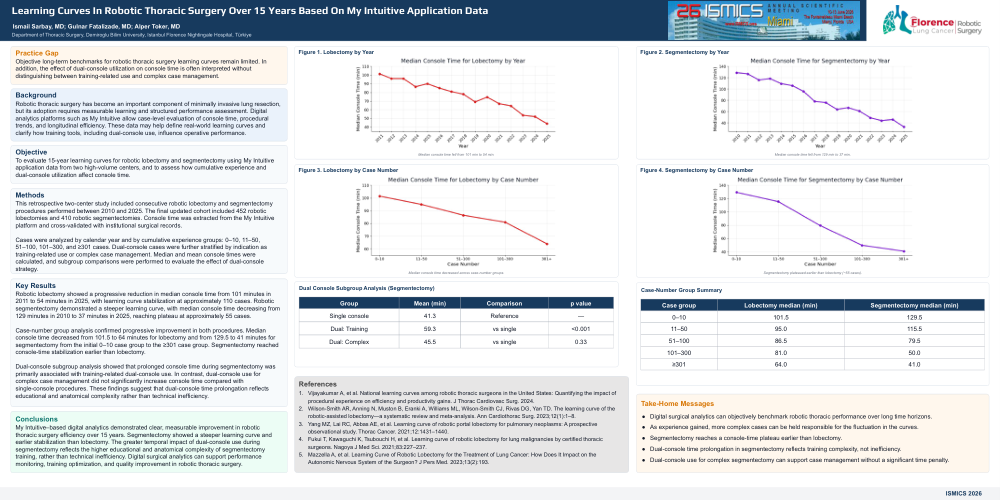
Robotic lobectomy showed a progressive reduction in median console time from 101 minutes in 2011 to 54 minutes in 2025, with learning curve stabilization at approximately 110 cases. Robotic segmentectomy demonstrated a steeper learning curve, with median console time decreasing from 129 minutes in 2010 to 37 minutes in 2025, reaching plateau at approximately 55 cases.
Case-number group analysis confirmed progressive improvement in both procedures. Median console time decreased from 101.5 to 64 minutes for lobectomy and from 129.5 to 41 minutes for segmentectomy from the initial 0–10 case group to the ≥301 case group. Segmentectomy reached console-time stabilization earlier than lobectomy.
Dual-console subgroup analysis showed that prolonged console time during segmentectomy was primarily associated with training-related dual-console use. In contrast, dual-console use for complex case management did not significantly increase console time compared with single-console procedures. These findings suggest that dual-console time prolongation reflects educational and anatomical complexity rather than technical inefficiency.
Conclusions
My Intuitive–based digital analytics demonstrated clear, measurable improvement in robotic thoracic surgery efficiency over 15 years. Segmentectomy showed a steeper learning curve and earlier stabilization than lobectomy. The greater temporal impact of dual-console use during segmentectomy reflects the higher educational and anatomical complexity of segmentectomy training, rather than technical inefficiency. Digital surgical analytics can support performance monitoring, training optimization, and quality improvement in robotic thoracic surgery.