395 posters, 1 audios, 13 topics, 29 sessions, 1,056 authors, 461 institutions
ePostersLive by SciGen Technologies S.A. All rights reserved.
51st Annual Regional Anesthesiology and Acute Pain Medicine Meeting
April 16 - 18, 2026 | Phoenix, Arizona

2312731
Outpatient Point of Care Ultrasound and Continuous Cervical ESP Block for Neck Strain with Brachial Plexus Symptoms: A Case Report
Part of Topic
Scientific Abstracts > Acute Pain
Outpatient Point of Care Ultrasound (POCUS) and Continuous Cervical ESP Block for Neck Strain with Brachial Plexus Symptoms: A Case Report
Sam Fischer, Callie Roach, Jerry Jones, Arvind Chandrashekar
A continuous cervical ESP block provided 10 days of pain relief for refractory radiculopathy following a motor vehicle accident, facilitating return to clinical duties and participation in physical therapy without opioids.
Introduction:
Neuropathic pain originating from the cervical nerve roots can be challenging to acutely manage. The classic approach to nerve impingement radiculopathies involves epidural steroid injections (ESIs) after a trial of physical therapy and oral analgesics (1, 2). However, ESIs often take 1-4 weeks to fully take effect, whereas local anesthetics can take effect instantly and provide long-lasting relief when used as a continuous infusion, which can be titrated with programmable pumps. Despite the frequent prescription of opioids for cervical radicular pain, current evidence indicates they provide no significant benefit for acute symptoms and are often associated with worse clinical outcomes (3). While initially used in the thoracic spine, the Erector Spinae Plane (ESP) block has been expanded to the high thoracic levels (T1–T2) for cervical pain in outpatient settings (4, 5). We present a case utilizing a continuous cervical ESP (C-ESP) block placed at the C6–C7 level for refractory, subacute neuropathic pain secondary to a cervical strain and radiculopathy. To the best of our knowledge, this is the first documented case of a continuous ESP block applied directly to the cervical level for this specific indication.
Case Details:
A 26-year-old male student nurse anesthetist self-referred to the outpatient Acute Pain Service (APS) three weeks after a rear-end motor vehicle collision (MVC). CT and MRI imaging revealed a right-sided C5 disc herniation. His baseline pain was 10/10, exacerbated by neck flexion, extension, and axial movement, as well as by RUE range of motion. He had numbness in the triceps region and the ulnar aspect of the forearm. He had weakness on the right side in push and pull movements, as well as decreased grip strength of the right hand. Symptoms were refractory to a multimodal regimen including amitriptyline, meloxicam, methocarbamol, oxycodone, and pregabalin, which notably caused "brain fog" that interfered with his clinical duties.
Case Details (continued)
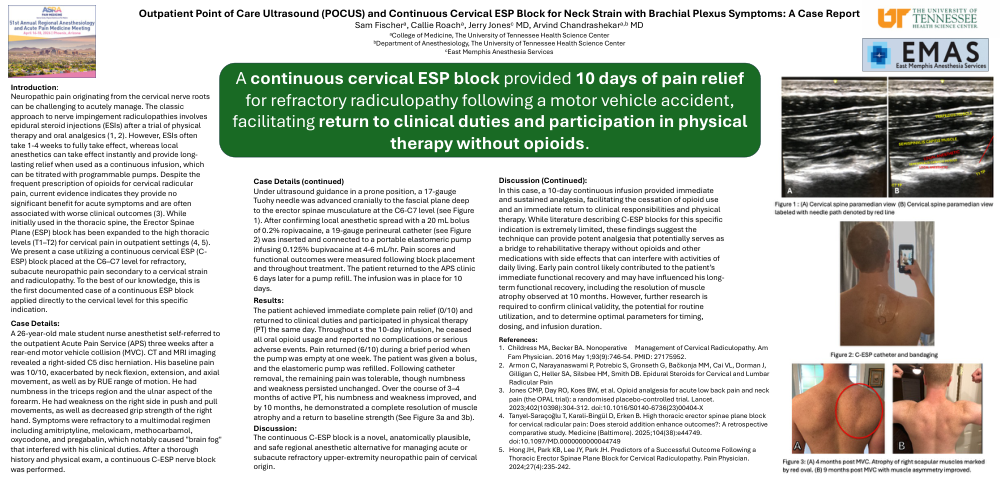
After a thorough history and physical exam, a continuous C-ESP nerve block was performed. Under ultrasound guidance in a prone position, a 17-gauge Tuohy needle was advanced cranially to the fascial plane deep to the erector spinae musculature at the C6-C7 level (see Figure 1). After confirming local anesthetic spread with a 20 mL bolus of 0.2% ropivacaine, a 19-gauge perineural catheter (see Figure 2) was inserted and connected to a portable elastomeric pump infusing 0.125% bupivacaine at 4-6 mL/hr. Pain scores and functional outcomes were measured following block placement and throughout treatment. The patient returned to the APS clinic 6 days later for a pump refill. The infusion was in place for 10 days.
Results:
The patient achieved immediate complete pain relief (0/10) and returned to clinical duties and participated in physical therapy (PT) the same day. Throughout s the 10-day infusion, he ceased all oral opioid usage and reported no complications or serious adverse events. Pain returned (6/10) during a brief period when the pump was empty at one week. The patient was given a bolus, and the elastomeric pump was refilled. Following catheter removal, the remaining pain was tolerable, though numbness and weakness persisted unchanged. Over the course of 3–4 months of active PT, his numbness and weakness improved, and by 10 months, he demonstrated a complete resolution of muscle atrophy and a return to baseline strength (See Figure 3a and 3b).
Discussion:
The continuous C-ESP block is a novel, anatomically plausible, and safe regional anesthetic alternative for managing acute or subacute refractory upper-extremity neuropathic pain of cervical origin. In this case, a 10-day continuous infusion provided immediate and sustained analgesia, facilitating the cessation of opioid use and an immediate return to clinical responsibilities and physical therapy. While literature describing C-ESP blocks for this specific indication is extremely limited, these findings suggest the technique can provide potent analgesia that potentially serves as a bridge to rehabilitative therapy without opioids and other medications with side effects that can interfere with activities of daily living. Early pain control likely contributed to the patient’s immediate functional recovery and may have influenced his long-term functional recovery, including the resolution of muscle atrophy observed at 10 months. However, further research is required to confirm clinical validity, the potential for routine utilization, and to determine optimal parameters for timing, dosing, and infusion duration.
References:
1. Childress MA, Becker BA. Nonoperative Management of Cervical Radiculopathy. Am Fam Physician. 2016 May 1;93(9):746-54. PMID: 27175952.
2.Armon C, Narayanaswami P, Potrebic S, Gronseth G, Bačkonja MM, Cai VL, Dorman J, Gilligan C, Heller SA, Silsbee HM, Smith DB. Epidural Steroids for Cervical and Lumbar Radicular Pain
3.Jones CMP, Day RO, Koes BW, et al. Opioid analgesia for acute low back pain and neck pain (the OPAL trial): a randomised placebo-controlled trial. Lancet. 2023;402(10398):304-312. doi:10.1016/S0140-6736(23)00404-X
4.Tanyel-Saraçoğlu T, Karali-Bingül D, Erken B. High thoracic erector spinae plane block for cervical radicular pain: Does steroid addition enhance outcomes?: A retrospective comparative study. Medicine (Baltimore). 2025;104(38):e44749. doi:10.1097/MD.0000000000044749
5.Hong JH, Park KB, Lee JY, Park JH. Predictors of a Successful Outcome Following a Thoracic Erector Spinae Plane Block for Cervical Radiculopathy. Pain Physician. 2024;27(4):235-242.