395 posters, 1 audios, 13 topics, 29 sessions, 1,056 authors, 461 institutions
ePostersLive by SciGen Technologies S.A. All rights reserved.
51st Annual Regional Anesthesiology and Acute Pain Medicine Meeting
April 16 - 18, 2026 | Phoenix, Arizona

2312105
Anesthesia Practice Patterns for Rotator Cuff Repair Across an Integrated Health System
Poster Presenter
Authors
Affiliations
Drexel University College of Medicine, Drexel University College of Medicine., Department of Anesthesia, The Permanente Medical Group, South San Francisco, California, USA; Department of Anesthesia and Perioperative Care, The University of California San Francisco, San Francisco, California, USA., Department of Anesthesia and Perioperative Care, The University of California San Francisco, San Francisco, California, USA.
Part of Topic
Safety/QA/QI Projects
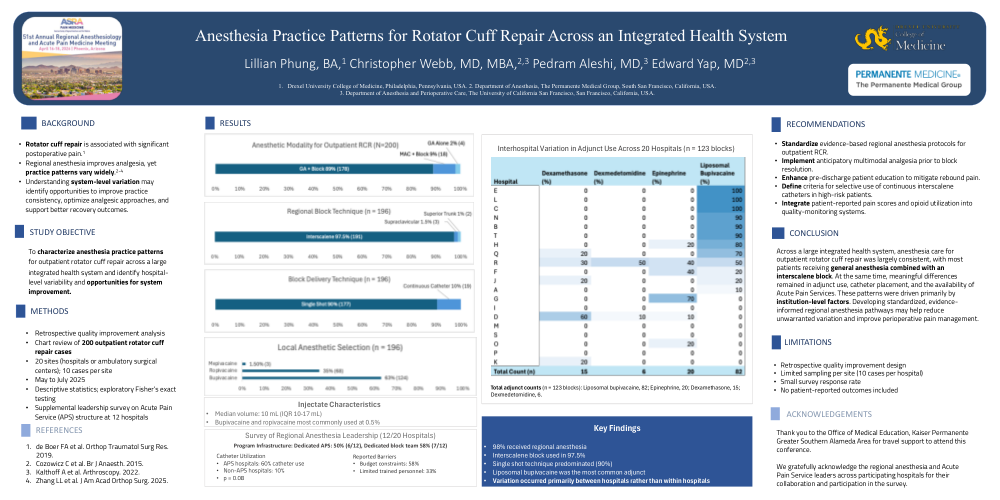
In this quality improvement study, we studied how anesthesia teams across 20 sites in a large integrated health system approach outpatient rotator cuff repair, which is a procedure linked to significant postoperative pain. After reviewing 200 cases, we found that 98% of patients received regional anesthesia, of which 97.5% received an interscalene nerve block. Yet, most practice variation lay between, rather than within, sites. Hospitals diverged in their choice of adjuncts like liposomal bupivacaine and dexamethasone, their use of continuous catheters, and whether they had a dedicated Acute Pain Service. A leadership survey revealed that budget constraints and staffing concerns underlie the barriers to implementing Acute Pain Service and regional block teams. We conclude that while common practices exist, there is a clear opportunity to standardize protocols, define when deviation from common practice is recommended for high-risk patients, and build patient-reported outcomes into how we track quality. We hope this work sparks conversation about the relationship between practice variation and evidence-informed perioperative pain management at the systems level.