395 posters, 1 audios, 13 topics, 29 sessions, 1,056 authors, 461 institutions
ePostersLive by SciGen Technologies S.A. All rights reserved.
51st Annual Regional Anesthesiology and Acute Pain Medicine Meeting
April 16 - 18, 2026 | Phoenix, Arizona

2349241
Variability in Peripheral Nerve Block Preference in Total Hip Arthroplasty: Influences and Surgeon-Anesthesiologist Dynamics
Poster Presenter
Part of Topic
Late Breaking Safety/QA/QI/Projects
2349241: Variability in Peripheral Nerve Block Preference in Total Hip Arhtroplasty: Influences and Surgeon-Anesthesiologist Dynamics
Samantha Riebesell, BS; Pa Thor, PhD; Periklis Giannakis, MD; Juliet E. Rowe, MPH; Jashvant Poeran, MD, PhD; Alexandra Sideris, PhD; Stavros Memtsoudis, MD, PhD, MBA; Daniel Maalouf, MD, MPH
Introduction
Peripheral nerve blocks (PNBs) are recommended in consensus guidelines (e.g., ICAROS) for their safety andanalgesic benefits in total hip arthroplasty (THA). However, evidence regarding their analgesic efficacy, safety,and motor‑sparing properties remains mixed. How surgeon preference, patient characteristics, andinterdisciplinary collaboration shape PNB selection in clinical practice is not well understood. This studyevaluated the factors influencing anesthesiologists’ PNB choices for THA and characterized patterns ofsurgeon–anesthesiologist collaboration.
Materials and Methods
A voluntary, anonymous REDCap survey was distributed to attending anesthesiologists at a high‑volumeorthopedic center (July–August 2025). Respondents rated the influence of patient-, provider-, andsystem‑level factors on PNB selection using 5‑point Likert scales. We summarized responses usingdescriptive statistics and explored associations with sex, age, and experience. Eleven follow‑up interviewswere conducted to qualitatively assess themes related to block selection, dosing strategies, andinterdisciplinary communication.
Results/Case Report
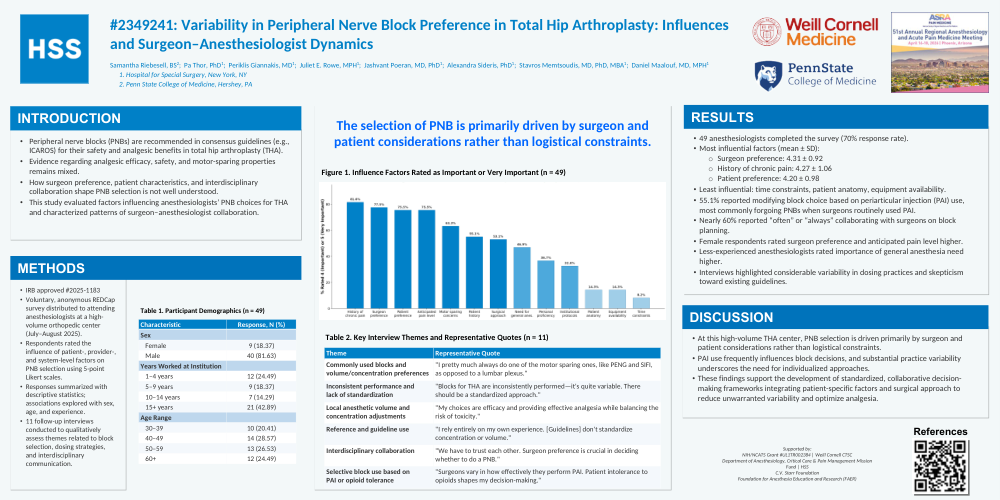
Forty‑nine anesthesiologists completed the survey (70% response rate). Surgeon preference (mean 4.31 ±0.92), history of chronic pain (4.27 ± 1.06), and patient preference (4.20 ± 0.98) were the most influentialfactors. Time constraints, patient anatomy, and equipment availability were least influential. Over half(55.1%) reported modifying block choice based on periarticular injection (PAI) use, most commonly forgoingPNBs when surgeons routinely used PAI. Nearly 60% reported “often” or “always” collaborating with surgeonson block planning. Subgroup analyses showed higher ratings for surgeon preference and anticipated painlevel among female respondents, and higher importance of general anesthesia need amongless‑experienced anesthesiologists. Interviews highlighted considerable variability in dosing practices andskepticism toward existing guidelines.
Discussion
At this high‑volume THA center, PNB selection is driven primarily by surgeon and patient considerationsrather than logistical constraints. PAI use frequently influences block decisions, and substantial practicevariability underscores the need for individualized approaches. These findings support the development ofstandardized, collaborative decision‑making frameworks integrating patient‑specific factors and surgicalapproach to reduce unwarranted variability and optimize analgesia.
References
Grinman L, Elmore B, Ardon AE, et al. Use of Peripheral Nerve Blocks for Total hip Arthroplasty.
Curr PainHeadache Rep. 2024;28(11):1113-1121. doi:10.1007/s11916-024-01287-7
Buffoli F, Bonetti C, Pugno C, et al. Comparison of two peripheral regional analgesic techniques for primaryelective total hip arthroplasty: a randomised clinical trial. Anaesthesia. Published online July 21, 2025.doi:10.1111/anae.16689
Tian Y, Lu Q, Yuan Y, Hu Z, Li W, Li K. The effect of pericapsular nerve group block and lateral femoralcutaneous nerve block on postoperative recovery after hip arthroplasty. Sci Rep. 2025;15(1):19913. Published2025 Jun 6. doi:10.1038/s41598-025-04699-6