395 posters, 1 audios, 13 topics, 29 sessions, 1,056 authors, 461 institutions
ePostersLive by SciGen Technologies S.A. All rights reserved.
51st Annual Regional Anesthesiology and Acute Pain Medicine Meeting
April 16 - 18, 2026 | Phoenix, Arizona

2352042
Paravertebral Catheters for Postsurgical Pain Management in the Bilateral Orthotopic Lung Transplant Patient
Poster Presenter
Authors
James Dunbar, Megan Schramski, Michael Canepa, Matthew Lyman
Affiliations
Part of Topic
Late Breaking Medically Challenging Cases
Title: Paravertebral Catheters for Post-Surgical Pain Management in a Bilateral Orthotopic Lung Transplant Patient
Authors: James Dunbar, MD; Megan Schramski, MD; Michael Canepa, MD; Matthew Lyman, MD
INTRO
• Providing effective post-operative analgesia for patients undergoing
bilateral lung transplant is critically important in the prevention of
subsequent complications. Acute pain after thoracotomy may
decrease the ability to breathe deeply, cough, and clear secretions.
When compounded, these factors may increase the risk for graft
dysfunction, atelectasis, and hypoxemia.
• While thoracic epidural analgesia (TEA) remains the “gold standard”
for pain control after lung transplantation, many factors can affect a
patient’s ability to receive an epidural. Often anticoagulation status
and coagulopathy preclude epidural placement, but in the case of
prior thoracic spine surgery or implanted epidural device (spinal
cord stimulator) paravertebral nerve block catheters can be placed
for effective analgesia post-operatively.
CASE DESCRIPTION
• A 56 year old female with past medical history of pulmonary
hypertension, obstructive sleep apnea, obesity, type 2 diabetes
mellitus, fibromyalgia, and chronic back pain s/p L5-S1 fusion with a
spinal cord stimulator in place presented for a bilateral lung
transplantation in the setting of Covid pneumonia with refractory
hypoxic respiratory failure. On postoperative day one, the patient
reported worsening incisional pain, for which the acute pain service
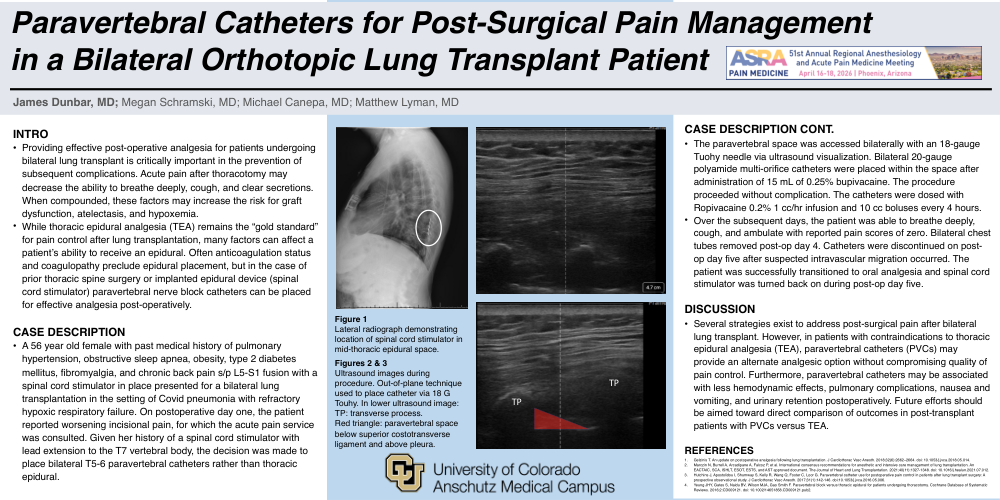
was consulted. Given her history of a spinal cord stimulator with
lead extension to the T7 vertebral body, the decision was made to
place bilateral T5-6 paravertebral catheters rather than thoracic
epidural.
CASE DESCRIPTION CONT.
• The paravertebral space was accessed bilaterally with an 18-gauge
Tuohy needle via ultrasound visualization. Bilateral 20-gauge
polyamide multi-orifice catheters were placed within the space after
administration of 15 mL of 0.25% bupivacaine. The procedure
proceeded without complication. The catheters were dosed with
Ropivacaine 0.2% 1 cc/hr infusion and 10 cc boluses every 4 hours.
• Over the subsequent days, the patient was able to breathe deeply,
cough, and ambulate with reported pain scores of zero. Bilateral chest
tubes removed post-op day 4. Catheters were discontinued on post-op
day five after suspected intravascular migration occurred. The
patient was successfully transitioned to oral analgesia and spinal cord
stimulator was turned back on during post-op day five.
DISCUSSION
• Several strategies exist to address post-surgical pain after bilateral
lung transplant. However, in patients with contraindications to thoracic
epidural analgesia (TEA), paravertebral catheters (PVCs) may
provide an alternate analgesic option without compromising quality of
pain control. Furthermore, paravertebral catheters may be associated
with less hemodynamic effects, pulmonary complications, nausea and
vomiting, and urinary retention postoperatively. Future efforts should
be aimed toward direct comparison of outcomes in post-transplant
patients with PVCs versus TEA.