395 posters, 1 audios, 13 topics, 29 sessions, 1,056 authors, 461 institutions
ePostersLive by SciGen Technologies S.A. All rights reserved.
51st Annual Regional Anesthesiology and Acute Pain Medicine Meeting
April 16 - 18, 2026 | Phoenix, Arizona

2361170
Cervical Sympathetic Blockade for PTSD: A Review of Clinical Outcomes and Randomized Trials
Poster Presenter
Authors
Part of Topic
Late Breaking Scientific Abstracts
Cervical Sympathetic Blockade for PTSD: A Review of Clinical Outcomes and Randomized Trials
Amir Meftah, MD1, Bamidele Johnson, MD PHD1, Samuel Thampi, MD, FAAPMR 1,2, Tolu Olupona, MD, DFAPA 1
1.One Brooklyn Health\Interfaith Medical center, 2. Brookdale Hospital, Kings Brook Jewish Hospital
Introduction
Stellate ganglion block (SGB) has emerged as a potential intervention for posttraumatic stress disorder (PTSD), based on the hypothesis that modulation of cervical sympathetic outflow reduces autonomic hyperarousal and downstream limbic dysregulation. The procedure is typically performed at the C6 level under ultrasound or fluoroscopic guidance, though alternative approaches include dual-level or bilateral blocks. We conducted a literature review to assess clinical outcomes, durability of response, and comparative efficacy versus sham procedures.
Materials and Methods
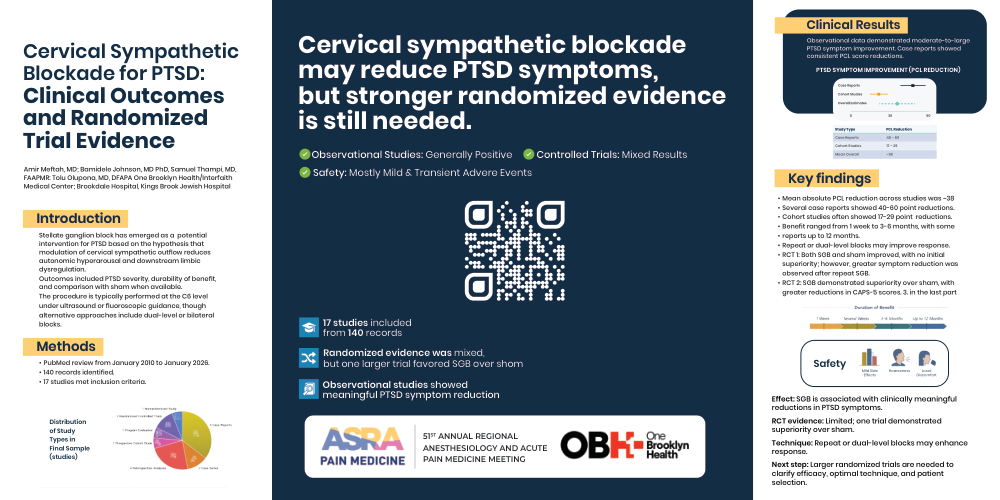
A systematic search of PubMed was conducted for studies published between January 2010 and January 2026 using the search terms “PTSD and SGB” and “PTSD and Cervical Block” Of 140 identified records, 17 met predefined inclusion criteria. Eligible studies reported human outcomes of stellate ganglion block (SGB) or cervical sympathetic block (CSB) as standalone interventions for posttraumatic stress disorder (PTSD). Primary endpoints included changes in symptom severity, most assessed using the PTSD Checklist (PCL) or the Clinician-Administered PTSD Scale (CAPS), as well as durability of response and comparison with sham procedures when available. The final sample included 6 case reports, 2 case series, 4 retrospective analyses, 1 prospective cohort study, 1 program evaluation, 2 randomized controlled trials, and 1 nonrandomized study.
Results/Case Report
Across observational designs, SGB/CSB was consistently associated with moderate to large reductions in PTSD symptom severity. The mean absolute reduction in PCL scores across studies was approximately 38 points, with several case reports demonstrating reductions exceeding 40–60 points. Retrospective and prospective cohorts commonly reported reductions between 17 and 29 points. Dual-level or repeat blocks appeared to yield greater symptom improvement in some cohorts, suggesting a possible dose-response relationship. Durability ranged from short-term improvement within 1 week to sustained benefit at 3–6 months, with several reports describing maintained response up to 12 months.
Findings from controlled trials were mixed. One RCT demonstrated significant improvement over time in both SGB and sham groups without superiority after initial treatment, though greater reduction was observed following repeat SGB. A larger RCT demonstrated statistically significant superiority of SGB over sham, with greater reductions in CAPS-5 scores. Adverse events were generally mild, transient, and comparable to sham in controlled studies.
Discussion
Current evidence suggests that SGB is associated with clinically meaningful reductions in PTSD symptom severity, particularly in observational studies demonstrating moderate-to-large effect sizes. Controlled data remain limited but indicate potential benefit, including evidence of superiority over sham in at least one adequately powered RCT. Repeat or dual-level blocks may enhance response. While promising, SGB requires further large-scale, rigorously designed randomized trials to clarify long-term efficacy, optimal procedural parameters, and patient selection criteria.
References
Alino J, Kosatka D, McLean B, Hirsch K. Efficacy of stellate ganglion block in the treatment of anxiety symptoms from combat-related post-traumatic stress disorder: a case series. Mil Med. 2013;178(4):e473-e476. doi:10.7205/MILMED-D-12-00386
Hanling SR, Hickey A, Lesnik I, et al. Stellate ganglion block for the treatment of posttraumatic stress disorder: a randomized, double-blind, controlled trial. Reg Anesth Pain Med. 2016;41(4):494-500. doi:10.1097/AAP.0000000000000402
Kuo J, Nicklay M. Botox-enhanced stellate ganglion blockade for the treatment of post-traumatic stress disorder. Cureus. 2023;15(4):e37573. doi:10.7759/cureus.37573
Lipov E. Successful use of stellate ganglion block and pulsed radiofrequency in the treatment of posttraumatic stress disorder: a case report. Pain Res Treat. 2010;2010:963948. doi:10.1155/2010/963948
Lipov EG, Faber JA. Efficacy of cervical sympathetic blockade in the treatment of primary and secondary PTSD symptoms: a case series. Heliyon. 2023;9(6):e17008. doi:10.1016/j.heliyon.2023.e17008
Lipov EG, Jacobs R, Springer S, Candido KD, Knezevic NN. Utility of cervical sympathetic block in treating post-traumatic stress disorder in multiple cohorts: a retrospective analysis. Pain Physician. 2022;25(1):77-85.
Lipov EG, Navaie M, Brown PR, et al. Stellate ganglion block improves refractory post-traumatic stress disorder and associated memory dysfunction: a case report and systematic literature review. Mil Med. 2013;178(2):e260-e264. doi:10.7205/MILMED-D-12-00290
Lynch JH, Mulvaney SW, Kim EH, et al. Effect of stellate ganglion block on specific symptom clusters for treatment of post-traumatic stress disorder. Mil Med. 2016;181(9):1135-1141. doi:10.7205/MILMED-D-15-00518
Mulvaney SW, Curtis KE, Ibrahim TS. Comparison C6 stellate ganglion versus C6 and C4 cervical sympathetic chain blocks for treatment of posttraumatic stress disorder: analysis of 147 patients. J Neurol Disord. 2019;7:1163.
Mulvaney SW, Lynch JH, Curtis KE, Ibrahim TS. The successful use of left-sided stellate ganglion block in patients that fail to respond to right-sided stellate ganglion block for the treatment of post-traumatic stress disorder symptoms: a retrospective analysis of 205 patients. Mil Med. 2022;187(7-8):e826-e829. doi:10.1093/milmed/usab056
Mulvaney SW, Lynch JH, Hickey MJ, et al. Stellate ganglion block used to treat symptoms associated with combat-related post-traumatic stress disorder: a case series of 166 patients. Mil Med. 2014;179(10):1133-1140. doi:10.7205/MILMED-D-14-00151
Mulvaney SW, McLean B, de Leeuw J. The use of stellate ganglion block in the treatment of panic/anxiety symptoms with combat-related post-traumatic stress disorder: preliminary results of long-term follow-up. Pain Pract. 2010;10(4):359-365. doi:10.1111/j.1533-2500.2010.00373.x
Odosso RJ, Petta L. The efficacy of the stellate ganglion block as a treatment modality for posttraumatic stress disorder among active duty combat veterans: a pilot program evaluation. Mil Med. 2021;186(7-8):e796-e803. doi:10.1093/milmed/usaa246
Olmsted KL, Bartoszek M, Mulvaney S, et al. Effect of stellate ganglion block treatment on posttraumatic stress disorder symptoms: a randomized clinical trial. JAMA Psychiatry. 2020;77(2):130-138. doi:10.1001/jamapsychiatry.2019.3474
Peterson AL, Straud CL, Young-McCaughan S, et al. Combining a stellate ganglion block with prolonged exposure therapy for posttraumatic stress disorder: a nonrandomized clinical trial. J Trauma Stress. 2022;35(6):1801-1809. doi:10.1002/jts.22873
Sterling L, Fisher K, Woodbury A. Stellate ganglion block for PTSD and chronic low back pain: a case report of three veterans. J Clin Med. 2025;14(10):3375. doi:10.3390/jcm14103375
Verrills P, Lipov E, Wright R, Sethi Z. Efficacy of right-sided cervical sympathetic block in treating post-traumatic stress disorder in Australian cohorts: a retrospective analysis. Res Pract Anesthesiol Open J. 2023;7(1):15-20.