395 posters, 1 audios, 13 topics, 29 sessions, 1,056 authors, 461 institutions
ePostersLive by SciGen Technologies S.A. All rights reserved.
51st Annual Regional Anesthesiology and Acute Pain Medicine Meeting
April 16 - 18, 2026 | Phoenix, Arizona

2363324
Longer Postoperative Epidural Duration is Associated with Lower Pain Scores and Odds of Opioid Use
Poster Presenter
Authors
Affiliations
null,
Part of Topic
Late Breaking Scientific Abstracts
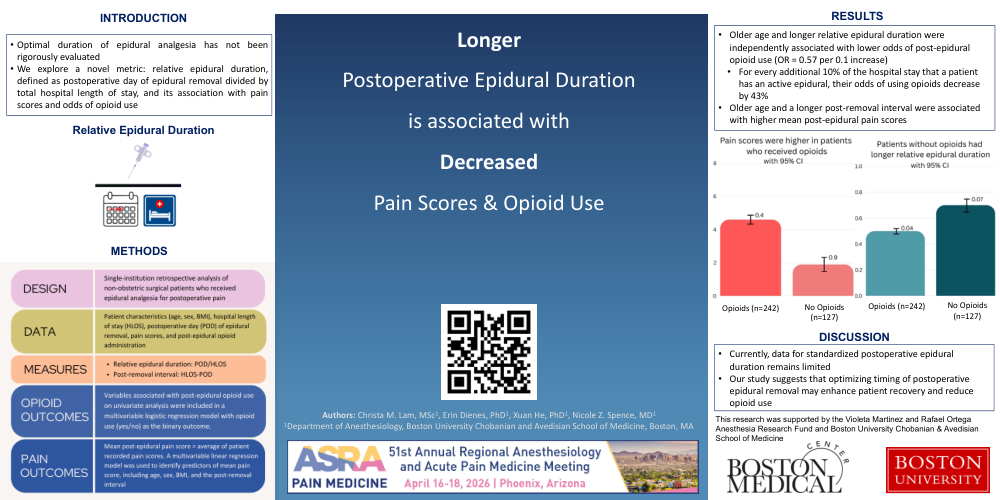
Introduction Optimizing postoperative pain management is critical to enhancing patient recovery and minimizing opioid use. Epidural analgesia is effective, however, optimal duration has not been rigorously evaluated. Premature discontinuation may lead to increased opioid requirements and higher pain scores. In this study, we explored a novel metric, relative epidural duration, defined as postoperative day of epidural removal divided by total hospital length of stay, and its association with post-epidural opioid use and pain scores.
Methods
A single-institution retrospective analysis of non-obstetric patients who received epidural analgesia for postoperative pain was performed. Patient characteristics, hospital length of stay (HLOS), postoperative day (POD) of epidural removal, pain scores, and opioid administration were obtained. Relative epidural duration was defined as POD divided by HLOS. Mean post-epidural pain scores were calculated for each patient by averaging all recorded scores after epidural removal. A multivariable linear regression model was constructed to evaluate predictors of mean pain score, including age, sex, BMI, and the interval between epidural removal and discharge (HLOS − POD).Variables associated with opioid use on univariate analysis were included in a multivariable logistic regression model with opioid use as the binary outcome. Odds ratios (ORs) were estimated. This study was reviewed and deemed exempt by the Institutional Review Board of Boston University under Human Research Protection Program Exempt Category 9. A waiver for research was granted.
Results
A total of 369 patients who received thoracic or lumbar epidural analgesia between 01/01/2020 and 04/30/2025 met the inclusion criteria. Two cohorts were created based on whether opioids were received (66%) or not received after epidural removal (34%). In multivariable logistic regression analysis, increased age and greater relative epidural duration were independently associated with post-epidural opioid use. Increasing relative epidural duration was associated with decreased odds of opioid use (OR = 0.57 per 0.1 increase), indicating a protective effect of longer epidural use relative to hospitalization. In linear regression analysis, both age and the interval between epidural removal and discharge (HLOS − POD) were significant predictors of mean pain score. Greater time between epidural removal and discharge was associated with higher mean pain scores, suggesting that earlier epidural removal relative to discharge may be associated with worse post-removal analgesia.
Discussion Evidence-based protocols guiding clinical decisions such as duration of postoperative epidural are essential to patient-centered care. Currently, data for standardized postoperative epidural duration remains limited. Our study showed that increased relative epidural duration was independently associated with reduced opioid use and pain scores, suggesting that optimizing timing may enhance patient recovery through non-opioid modalities.
References
1. Pirie K, Traer E, Finniss D, Myles PS, Riedel B. Current approaches to acute postoperative pain management after major abdominal surgery: a narrative review and future directions. Br J Anaesth. 2022 Sep;129(3):378-393. doi: 10.1016/j.bja.2022.05.029. Epub 2022 Jul 6. PMID: 35803751.
2. Guay J, Kopp S. Epidural pain relief versus systemic opioid-based pain relief for abdominal aortic surgery. Cochrane Database Syst Rev. 2016 Jan 5;2016(1):CD005059. doi: 10.1002/14651858.CD005059.pub4. PMID: 26731032; PMCID: PMC6464571.
3. Ljungqvist O, Scott M, Fearon KC. Enhanced Recovery After Surgery: A Review. JAMA Surg. 2017 Mar 1;152(3):292-298. doi: 10.1001/jamasurg.2016.4952. PMID: 28097305.
4. Pöpping DM, Elia N, Van Aken HK, Marret E, Schug SA, Kranke P, Wenk M, Tramèr MR. Impact of epidural analgesia on mortality and morbidity after surgery: systematic review and meta-analysis of randomized controlled trials. Ann Surg. 2014 Jun;259(6):1056-67. doi: 10.1097/SLA.0000000000000237. PMID: 24096762