395 posters, 1 audios, 13 topics, 29 sessions, 1,056 authors, 461 institutions
ePostersLive by SciGen Technologies S.A. All rights reserved.
51st Annual Regional Anesthesiology and Acute Pain Medicine Meeting
April 16 - 18, 2026 | Phoenix, Arizona

2363294
Evaluating Buprenorphine as an Alternative to Full Opioid Agonists for Pain Management in Sickle Cell Disease: A Scoping Review
Poster Presenter
Authors
Part of Topic
Late Breaking Scientific Abstracts
Management of vaso-occlusive crises and chronic pain in Sickle Cell Disease (SCD) relies heavily on opioid therapy. Although full opioid agonists provide effective acute analgesia, long term use is associated with tolerance, dose escalation and adverse effects [1]. Buprenorphine, a partial μ-opioid agonist with favorable safety profile, may offer effective pain relief with fewer complications. This review evaluates buprenorphine as an alternative strategy for pain management in SCD patients.
Literature search conducted following PRISMA guidelines: Search strategy used controlled and relevant keywords to identify studies evaluating partial opioid agonists for pain management in SCD. Data bases searched included PubMed, MEDLINE, Embase, and the Cochrane Library. Eligible studies: evaluating partial opioid agonists for the management of acute and chronic pain in SCD patients. Excluded studies: no original clinical data, pediatric populations and studies focused only on full opioid agonists.
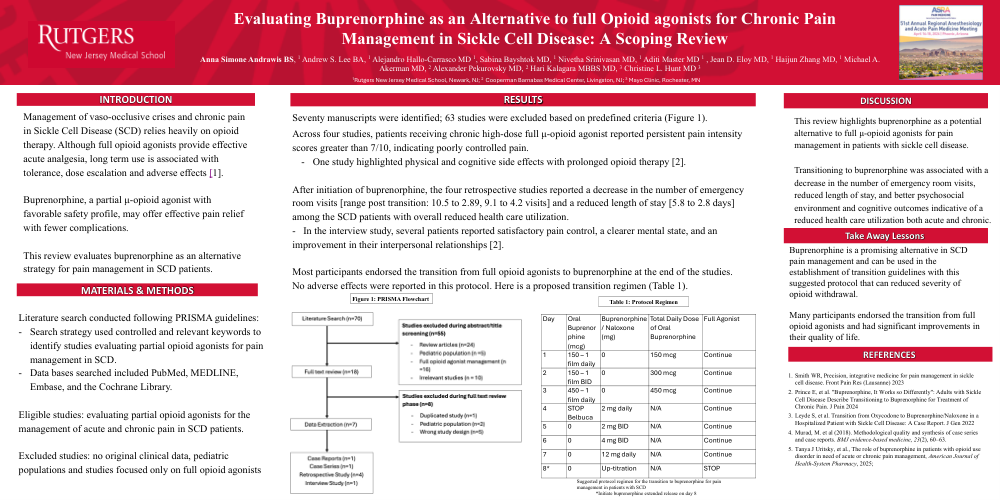
Seventy manuscripts were identified; 63 studies were excluded based on predefined criteria (Figure 1). Across four studies, patients receiving chronic high-dose full μ-opioid agonist reported persistent pain intensity scores greater than 7/10, indicating poorly controlled pain. One study highlighted physical and cognitive side effects with prolonged opioid therapy [2]. After initiation of buprenorphine, the four retrospective studies reported a decrease in the number of emergency room visits and a reduced length of stay among the SCD patients. In the interview study, several patients reported satisfactory pain control, a clearer mental state, and an improvement in their interpersonal relationships [2]. Most participants endorsed the transition from full opioid agonists to buprenorphine at the end of the studies. No adverse effects were reported in this protocol. Here is a proposed transition regimen (Table 1).
This review highlights buprenorphine as a potential alternative to full μ-opioid agonists for pain management in patients with sickle cell disease. Transitioning to buprenorphine was associated with a decrease in the number of emergency room visits, reduced length of stay, and better psychosocial environment and cognitive outcomes. Takeaway lessons are: Buprenorphine is a promising alternative in SCD pain management and can be used in the establishment of transition guidelines. Many participants endorsed the transition from full opioid agonists and had significant improvements in their quality of life.
1.Smith WR, Precision, integrative medicine for pain management in sickle cell disease. Front Pain Res (Lausanne) 2023
2.Prince E, et al. "Buprenorphine, It Works so Differently": Adults with Sickle Cell Disease Describe Transitioning to Buprenorphine for Treatment of Chronic Pain. J Pain 2024
3.Leyde S, et al. Transition from Oxycodone to Buprenorphine/Naloxone in a Hospitalized Patient with Sickle Cell Disease: A Case Report. J Gen 2022
4.Murad, M. et al (2018). Methodological quality and synthesis of case series and case reports. BMJ evidence-based medicine, 23(2), 60–63.
5.Tanya J Uritsky, et al., The role of buprenorphine in patients with opioid use disorder in need of acute or chronic pain management, American Journal of Health-System Pharmacy, 2025;