395 posters, 1 audios, 13 topics, 29 sessions, 1,056 authors, 461 institutions
ePostersLive by SciGen Technologies S.A. All rights reserved.
51st Annual Regional Anesthesiology and Acute Pain Medicine Meeting
April 16 - 18, 2026 | Phoenix, Arizona

2350237
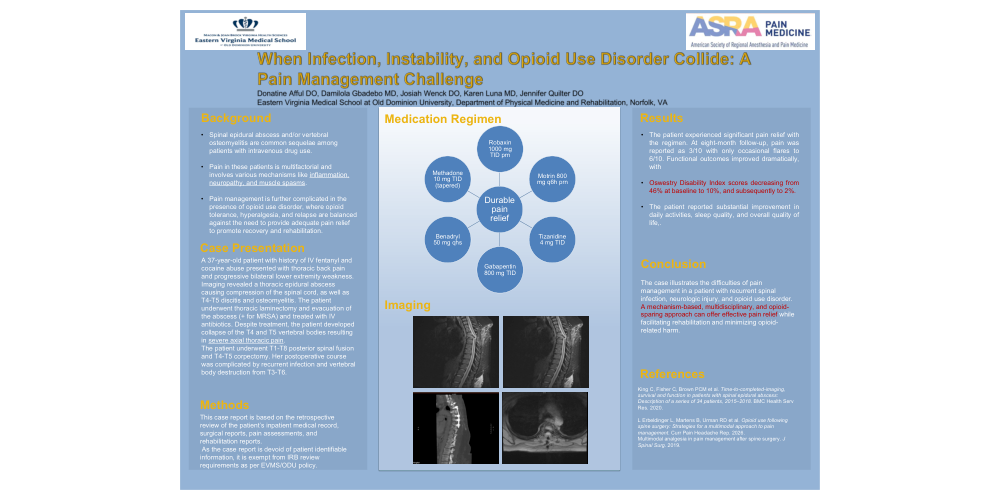
When Infection, Instability, and Opioid Use Disorder Collide: A Pain ManagementChallenge
Poster Presenter
Authors
Donatine Afful, Damilola Gbadebo, Josiah Wenck, Karen Luna, Jennifer Quilter
Affiliations
Eastern Virginia Medical School at Old Dominion University, Department of Physical Medicine and Rehabilitation, Eastern Virginia Medical School at Old Dominion University, Department of Physical Medicine and Rehabilitation, Norfolk, VA
Part of Topic
Late Breaking Medically Challenging Cases
A 37-year-old patient with a past medical history of IV fentanyl and cocaine abuse presented with increasing severity of thoracic back pain and progressive bilateral lower extremity weakness. Imaging revealed a thoracic epidural abscess causing compression of the spinal cord, as well as associated T4-T5 discitis and osteomyelitis. The patient underwent emergent thoracic laminectomy and evacuation of the abscess, and cultures were positive for methicillin-sensitive Staphylococcus aureus (MRSA) complicated by bacteremia. The patient underwent an eight-week IV cefazolin regimen.
Despite treatment, the patient developed progressive collapse of the T4 and T5 vertebral bodies, leading to instability and resulting in severe axial thoracic pain. The patient underwent T1-T8 posterior spinal fusion and T4-T5 corpectomy. Her postoperative course was complicated by recurrent infection with MRSA, vertebral body destruction from T3-T6, and incomplete paraplegia. The patient underwent surgical washout and IV vancomycin, followed by long-term oral antibiotics.
Interventions were not pursued secondary to infection and hardware. Gabapentin was prescribed for neuropathic pain, and scheduled robaxin was given for muscle spasms. NSAIDs were prescribed as tolerated. Methadone was initially prescribed for analgesia and treatment of OUD. Methadone was tapered and discontinued as pain was controlled. Short-acting opioids were minimized and discontinued. With this regimen, the patient reported improved pain control and underwent rehabilitation.