395 posters, 1 audios, 13 topics, 29 sessions, 1,056 authors, 461 institutions
ePostersLive by SciGen Technologies S.A. All rights reserved.
51st Annual Regional Anesthesiology and Acute Pain Medicine Meeting
April 16 - 18, 2026 | Phoenix, Arizona

2318653
Brachial Plexus Blocks for Clavicle Surgery
Poster Presenter
Authors
Jonathan Shen, Nishita Lockwood, Rana Movahedi, Pamela Chia, Xuezhi Dong
Affiliations
UCLA,
Part of Topic
Scientific Abstracts > Regional Anesthesia
Introduction
Brachial Plexus Nerve Blocks for Clavicular Surgery
Jonathan Shen DO, Nishita Lockwood MD, Pamela Chia MD, Rana Movahedi MD, Xuezhi Dong MD
Department of Anesthesiology & Perioperative Medicine, David Geffen School of Medicine, UCLA
• Clavicular ORIF can lead to significant
post-operative pain
• Regional techniques over time have
grown to provide more analgesia
• This study aims to investigate how
brachial plexus, with cervical plexus
blocks, affect opioid consumption, PONV,
and recovery rates
• Retrospective chart review of block vs no
block for patient’s receiving GA
Methods
• From 1/1/23- 12/1/25: 162 cases after
excluding ASA IV, emergency cases,
concurrent procedures, or those with pre-op
diagnosis of COPD
• Block group received either an
interscalene/superior trunk/supraclavicular
block with cervical plexus block
• Paired T-test for continuous and Chi-
squared for categorical variables
• Primary outcomes: intra-op opioid
requirements, post-op pain scores, PACU
opioid consumption
• Secondary outcomes: PACU antiemetic
use, PACU LOS, hospital LOS
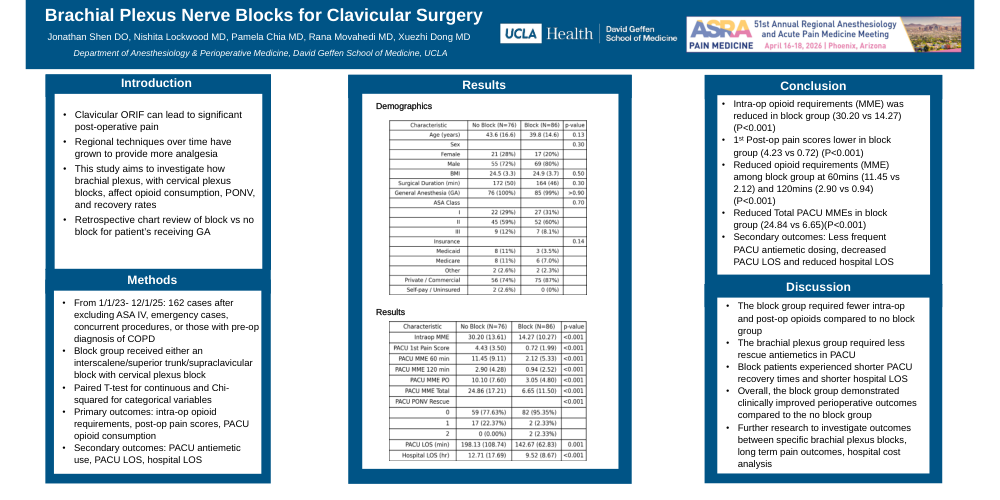
Intra-op opioid requirements (MME) was
reduced in block group (30.20 vs 14.27)
(P<0.001)
• 1st Post-op pain scores lower in block
group (4.23 vs 0.72) (P<0.001)
• Reduced opioid requirements (MME)
among block group at 60mins (11.45 vs
2.12) and 120mins (2.90 vs 0.94)
(P<0.001)
• Reduced Total PACU MMEs in block
group (24.84 vs 6.65)(P<0.001)
• Secondary outcomes: Less frequent
PACU antiemetic dosing, decreased
PACU LOS and reduced hospital LOS
Discussion
• The block group required fewer intra-op
and post-op opioids compared to no block
group
• The brachial plexus group required less
rescue antiemetics in PACU
• Block patients experienced shorter PACU
recovery times and shorter hospital LOS
• Overall, the block group demonstrated
clinically improved perioperative outcomes
compared to the no block group
• Further research to investigate outcomes
between specific brachial plexus blocks,
long term pain outcomes, hospital cost
analysis