395 posters, 1 audios, 13 topics, 29 sessions, 1,056 authors, 461 institutions
ePostersLive by SciGen Technologies S.A. All rights reserved.
51st Annual Regional Anesthesiology and Acute Pain Medicine Meeting
April 16 - 18, 2026 | Phoenix, Arizona

2317622
Brachial Plexus Catheter as a Bridge to Peripheral Nerve Stimulation in Metastatic Cancer Pain
Poster Presenter
Part of Topic
Scientific Abstracts > Regional Anesthesia
Introduction:
Cancer-related bone pain is common, debilitating, and frequently refractory to systemic therapies. Patients with
metastatic disease often experience prolonged hospitalizations due to uncontrolled pain, opioid-related adverse effects,
and limited therapeutic alternatives. 1Although opioids have traditionally been the cornerstone of treatment for severe
cancer-related pain, their use is constrained by adverse effects, tolerance, and reduced quality of life. Peripheral nerve
stimulation (PNS) is an emerging therapy for refractory cancer pain but is typically performed in the outpatient setting.
We describe the inpatient use of a continuous brachial plexus catheter as a bridge to PNS in a patient with severe
metastatic humeral pain, highlighting the value of collaboration between acute and chronic pain services.
Materials and Methods:
This report describes a single-patient case. Per institutional policy, the case was deemed exempt from IRB review as it
contains no patient-identifiable information. Written informed consent for procedures and publication was obtained
from the patient.
Case Report:
A 92-year-old man with lung adenocarcinoma, chronic kidney disease, and chronic anticoagulation presented with
severe right upper extremity pain secondary to lytic metastatic disease of the humerus and a pathologic fracture.
Despite surgical fixation, he remained hospitalized for several months due to refractory pain. Multimodal
pharmacologic management was limited by comorbidities and adverse effects, including somnolence from gabapentin
and ketamine and contraindications to nonsteroidal anti-inflammatory drugs. He was maintained on methadone,
oxycodone, and oral dexamethasone with inadequate relief.
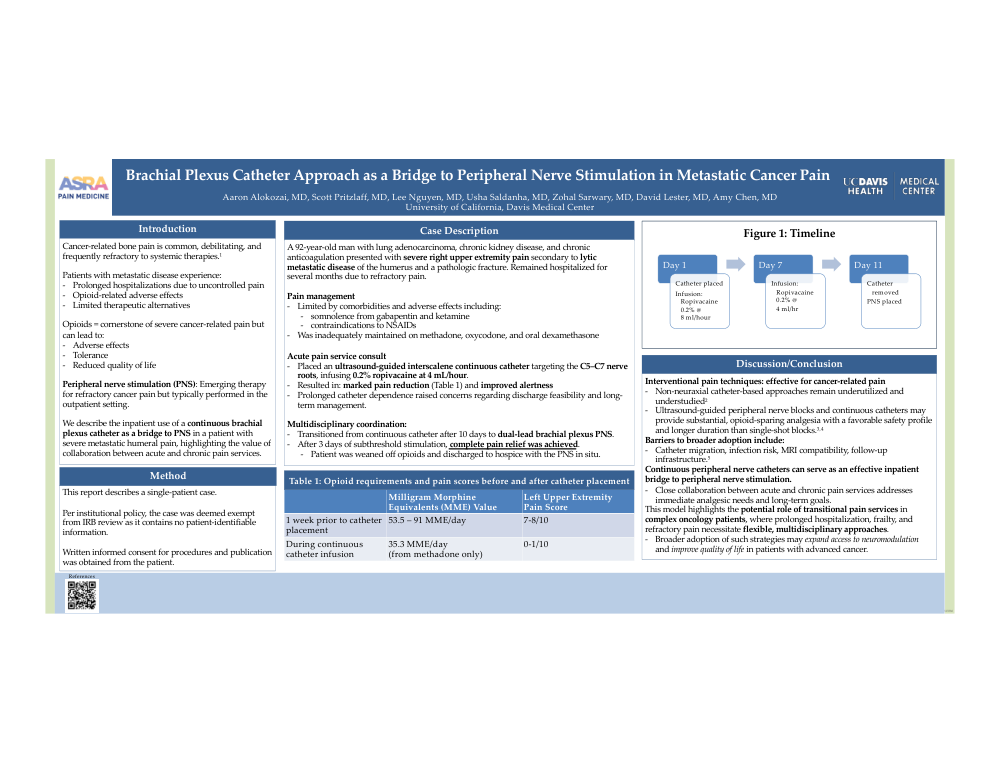
The acute pain service was consulted and placed an ultrasound-guided interscalene continuous catheter targeting the
C5–C7 nerve roots, infusing 0.2% ropivacaine at 4 mL/hour. This resulted in marked pain reduction and improved
alertness, enabling medication de-escalation. However, prolonged catheter dependence raised concerns regarding
discharge feasibility and long-term management.
After multidisciplinary coordination, he was transitioned from a continuous nerve block to temporary PNS. Following
10 days of infusion, the catheter was removed with full neurologic recovery, and a dual-lead brachial plexus PNS was
placed. After three days of subthreshold stimulation, he achieved complete pain relief, was weaned off opioids, and was
discharged to hospice with the PNS in situ.
Discussion:
Interventional pain techniques are effective for cancer-related pain, yet non-neuraxial catheter-based approaches remain
underutilized and understudied.2 Existing literature, largely limited to case reports and small series, suggests that
ultrasound-guided peripheral nerve blocks and continuous catheters provide substantial, opioid-sparing analgesia with a
favorable safety profile and longer duration than single-shot blocks. 3,4 Barriers to broader adoption include concerns
regarding catheter migration, infection risk, MRI compatibility, and follow-up infrastructure.5 This case demonstrates
that continuous peripheral nerve catheters can serve as an effective inpatient bridge to peripheral nerve stimulation,
challenging the traditional outpatient-only paradigm for chronic pain interventions. Importantly, close collaboration
between acute and chronic pain services enabled seamless transition across care phases, addressing both immediate
analgesic needs and long-term goals. This model highlights the potential role of transitional pain services in complex
oncology patients, where prolonged hospitalization, frailty, and refractory pain necessitate flexible, multidisciplinary
approaches. Broader adoption of such strategies may expand access to neuromodulation and improve quality of life in
patients with advanced cancer.