395 posters, 1 audios, 13 topics, 29 sessions, 1,056 authors, 461 institutions
ePostersLive by SciGen Technologies S.A. All rights reserved.
51st Annual Regional Anesthesiology and Acute Pain Medicine Meeting
April 16 - 18, 2026 | Phoenix, Arizona

2301947
Does Hypersensitivity Occur After Axillary Brachial Plexus Block in Healthy Volunteers? A Mechanistic Study of Rebound Pain
Poster Presenter
Authors
Yun-Yun Chen, Jenna Wilson, Patrick Collins, Sheila Gokul, Philipp Lirk, Kristin Schreiber
Affiliations
Department of Anesthesiology, Brigham and Women’s Hospital, Mass General Brigham, Boston, MA, USA, Department of Anesthesiology, Critical Care and Pain Medicine, UT Health Houston, McGovern Medical School, Houston, TX, USA, Department of Anesthesiology, Perioperative and Pain Medicine, Stanford Medicine, Palo Alto, CA, USA
Part of Topic
Scientific Abstracts > Regional Anesthesia
Does Hypersensitivity Occur After Axillary Brachial Plexus Block in Healthy Volunteers?
A Mechanistic Study of Rebound Pain
Results:
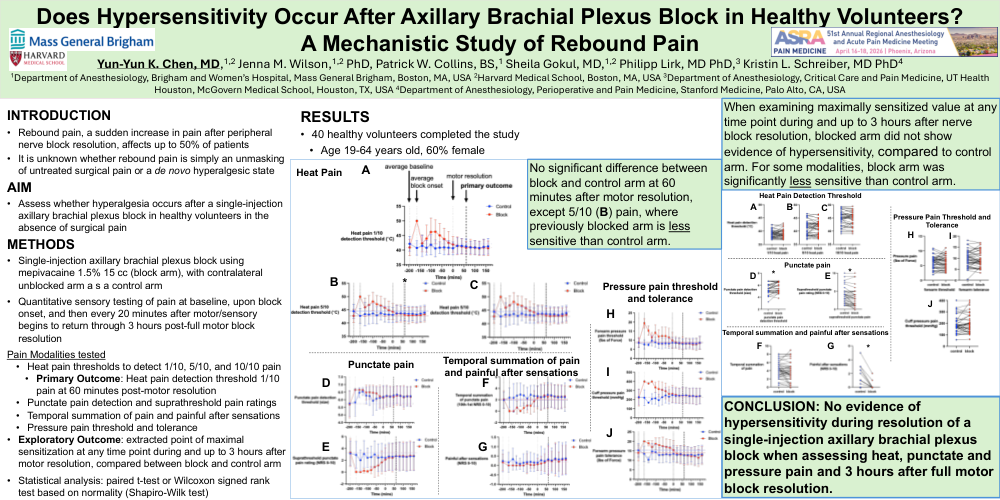
No significant difference between block and control arm at 60 minutes after motor resolution, except 5/10 (B) pain, where previously blocked arm is less sensitive than control arm.
When examining maximally sensitized value at any time point during and up to 3 hours after nerve block resolution, blocked arm did not show evidence of hypersensitivity, compared to control arm. For some modalities, block arm was significantly less sensitive than control arm.
CONCLUSION: No evidence of hypersensitivity during resolution of a single-injection axillary brachial plexus block when assessing heat, punctate and pressure pain and 3 hours after full motor block resolution.