395 posters, 1 audios, 13 topics, 29 sessions, 1,056 authors, 461 institutions
ePostersLive by SciGen Technologies S.A. All rights reserved.
51st Annual Regional Anesthesiology and Acute Pain Medicine Meeting
April 16 - 18, 2026 | Phoenix, Arizona

2317198
Prophylactic and Therapeutic Use of Epidural Hydroxyethyl Starch for Management of PDPH
Poster Presenter
Part of Topic
Medically Challenging Cases
Prophylactic and Therapeutic Use of Epidural Hydroxyethyl Starch for Management of PDPH
Introduction
•Postdural puncture headache (PDPH) is a potential complication associated with a lumbar puncture characterized by a bilateral frontal or occipital headache.
•Research on the off-label use of hydroxyethyl starch in management of post-dural puncture (PDPH) is scarce
•Management of a PDPH is typically supportive care with bed rest, oral pain medications, caffeine, with an epidural blood patch reserved for cases refractory to these supportive measures.
•Several studies mention the use of epidural hydroxyethyl starch as a suitable alternative in the event a blood patch is contraindicated.
Materials and Methods
•We systemically searched PubMed and EMBASE using keywords such as ”epidural hydroxyethyl starch”, “post-dural puncture headache", and “PDPH”.
•Articles were included only if patients in the study received an epidural infusion of hydroxyethyl starch as prophylaxis or treatment tfor a post-dural puncture headache.
•We narrowed our search to 21 articles.
•The dosages and success rates were noted for each article.
Results
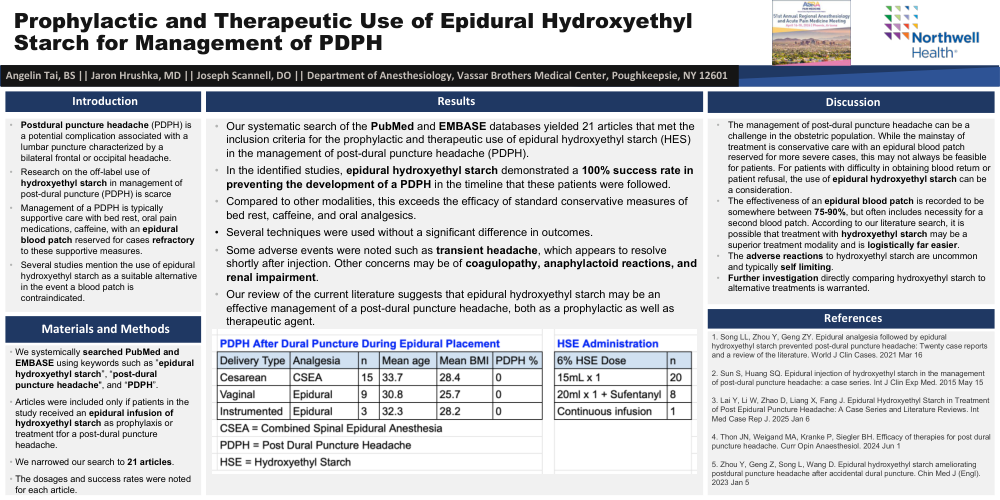
•Our systematic search of the PubMed and EMBASE databases yielded 21 articles that met the inclusion criteria for the prophylactic and therapeutic use of epidural hydroxyethyl starch (HES) in the management of post-dural puncture headache (PDPH).
•In the identified studies, epidural hydroxyethyl starch demonstrated a 100% success rate in preventing the development of a PDPH in the timeline that these patients were followed.
•Compared to other modalities, this exceeds the efficacy of standard conservative measures of bed rest, caffeine, and oral analgesics.
•Several techniques were used without a significant difference in outcomes.
•Some adverse events were noted such as transient headache, which appears to resolve shortly after injection. Other concerns may be of coagulopathy, anaphylactoid reactions, and renal impairment.
•Our review of the current literature suggests that epidural hydroxyethyl starch may be an effective management of a post-dural puncture headache, both as a prophylactic as well as therapeutic agent.
Discussion
•The management of post-dural puncture headache can be a challenge in the obstetric population. While the mainstay of treatment is conservative care with an epidural blood patch reserved for more severe cases, this may not always be feasible for patients. For patients with difficulty in obtaining blood return or patient refusal, the use of epidural hydroxyethyl starch can be a consideration.
•The effectiveness of an epidural blood patch is recorded to be somewhere between 75-90%, but often includes necessity for a second blood patch. According to our literature search, it is possible that treatment with hydroxyethyl starch may be a superior treatment modality and is logistically far easier.
•The adverse reactions to hydroxyethyl starch are uncommon and typically self limiting.
•Further investigation directly comparing hydroxyethyl starch to alternative treatments is warranted.