395 posters, 1 audios, 13 topics, 29 sessions, 1,056 authors, 461 institutions
ePostersLive by SciGen Technologies S.A. All rights reserved.
51st Annual Regional Anesthesiology and Acute Pain Medicine Meeting
April 16 - 18, 2026 | Phoenix, Arizona

2317150
Ultrasound-Guided Regional Anesthesia for Extravascular ICD Implantation
Poster Presenter
Authors
Affiliations
Part of Topic
Medically Challenging Cases
Ultrasound-Guided Regional Anesthesia For Extravascular ICD Implantation
Connor Singrey, MD, Nicholas Wegener, MD, and Tiffany Lin, MD
Department of Anesthesiology Weill Cornell Medicine, NewYork-Presbyterian Hospital, New York, NY
Introduction
•Regional anesthesia has been used extensively for ICD and PPM implantation.1
•For subcutaneous ICDs, serratus anterior (SAPB) and transversus thoracis muscle plane blocks (TTMP) have been shown to be superior to local anesthesia.2-3
•We present a case report of an extravascular ICD (EV-ICD) placement under general anesthesia with concurrent regional anesthesia.
•Regional specifically for EV-ICD sub-serratus incision and substernal tunneling has not be previously described.
Methods
This patient gave consent to have their case written up. This case is devoid of patient identifiable information and is exempt from IRB review requirements per NewYork-Presbyterian policy.
Case Report
A 37 year-old 79.8 kg male with no past medical history was brought by EMS to the emergency department after cardiac arrest. He underwent cardiac catheterization with PCI of proximal LAD stenosis, subsequent DES placement, and initiation of dual antiplatelet therapy. After discharge, he underwent an EP study showing readily inducible polymorphic ventricular tachycardia.
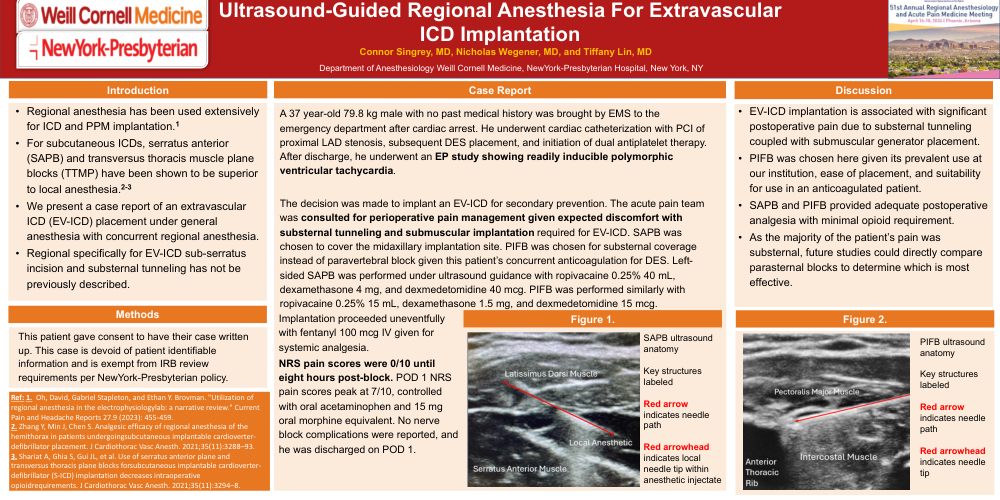
The decision was made to implant an EV-ICD for secondary prevention. The acute pain team was consulted for perioperative pain management given expected discomfort with substernal tunneling and submuscular implantation required for EV-ICD. SAPB was chosen to cover the midaxillary implantation site. PIFB was chosen for substernal coverage instead of paravertebral block given this patient’s concurrent anticoagulation for DES. Left-sided SAPB was performed under ultrasound guidance with ropivacaine 0.25% 40 mL, dexamethasone 4 mg, and dexmedetomidine 40 mcg. PIFB was performed similarly with ropivacaine 0.25% 15 mL, dexamethasone 1.5 mg, and dexmedetomidine 15 mcg.
Implantation proceeded uneventfully with fentanyl 100 mcg IV given for systemic analgesia. NRS pain scores were 0/10 until eight hours post-block. POD 1 NRS pain scores peak at 7/10, controlled with oral acetaminophen and 15 mg oral morphine equivalent. No nerve block complications were reported, and he was discharged on POD 1.
Discussion
•EV-ICD implantation is associated with significant postoperative pain due to substernal tunneling coupled with submuscular generator placement.
•PIFB was chosen here given its prevalent use at our institution, ease of placement, and suitability for use in an anticoagulated patient.
•SAPB and PIFB provided adequate postoperative analgesia with minimal opioid requirement.
•As the majority of the patient’s pain was substernal, future studies could directly compare parasternal blocks to determine which is most effective.
Ref: 1. Oh, David, Gabriel Stapleton, and Ethan Y. Brovman. "Utilization of regional anesthesia in the electrophysiology lab: a narrative review." Current Pain and Headache Reports 27.9 (2023): 455-459.
2. Zhang Y, Min J, Chen S. Analgesic efficacy of regional anesthesia of the hemithorax in patients undergoing subcutaneous implantable cardioverter-defibrillator placement. J Cardiothorac Vasc Anesth. 2021;35(11):3288–93.
3. Shariat A, Ghia S, Gui JL, et al. Use of serratus anterior plane and transversus thoracis plane blocks for subcutaneous implantable cardioverter-defibrillator (S-ICD) implantation decreases intraoperative opioid requirements. J Cardiothorac Vasc Anesth. 2021;35(11):3294–8.