395 posters, 1 audios, 13 topics, 29 sessions, 1,056 authors, 461 institutions
ePostersLive by SciGen Technologies S.A. All rights reserved.
51st Annual Regional Anesthesiology and Acute Pain Medicine Meeting
April 16 - 18, 2026 | Phoenix, Arizona

2316647
Predicting Persistent Postoperative Pain After Total Knee Arthroplasty Using Machine Learning with Clinical and Biological Data
Poster Presenter
Part of Topic
Scientific Abstracts > Chronic Pain
Introduction
Persistent postoperative pain (PPP) affects ~20% of patients following total knee arthroplasty (TKA) and is associated with patient dissatisfaction and reduced quality of life.1, 2 These patients exhibit distinct perioperative profiles, suggesting that these responses may influence long-term outcomes.3 The relative contribution of specific clinical and/or biological (e.g. cytokines) features for predicting PPP remain poorly understood. This study applies a machine learning (ML) approach to identify key clinical and biological predictors of PPP after TKA.
Material and Methods
This post-hoc ML analysis of previously published data 3 (IRB#2015-361) included 160 patients with 318 clinical and biological (serum cytokine/adipokine levels) features. The outcome was PPP, defined as pain NRS >0 in the operative knee with movement at six months post-TKA.
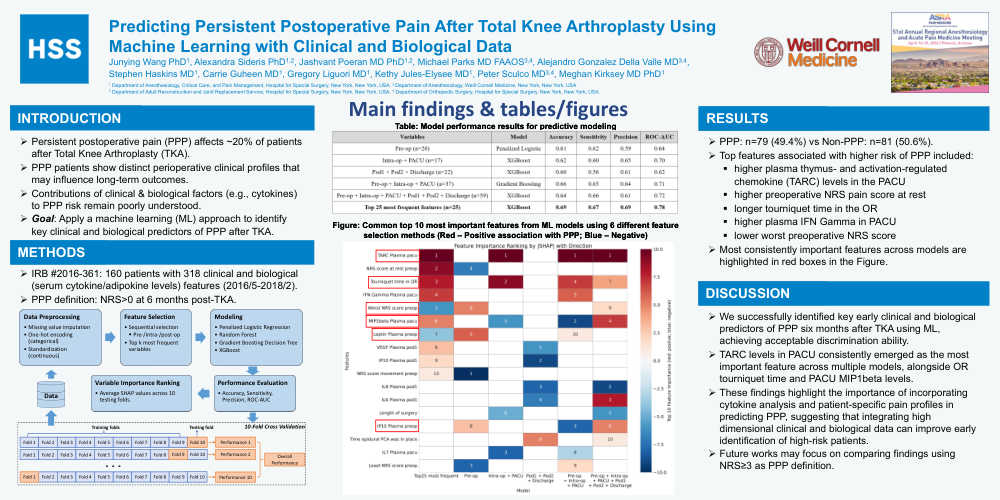
First, feature dimensionality reduction was applied using two strategies (Table 1): (1) univariable analysis to select features with p<0.25 for different timepoints 4, and (2) repeated ML models to identify the top 25 most important features. Then, ten-fold cross-validation (CV) was performed, with each fold iteratively treated as testing data and the remaining folds used for training. Model performance was evaluated using accuracy, sensitivity, precision, and ROC-AUC. Feature importance was calculated as the average SHAP value across testing folds. We applied four ML models—penalized logistic regression, random forest, gradient boosting decision tree, and XGBoost—and reported the one achieving the highest AUC for each feature selection strategy.
Results
PPP prevalence was 49.4% (n=79). Among the four applied ML models (Table 2, Figure 1), XGBoost with feature selection based on the top 25 most important features demonstrated the best model performance: accuracy 0.69, sensitivity 0.67, precision 0.69, and ROC-AUC 0.78, indicating acceptable discrimination ability for PPP (Table 2). The top important features associated with higher risk of PPP included higher plasma thymus- and activation-regulated chemokine (TARC) levels in the post-anesthesia care unit (PACU), higher preoperative NRS pain score at rest, longer tourniquet time in the operating room (OR), higher plasma IFN Gamma in PACU, and lower worst preoperative NRS score (Figure 1).
After comparing the occurrence of the top 10 features across models, plasma TARC levels in PACU emerged as the most consistently important feature in 4 approaches. Other features that appeared frequently included tourniquet time in OR, plasma MIP1beta in PACU, worst preoperative NRS score, and preoperative plasma levels of leptin and IP-10 (Figure 1).
Discussion
We successfully identified key early clinical and biological predictors of PPP six months after TKA using ML, achieving acceptable discrimination ability. TARC levels in PACU consistently emerged as the most important feature across multiple models, alongside OR tourniquet time and PACU MIP1beta levels. These findings highlight the importance of incorporating cytokine analysis and patient-specific pain profiles in predicting PPP, suggesting that integrating high dimensional clinical and biological data can improve early identification of high-risk patients.