395 posters, 1 audios, 13 topics, 29 sessions, 1,056 authors, 461 institutions
ePostersLive by SciGen Technologies S.A. All rights reserved.
51st Annual Regional Anesthesiology and Acute Pain Medicine Meeting
April 16 - 18, 2026 | Phoenix, Arizona

2316544
Paravertebral Block for Minimally Invasive Mitral Valve Surgery: A Case Series
Poster Presenter
Authors
Matheus Montano dos Santos, Robert McClain, Alberto Ardon, Naina Singh, Fatima Serhan, Basar Sareyypoglu, Hari Kalagara
Affiliations
Mayo Clinic Florida Jacksonville, Department of Regional Anesthesiology and Acute Pain Medicine Mayo Clinic Florida Jacksonville, Department of Cardiothoracic Surgery Mayo Clinic Florida Jacksonville
Part of Topic
Scientific Abstracts > Regional Anesthesia
INTRODUCTION:
Minimally invasive mitral valve surgery (MIMVS) via right mini-thoracotomy is associated with significant thoracic pain, affecting early extubation and recovery. Thoracic wall regional anesthesia techniques have gained increasing interest as part of opioid-sparing multimodal analgesia for cardiac surgery. In particular, fascial plane blocks such as the erector spinae plane or serratus anterior plane have emerged as attractive alternatives to neuraxial techniques by providing effective analgesia while avoiding the risks with anticoagulation in cardiac surgery. Paravertebral block (TPVB) provides reliable somatic and sympathetic blockade and has demonstrated to be superior to fascial plane blocks in open thoracic surgery, but its role in MIMVS has not been well defined. This preparatory case series evaluates the feasibility, safety, and early clinical outcomes of TPVB in patients undergoing MIMVS.
MATERIALS AND METHODS
This study included 8 adult patients undergoing elective MIMVS via right mini-thoracotomy who received preoperative single-shot land mark-based or US-guided PVB with Ropivacaine 0.5%. Data were collected retrospectively from the electronic medical record and included demographic variables, post operative pain scores, perioperative opioid consumption, time, hospital LOS and need for reintubation. No comparative statistical analysis was performed. IRB statement: This study is exempt from IRB review requirements as per our institution’s policy.
RESULTS
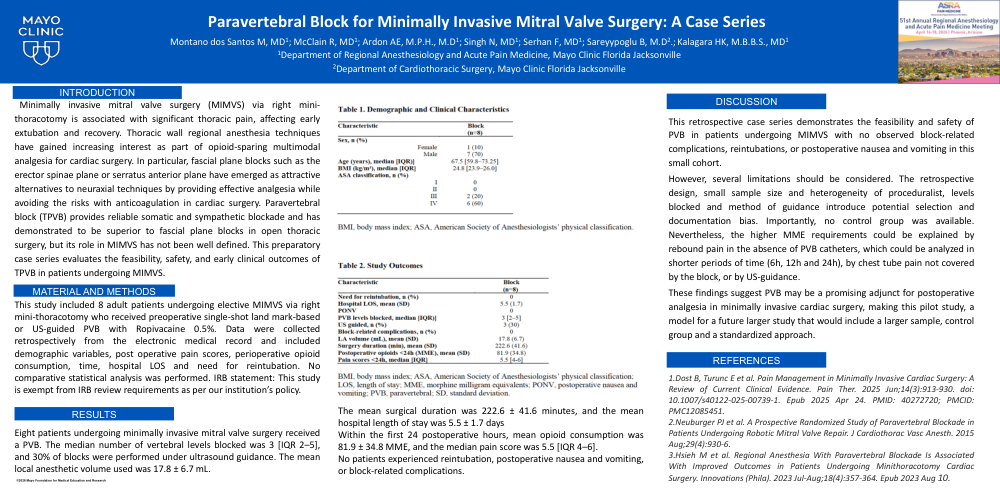
Eight patients undergoing minimally invasive mitral valve surgery received a PVB. The median number of vertebral levels blocked was 3 [IQR 2–5], and 30% of blocks were performed under ultrasound guidance. The mean local anesthetic volume used was 17.8 ± 6.7 mL. The mean surgical duration was 222.6 ± 41.6 minutes, and the mean hospital length of stay was 5.5 ± 1.7 days.Within the first 24 postoperative hours, mean opioid consumption was 81.9 ± 34.8 MME, and the median pain score was 5.5 [IQR 4–6]. No patients experienced reintubation, postoperative nausea and vomiting, or block-related complications.
DISCUSSION
This retrospective case series demonstrates the feasibility and safety of PVB in patients undergoing MIMVS with no observed block-related complications, reintubations, or postoperative nausea and vomiting in this small cohort. However, several limitations should be considered. The retrospective design, small sample size and heterogeneity of proceduralist, levels blocked and method of guidance introduce potential selection and documentation bias. Importantly, no control group was available. Nevertheless, the higher MME requirements could be explained by rebound pain in the absence of PVB catheters, which could be analyzed in shorter periods of time (6h, 12h and 24h), by chest tube pain not covered by the block, or by US-guidance.
These findings suggest PVB may be a promising adjunct for postoperative analgesia in minimally invasive cardiac surgery, making this pilot study, a model for a future larger study that would include a larger sample, control group and a standardized approach.