395 posters, 1 audios, 13 topics, 29 sessions, 1,056 authors, 461 institutions
ePostersLive by SciGen Technologies S.A. All rights reserved.
51st Annual Regional Anesthesiology and Acute Pain Medicine Meeting
April 16 - 18, 2026 | Phoenix, Arizona

2296037
Assessment of Diversity, Equity and Inclusion Education in Anesthesiology: A Survey of the American Society of Anesthesiologists
Poster Presenter
Authors
Affiliations
Part of Topic
Scientific Abstracts > Regional Anesthesia
An Assessment of Diversity, Equity and Inclusion Education in Anesthesiology: A Survey of the American Society of Anesthesiologists (ASA) Membership
Mia Zonies1, Juliet Rowe1, Pa Thor1, Richard Jones1,2, Lucresse Tato3, Janet Adeola4, Zara Adamou4, Eman Nada5, Bridget P. Pulos6, Katie J. O’ Conor7, David L. Lee1,2, Renuka George8, Adam J. Milam7, Herodotos Ellinas9, Jashvant Poeran1, Edward R. Mariano10,11, Sylvia H. Wilson12, Uchenna O. Umeh1,2
1Hospital for Special Surgery, Department of Anesthesiology, Critical Care & Pain Management, New York, NY, USA; 2Department of Anesthesiology, Weill Cornell Medicine, New York, NY, USA; 3CUNY School of Medicine, New York, NY, US; 4Brigham and Women’s Hospital, Department of Anesthesiology, Perioperative Care and Pain Medicine; 5Department of Anesthesiology, Stony Brook University, Stony Brook, NY, USA; 6Department of Anesthesiology and Perioperative Medicine, Mayo Clinic, Rochester, MN, USA; 7Department of Anesthesiology and Critical Care Medicine, Johns Hopkins Medicine, Baltimore, MD, USA; 8Department of Anesthesiology, University of Colorado Anschutz, Aurora, CO, USA; 9Department of Anesthesiology, University of Minnesota, Minneapolis, MN, USA ; 10Anesthesiology Perioperative and Pain Medicine, Stanford University School of Medicine, Stanford, California, USA; 11Anesthesiology, Perioperative and Pain Medicine, Veterans Affairs Palo Alto Health Care System, Palo Alto, California, USA,; 12Department of Anesthesia and Perioperative Medicine, Medical University of South Carolina, Charleston, SC, USA
Introduction
It is essential to train physicians who are culturally agile and adaptable.
Assessing anesthesiologists’ current understanding of diversity, equity, and inclusion (DEI) can help guide the integration of DEI education into formal anesthesiology training and maintenance of certification programs.
This survey-based study examined the demographic characteristics and educational experiences of members of the American Society of Anesthesiologists (ASA), in relation to members’ knowledge of and satisfaction with DEI-related education within their institutions.
Methods
This cross-sectional survey study was approved by the Hospital for Special Surgery’s Institutional Review Board (IRB#2025-0329).
A 24-item electronic questionnaire, created through an iterative process by the investigators, assessed perceived importance of competency training, current knowledge levels, and the type and perceived effectiveness of DEI and cultural competency training and took approximately 5-10 minutes to complete.
The survey was distributed via email to all ASA members who had opted to receive promotional emails with three follow-up reminder emails.
Survey completion was voluntary, and there was no payment for study participation.
Survey responses were summarized using descriptive statistics.
Chi-squared tests were used to examine differences by gender, geographic region, and career stage.
Results
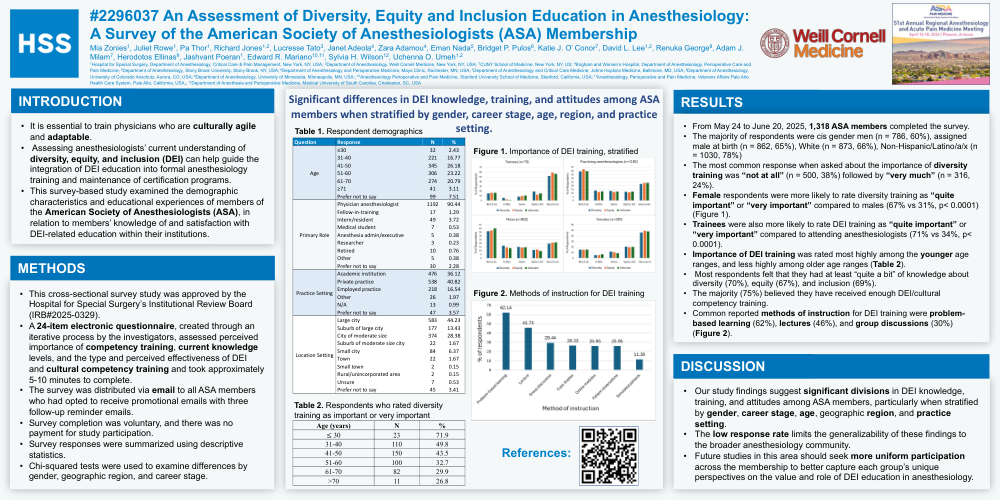
From May 24 to June 20, 2025, 1,318 ASA members completed the survey.
The majority of respondents were cis gender men (n = 786, 60%), assigned male at birth (n = 862, 65%), White (n = 873, 66%), Non-Hispanic/Latino/a/x (n = 1030, 78%)
The most common response when asked about the importance of diversity training was “not at all” (n = 500, 38%) followed by “very much” (n = 316, 24%).
Female respondents were more likely to rate diversity training as “quite important” or “very important” compared to males (67% vs 31%, p< 0.0001) (Figure 1).
Trainees were also more likely to rate DEI training as “quite important” or “very important” compared to attending anesthesiologists (71% vs 34%, p< 0.0001).
Importance of DEI training was rated most highly among the younger age ranges, and less highly among older age ranges (Table 2).
Most respondents felt that they had at least “quite a bit” of knowledge about diversity (70%), equity (67%), and inclusion (69%).
The majority (75%) believed they have received enough DEI/cultural competency training.
Common reported methods of instruction for DEI training were problem-based learning (62%), lectures (46%), and group discussions (30%) (Figure 2).
Discussion
Our study findings suggest significant differences in DEI knowledge, training, and attitudes among ASA members, particularly when stratified by gender, career stage, age, geographic region, and practice setting.
•The low response rate limits the generalizability of these findings to the broader anesthesiology community.
•Future studies in this area should seek more uniform participation across the membership to better capture each group’s unique perspectives on the value and role of DEI education in anesthesiology.