395 posters, 1 audios, 13 topics, 29 sessions, 1,056 authors, 461 institutions
ePostersLive by SciGen Technologies S.A. All rights reserved.
51st Annual Regional Anesthesiology and Acute Pain Medicine Meeting
April 16 - 18, 2026 | Phoenix, Arizona

2315837
Multiport Rectus Sheath Catheters as an Alternative Analgesic Strategy After Midline Laparotomy
Poster Presenter
Authors
Affiliations
Part of Topic
Scientific Abstracts > Acute Pain
Introduction
Abdominal wall plane blocks reduce postoperative pain scores and opioid consumption. Rectus sheath blocks are increasingly used for patients undergoing laparotomy, who are at risk for significant postoperative pain and delayed return of bowel function. Multiport catheter techniques offer an alternative to epidural analgesia, particularly in patients with contraindications such as anticoagulation or technically difficult placement (1). We describe a patient who received bilateral multiport rectus sheath catheters after laparotomy for postoperative analgesia.
Case Report
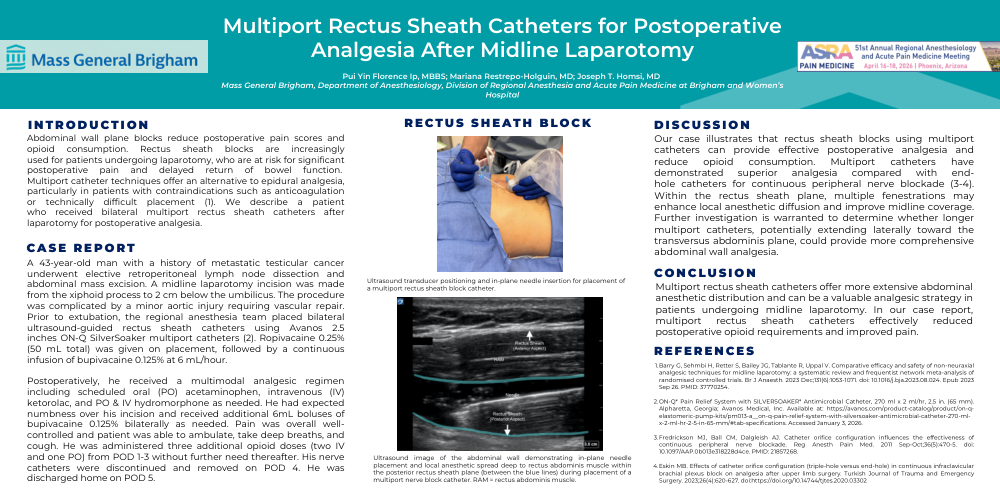
A 43-year-old man with a history of metastatic testicular cancer underwent elective retroperitoneal lymph node dissection and abdominal mass excision. A midline laparotomy incision was made from the xiphoid process to 2 cm below the umbilicus. The procedure was complicated by a minor aortic injury requiring vascular repair. Prior to extubation, the regional anesthesia team placed bilateral ultrasound-guided rectus sheath catheters using Avanos 2.5 inches ON-Q SilverSoaker multiport catheters (2). Ropivacaine 0.25% (50 mL total) was given on placement, followed by a continuous infusion of bupivacaine 0.125% at 6 mL/hour.
Postoperatively, he received a multimodal analgesic regimen including scheduled oral (PO) acetaminophen, intravenous (IV) ketorolac, and PO & IV hydromorphone as needed. He had expected numbness over his incision and received additional 6mL boluses of bupivacaine 0.125% bilaterally as needed. Pain was overall well-controlled and patient was able to ambulate, take deep breaths, and cough. He was administered three additional opioid doses (two IV and one PO) from POD 1-3 without further need thereafter. His nerve catheters were discontinued and removed on POD 4. He was discharged home on POD 5.
Discussion
Our case illustrates that rectus sheath blocks using multiport catheters can provide effective postoperative analgesia and reduce opioid consumption. Multiport catheters have demonstrated superior analgesia compared with end-hole catheters for continuous peripheral nerve blockade (3-4). Within the rectus sheath plane, multiple fenestrations may enhance local anesthetic diffusion and improve midline coverage. Further investigation is warranted to determine whether longer multiport catheters, potentially extending laterally toward the transversus abdominis plane, could provide more comprehensive abdominal wall analgesia.
Conclusion
Multiport rectus sheath catheters offer more extensive abdominal anesthetic distribution and can be a valuable analgesic strategy in patients undergoing midline laparotomy. In our case report, multiport rectus sheath catheters effectively reduced postoperative opioid requirements and improved pain.
References
1. Barry G, Sehmbi H, Retter S, Bailey JG, Tablante R, Uppal V. Comparative efficacy and safety of non-neuraxial analgesic techniques for midline laparotomy: a systematic review and frequentist network meta-analysis of randomised controlled trials. Br J Anaesth. 2023 Dec;131(6):1053-1071. doi: 10.1016/j.bja.2023.08.024. Epub 2023 Sep 26. PMID: 37770254.
2. ON-Q* Pain Relief System with SILVERSOAKER* Antimicrobial Catheter, 270 ml x 2 ml/hr, 2.5 in. (65 mm). Alpharetta, Georgia; Avanos Medical, Inc. Available at: https://avanos.com/product-catalog/product/on-q-elastomeric-pump-kits/pm013-a__on-q-pain-relief-system-with-silversoaker-antimicrobial-catheter-270-ml-x-2-ml-hr-2-5-in-65-mm/#tab-specifications. Accessed January 3, 2026.
3. Fredrickson MJ, Ball CM, Dalgleish AJ. Catheter orifice configuration influences the effectiveness of continuous peripheral nerve blockade. Reg Anesth Pain Med. 2011 Sep-Oct;36(5):470-5. doi: 10.1097/AAP.0b013e318228d4ce. PMID: 21857268.
4. Eskin MB. Effects of catheter orifice configuration (triple-hole versus end-hole) in continuous infraclavicular brachial plexus block on analgesia after upper limb surgery. Turkish Journal of Trauma and Emergency Surgery. 2023;26(4):620-627. doi:https://doi.org/10.14744/tjtes.2020.03302