206 posters, 13 topics, 5 sessions, 713 authors, 294 institutions
ePostersLive by SciGen Technologies S.A. All rights reserved.
AAPS 104th Annual Meeting
May 2-5, 2026 | Lihue, HI

D13
Resident Education Of Free Flap Monitoring: A Two-year Evaluation Of An Online Learning Module
Poster Presenter
Authors
Shelby Chun Fat, Shuyan Wei, Hamzah Almadani, Farin Amersi, Philip Brazio
Affiliations
Part of Topic
Education and Practice Management
Introduction: Vascular compromise of free flaps most commonly occurs within 48 hours postoperatively1. Re-exploration salvage rates are ~70%2. Meticulous monitoring is essential for early detection. Most studies in the literature focus on educating nurses in postoperative flap monitoring. At many institutions, off-service residents care for these patients overnight. This knowledge gap is an opportunity to adapt and tailor the nursing educational framework for residents. We created a time-efficient, multi-component online module to improve first-year residents’ competency in free flap monitoring. This study aimed to evaluate the effectiveness of each component in improving knowledge and self-reported comfort levels.
Methods: Residents cross-covering plastic surgery patients at Cedars-Sinai Medical center (Los Angeles, CA) were included. These included general surgery, neurosurgery, urology, anesthesia, podiatry, ENT, orthopedic, and cardiothoracic surgery residents. For 2 years (2024-2025), they were assigned: 1) Online module: Pamphlet, 11-minute PowerPoint presentation, supplemental videos and 2) 1.5 hour in-person session with hands-on clinical experience with dopplers. Participants were asked to complete background questions, comfort level surveys (before and after), knowledge-based quizzes (before and after), and feedback questions. Statistical analysis was performed with R software.
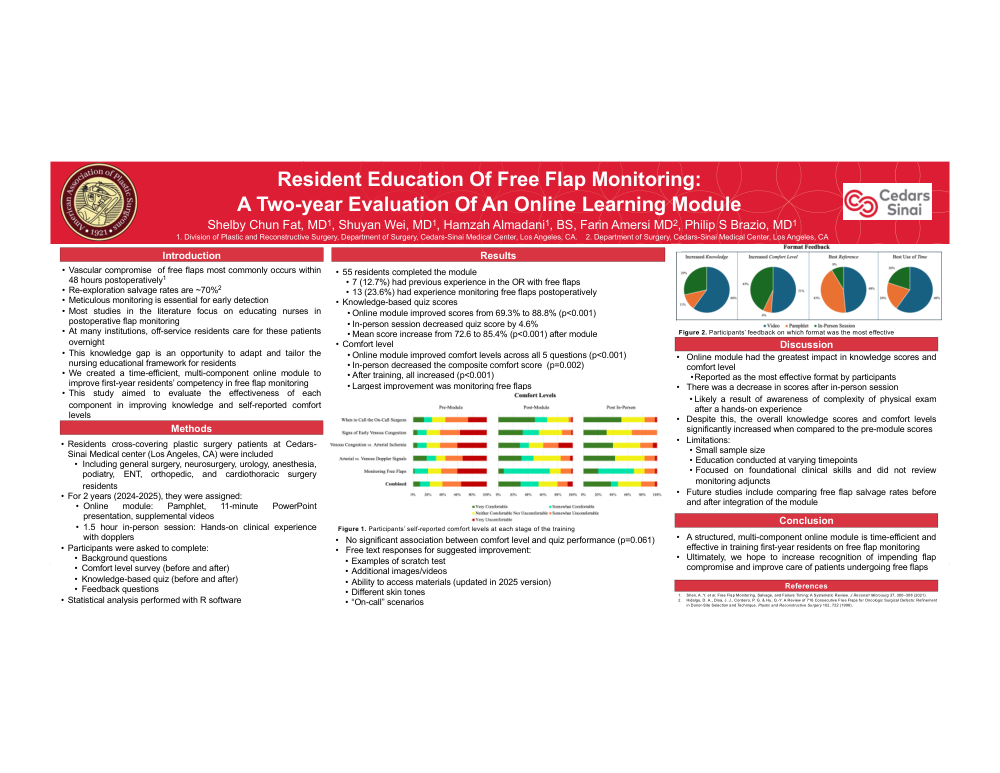
Results: 55 residents completed the module. 7 (12.7%) had previous experience in the OR with free flaps and 13 (23.6%) had experience monitoring free flaps postoperatively. The online module improved knowledge scores from 69.3% to 88.8% (p<0.001). After the in-person session the quiz score decreased by 4.6%. The mean knowledge score increased from 72.6 to 85.4% (p<0.001) after the module. The online module improved the comfort levels across all 5 questions (p<0.001). After the in-person session, the composite comfort score decreased (p=0.002). However, after the entire training, all comfort levels increased (p<0.001) with the largest improvement in monitoring free flaps. There was no significant association between comfort level and quiz performance (p=0.061). The free text responses for suggested improvement included: examples of scratch test, additional images/videos, ability to access materials (updated in 2025 version), different skin tones, and “on-call” scenarios.
Discussion: The online module had the greatest impact in knowledge scores and comfort level. This was also reported as the most effective format by participants. There was a decrease in scores after in-person session, which was likely a result of awareness of complexity of physical exam after a hands-on experience. Despite this, the overall knowledge scores and comfort levels significantly increased when compared to the pre-module scores. Some of the limitations include a small sample size, education conducted at varying timepoints, and a focus on foundational clinical skills without reviewing monitoring adjuncts. Future studies include comparing free flap salvage rates before and after integration of the module.
Conclusion: A structured, multi-component online module is time-efficient and effective in training first-year residents on free flap monitoring. Ultimately, we hope to increase recognition of impending flap compromise and improve care of patients undergoing free flaps.