206 posters, 13 topics, 5 sessions, 713 authors, 294 institutions
ePostersLive by SciGen Technologies S.A. All rights reserved.
AAPS 104th Annual Meeting
May 2-5, 2026 | Lihue, HI

PC28
Microtia Reconstruction In Facio-auriculo-vertebral Spectrum: A 20-year Experience
Poster Presenter
Authors
Janey Lee, Lucy Sheahan, Avery Apostle, Jenna Stelmar, Melissa Kanack, Benjamin Massenburg, Amanda Gosman
Affiliations
Part of Topic
Craniofacial/Peds
Objectives:
•Measure prevalence and type of auricular anomalies in facio-auriculo-vertebral spectrum (FAV)
•Assess surgical management of FAV, focusing on microtia reconstruction
Methods:
•Retrospective review
•Patients with FAV seen by Craniofacial team or Genetics Dysmorphology (1999-2025)
•Cohort
on = 201
oMedian age at presentation 0.6 years [IQR 0.2–1.9]
oMedian age at last follow-up 9.5 years [IQR 3.9–15.2]
•Variables
oCraniofacial features
oSurgical history
•Analysis
oDescriptive statistics
oANOVA compared number of surgeries and age at surgery
Results:
201 patients with FAV
→ Mean of 3.1 surgeries (SD 3.9); 74% of patients (n=148) had ≥1 surgery
→ Mean of 1.9 craniofacial surgeries (SD 2.7); 61% of patients (n=123) had ≥1 craniofacial surgery
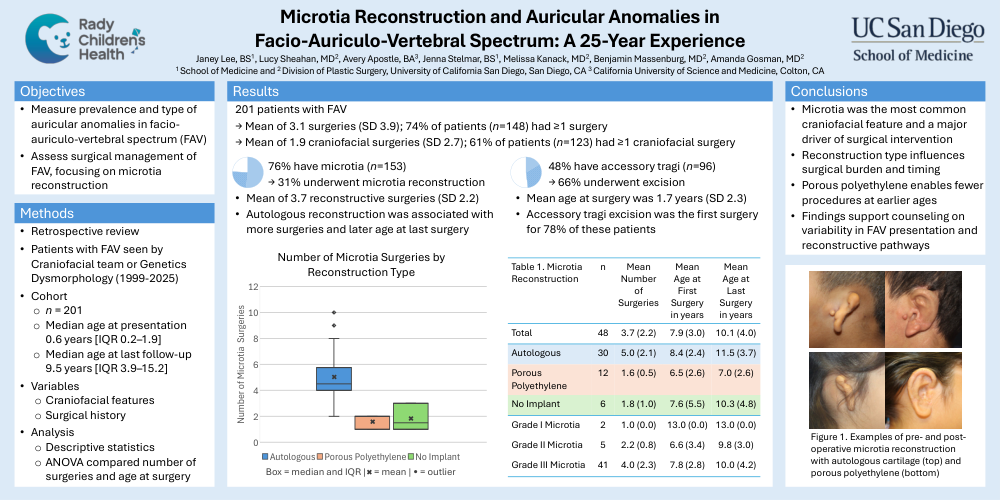
76% have microtia (n=153)
→ 31% underwent microtia reconstruction
•Mean of 3.7 reconstructive surgeries (SD 2.2)
•Autologous reconstruction was associated with more surgeries and later age at last surgery
48% have accessory tragi (n=96)
→ 66% underwent excision
•Mean age at surgery was 1.7 years (SD 2.3)
•Accessory tragi excision was the first surgery for 78% of these patients
Conclusions:
•Microtia was the most common craniofacial feature and a major driver of surgical intervention
•Reconstruction type influences surgical burden and timing
•Porous polyethylene enables fewer procedures at earlier ages
•Findings support counseling on variability in FAV presentation and reconstructive pathways