206 posters, 13 topics, 5 sessions, 713 authors, 294 institutions
ePostersLive by SciGen Technologies S.A. All rights reserved.
AAPS 104th Annual Meeting
May 2-5, 2026 | Lihue, HI

D67
Patient Reported Outcome Measures Following Breast Reconstruction: A Systematic Review And Meta-analysis Utilizing The Breast-Q
Poster Presenter
Authors
Jonathan Mokhtar, Fatemeh Akbarpoor, Karen Blanco, Emanuele Batista, Hanin Al-Kilani, Guilherme Machado, Juliana Oliveria, Abanob Attalah, Sara Vidha, Lucas Kreutz-Rodrigues, Aparna Vijayasekaran, Alexandre Lellouch, Curtis Cetrulo, Krishna Vyas, Mario Cherubino, Raffi Gurunian
Affiliations
Mohammed Bin Rashid University of Medicine and Health Sciences,
Part of Topic
Aesthetic Breast/Body Contouring
Background
Patient-reported outcome measures (PROMs) play a crucial role in evaluating the success of breast reconstruction. The BREAST-Q provides a standardized measure of satisfaction and quality of life; however, comparative outcomes between autologous– and implant-based breast reconstruction (ABBR and IBBR) remain incompletely defined. This meta-analysis compared PROMs between ABBR and IBBR using the BREAST-Q.
Methods
A systematic search of PubMed, Embase, Scopus, Web of Science, and CENTRAL was conducted from database inception through May 2025. Studies comparing PROMs using the BREAST-Q in patients undergoing ABBR vs. IBBR were included. Pooled analyses were performed using a random-effects model, risk of bias was assessed with ROBINS-I and RoB 2.0, and certainty of evidence was assessed with GRADE.
Results
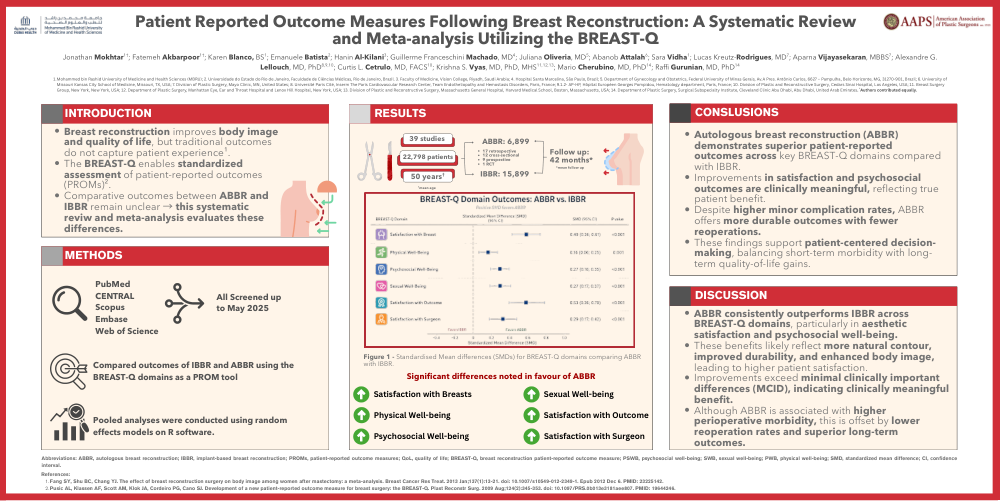
Thirty-nine studies comprising 22,798 patients (6,899 ABBR; 15,899 IBBR) were included. ABBR was associated with significantly higher satisfaction with breasts (SMD, 0.49; 95% CI [0.36–0.61]; p < 0.001), psychosocial well-being (SMD, 0.27; 95% CI [0.18–0.35]; p < 0.001), satisfaction with outcome (SMD, 0.53; 95% CI [0.36–0.70]; p < 0.001), and sexual well-being (0.27; 95% CI [0.17–0.37]; p < 0.001). Physical well-being differences were modest (SMD, 0.16; 95% CI [0.06–0.25]; p = 0.001). ABBR was associated with higher rates of minor complications (OR 2.44) but lower reoperation rates (OR 0.38).
Conclusion
Autologous reconstruction was associated with higher patient-reported outcome measures and clinically meaningful advantages in the aesthetic and overall outcome domains. These findings support individualized reconstructive decision-making that balances early morbidity against long-term quality-of-life benefit.