206 posters, 13 topics, 5 sessions, 713 authors, 294 institutions
ePostersLive by SciGen Technologies S.A. All rights reserved.
AAPS 104th Annual Meeting
May 2-5, 2026 | Lihue, HI

D66
National Trends And Outcomes In Breast Implant Removal And Exchange Across Surgical Indications
Poster Presenter
Part of Topic
Aesthetic Breast/Body Contouring
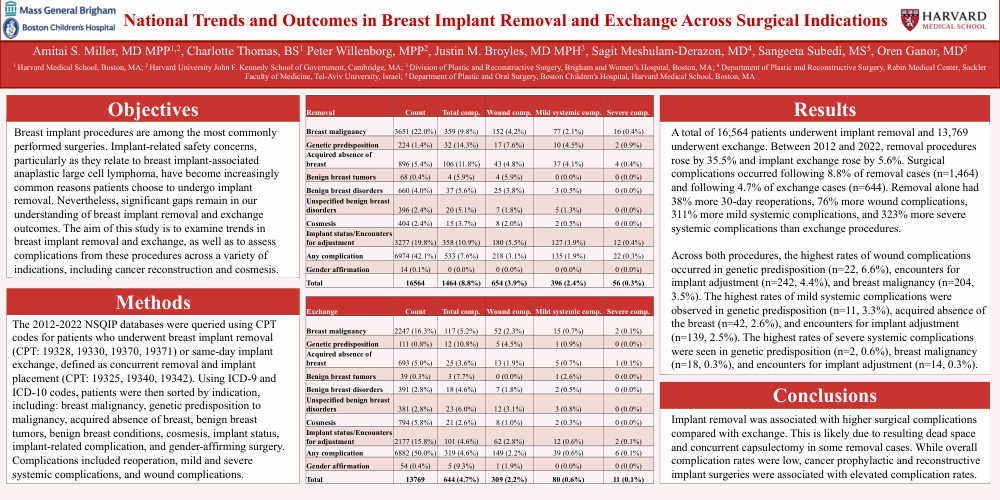
Objectives: Breast implant procedures are among the most commonly performed surgeries. Implant-related safety concerns, particularly as they relate to breast implant-associated anaplastic large cell lymphoma,have become increasinglycommon reasons patients choose to undergo implant removal. Nevertheless, significant gaps remain in our understanding of breast implant removal and exchange outcomes. The aim of this study is to examine trends in breast implant removal and exchange, as well as to assess complications from these procedures across a variety of indications, including cancer reconstruction and cosmesis.
Methods: The 2012-2022 NSQIP databases were queried using CPT codes for patients who underwent breast implant removal (CPT: 19328, 19330, 19370, 19371) or same-day implant exchange, defined as concurrent removal and implant placement (CPT: 19325, 19340, 19342). Using ICD-9 and ICD-10 codes, patients were then sorted by indication, including: breast malignancy, genetic predisposition to malignancy, acquired absence of breast, benign breast tumors, benign breast conditions, cosmesis, implant status, implant-related complication, and gender-affirming surgery.
Complications included reoperation, mild and severe systemic complications, and wound complications.
Results: A total of 16,564 patients underwent implant removal and 13,769 underwent exchange. Between 2012 and 2022, removal procedures rose by 35.5% and implant exchange rose by 5.6%. Surgical complications occurred following 8.8% of removal cases (n=1,464) and following 4.7% of exchange cases (n=644). Removal alone had 38% more 30-day reoperations, 76% more wound complications, 311% more mild systemic complications, and 323% more severe systemic complications than exchange procedures.
Across both procedures, the highest rates of wound complications occurred in genetic predisposition (n=22, 6.6%), encounters for implant adjustment (n=242, 4.4%), and breast malignancy (n=204, 3.5%). The highest rates of mild systemic complications were observed in genetic predisposition (n=11, 3.3%), acquired absence of the breast (n=42, 2.6%), and encounters for implant adjustment (n=139, 2.5%). The highest rates of severe systemic complications were seen in genetic predisposition (n=2, 0.6%), breast malignancy (n=18, 0.3%), and encounters for implant adjustment (n=14, 0.3%).
Conclusions: Implant removal was associated with higher surgical complications compared with exchange. This is likely due to resulting dead space and concurrent capsulectomy in some removal cases. While overall complication rates were low, cancer prophylactic and reconstructive implant surgeries were associated with elevated complication rates.