193 posters, 19 videos, 10 audios, 3 topics, 28 sessions, 714 authors, 278 institutions
ePostersLive by SciGen Technologies S.A. All rights reserved.
9th World Congress on Vascular Access 2026
15 - 17 April, 2026 | Valencia, Spain

372
pH and osmolarity of antibiotics administered via elastomeric pumps in OPAT: implications for venous tolerance and catheter choice
Poster Presenter
Part of Topic
pH and osmolarity of antibiotics administered via elastomeric pumps in OPAT: implications for venous tolerance and catheter choice:
Introduction & Objective
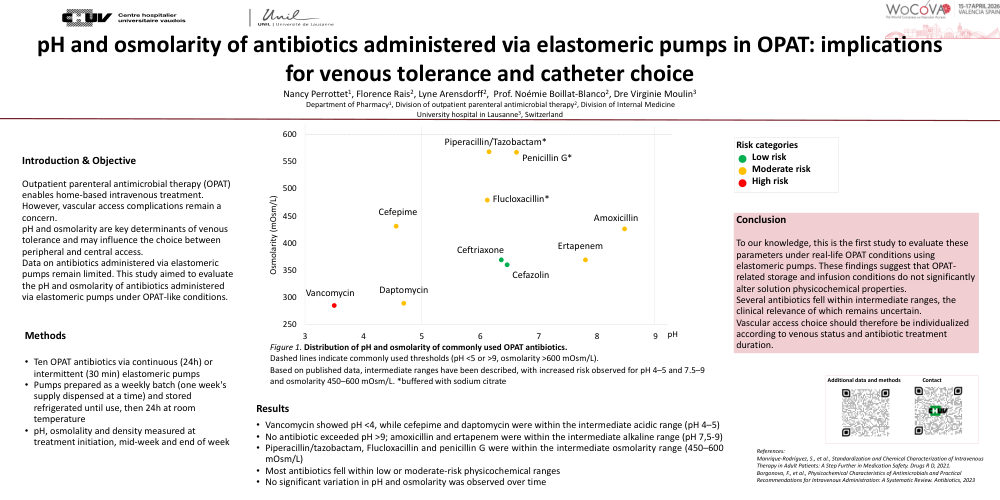
Outpatient parenteral antimicrobial therapy (OPAT) enables home-based intravenous treatment.However, vascular access complications remain a concern. pH and osmolarity are key determinants of venous tolerance and may influence the choice between peripheral and central access. Data on antibiotics administered via elastomeric pumps remain limited. This study aimed to evaluate the pH and osmolarity of antibiotics administered via elastomeric pumps under OPAT-like conditions
Methods
Results
Conclusion
To our knowledge, this is the first study to evaluate these parameters under real-life OPAT conditions using elastomeric pumps. These findings suggest that OPAT-related storage and infusion conditions do not significantly alter solution physicochemical properties.
Several antibiotics fell within intermediate ranges, the clinical relevance of which remains uncertain.
Vascular access choice should therefore be individualized according to venous status and antibiotic treatment duration.