1,267 posters, 47 videos, 13 topics, 4 sessions, 853 authors
ePostersLive by SciGen Technologies S.A. All rights reserved.
SOHO 2026 Annual Meeting
September 9 - 12, 2026 | George R. Brown Convention Center, Houston, Texas

CML - 1754
Pulmonary Embolism as a Contributing Cause of Death in U.S. Hematologic Malignancy Patients: A 26-Year National Trend Analysis Using CDC WONDER Multiple Cause-of-Death Data (1999-2024)
Poster Presenter
Authors
Part of Topic
Chronic Myeloid Leukemia (CML)
Pulmonary Embolism as a Contributing Cause of Death in U.S Hematologic Malignancy Patients: A 26-Year National Trend Analysis Using CDC WONDER Database (1999-2024) Shrusty Patil, Hardik Jain, Akshata Vaggar, Nilay Solanki, Vruti Patel, Yash Trivedi, Kevin Patel, Hardik Desai, Vishrant Amin Presenter Affiliation: Raichur Institute of Medical Sciences, Raichur, Karnataka, India
Background: : Pulmonary Embolism (PE) is a life-threatening thromboembolic complication disproportionately affecting patients with hematologic malignancies. Despite clinical evidence linking hypercoagulable states in blood cancers to venous thromboembolism-related mortality, large scale national trend data quantifying PE as a contributing cause of death remain sparse.
Method : Using CDC WONDER multiple cause of death database, we evaluated deaths due to hematologic malignancy as the underlying cause and PE as a contributing cause by age, sex, year, race, location from 1999 to 2024.
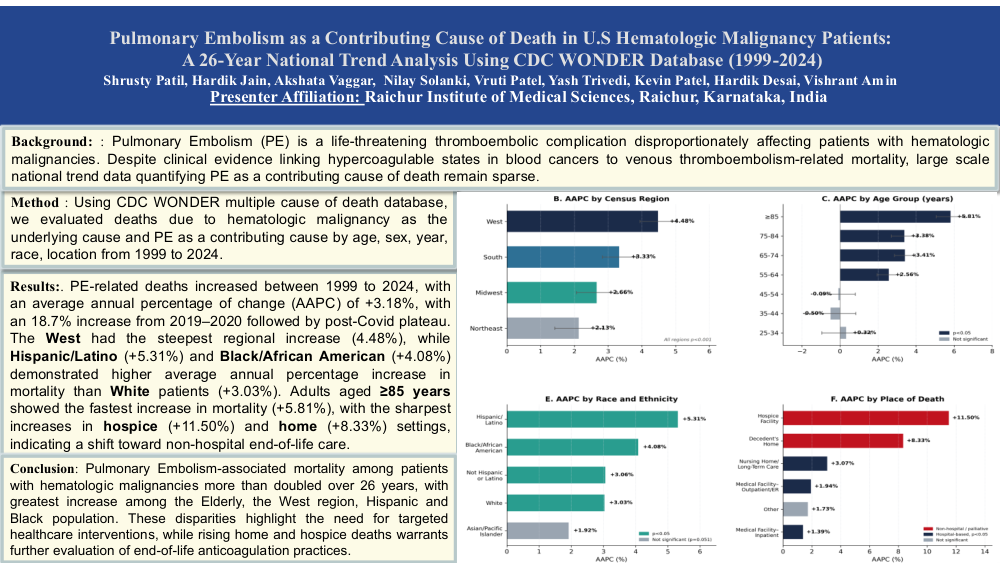
Results:. PE-related deaths increased between 1999 to 2024, with an average annual percentage of change (AAPC) of +3.18%, with an 18.7% increase from 2019–2020 followed by post-Covid plateau. The West had the steepest regional increase (4.48%), while Hispanic/Latino (+5.31%) and Black/African American (+4.08%) demonstrated higher average annual percentage increase in mortality than White patients (+3.03%). Adults aged ≥85 years showed the fastest increase in mortality (+5.81%), with the sharpest increases in hospice (+11.50%) and home (+8.33%) settings, indicating a shift toward non-hospital end-of-life care.
Conclusion: Pulmonary Embolism-associated mortality among patients with hematologic malignancies more than doubled over 26 years, with greatest increase among the Elderly, the West region, Hispanic and Black population. These disparities highlight the need for targeted healthcare interventions, while rising home and hospice deaths warrants further evaluation of end-of-life anticoagulation practices