1,267 posters, 47 videos, 13 topics, 4 sessions, 853 authors
ePostersLive by SciGen Technologies S.A. All rights reserved.
SOHO 2026 Annual Meeting
September 9 - 12, 2026 | George R. Brown Convention Center, Houston, Texas

CT - 1718
Clinical Features and Outcomes of Transplant-Associated Thrombotic Microangiopathy Following Haploidentical Allogenic Stem Cell Transplantation
Poster Presenter
Authors
Part of Topic
Cellular Therapy (CT)
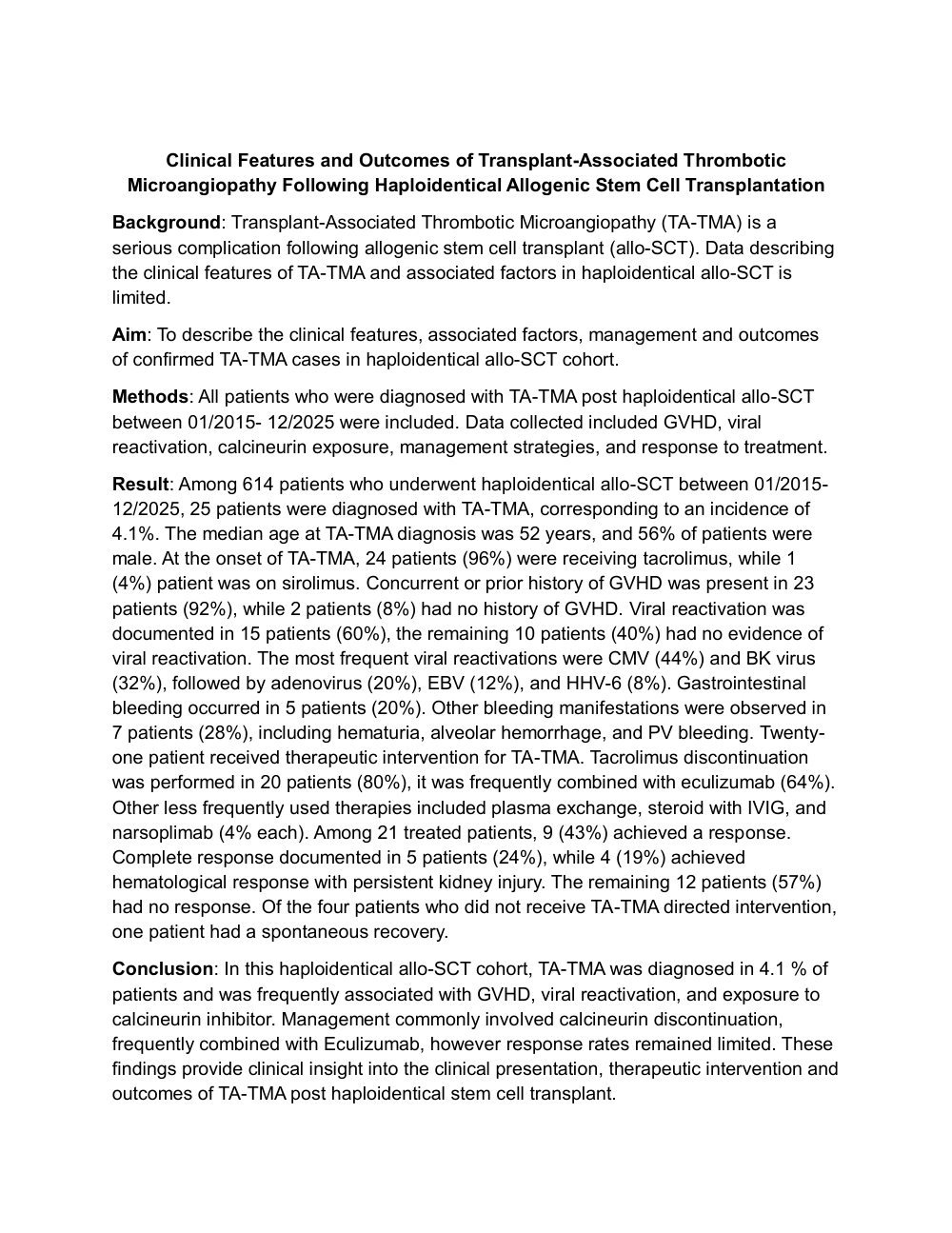
Clinical Features and Outcomes of Transplant-Associated Thrombotic Microangiopathy Following Haploidentical Allogenic Stem Cell Transplantation
Background: Transplant-Associated Thrombotic Microangiopathy (TA-TMA) is a serious complication following allogenic stem cell transplant (allo-SCT). Data describing the clinical features of TA-TMA and associated factors in haploidentical allo-SCT is limited.
Aim: To describe the clinical features, associated factors, management and outcomes of confirmed TA-TMA cases in haploidentical allo-SCT cohort.
Methods: All patients who were diagnosed with TA-TMA post haploidentical allo-SCT between 01/2015- 12/2025 were included. Data collected included GVHD, viral reactivation, calcineurin exposure, management strategies, and response to treatment.
Result: Among 614 patients who underwent haploidentical allo-SCT between 01/2015- 12/2025, 25 patients were diagnosed with TA-TMA, corresponding to an incidence of 4.1%. The median age at TA-TMA diagnosis was 52 years, and 56% of patients were male. At the onset of TA-TMA, 24 patients (96%) were receiving tacrolimus, while 1 (4%) patient was on sirolimus. Concurrent or prior history of GVHD was present in 23 patients (92%), while 2 patients (8%) had no history of GVHD. Viral reactivation was documented in 15 patients (60%), the remaining 10 patients (40%) had no evidence of viral reactivation. The most frequent viral reactivations were CMV (44%) and BK virus (32%), followed by adenovirus (20%), EBV (12%), and HHV-6 (8%). Gastrointestinal bleeding occurred in 5 patients (20%). Other bleeding manifestations were observed in 7 patients (28%), including hematuria, alveolar hemorrhage, and PV bleeding. Twenty-one patient received therapeutic intervention for TA-TMA. Tacrolimus discontinuation was performed in 20 patients (80%), it was frequently combined with eculizumab (64%). Other less frequently used therapies included plasma exchange, steroid with IVIG, and narsoplimab (4% each). Among 21 treated patients, 9 (43%) achieved a response. Complete response documented in 5 patients (24%), while 4 (19%) achieved hematological response with persistent kidney injury. The remaining 12 patients (57%) had no response. Of the four patients who did not receive TA-TMA directed intervention, one patient had a spontaneous recovery.
Conclusion: In this haploidentical allo-SCT cohort, TA-TMA was diagnosed in 4.1 % of patients and was frequently associated with GVHD, viral reactivation, and exposure to calcineurin inhibitor. Management commonly involved calcineurin discontinuation, frequently combined with Eculizumab, however response rates remained limited. These findings provide clinical insight into the clinical presentation, therapeutic intervention and outcomes of TA-TMA post haploidentical stem cell transplant.