1,267 posters, 47 videos, 13 topics, 4 sessions, 853 authors
ePostersLive by SciGen Technologies S.A. All rights reserved.
SOHO 2026 Annual Meeting
September 9 - 12, 2026 | George R. Brown Convention Center, Houston, Texas

MPN - 1673
Hypocellular Bone Marrow as an Independent Adverse Prognostic Feature in Primary Myelofibrosis: A Real-World Analysis of 241 Patients
Poster Presenter
Authors
Part of Topic
Myeloproliferative Neoplasms (MPN)
Hypocellular Bone Marrow as an Independent Adverse Prognostic Feature
in Primary Myelofibrosis: A Real-World Analysis of 241 Patients
Elmir Guluyev, MD (1,2); Madad Abbasov, MD (1); Gulnar Garayeva, MD (2);
Azer Kerimov, MD, PhD (2)
(1) Main Clinical Hospital of the Ministry of Defense of Azerbaijan,
Department of Hematology, Baku, Azerbaijan
(2) National Hematology and Transfusiology Center, Baku, Azerbaijan
BACKGROUND
Primary myelofibrosis (PMF) encompasses a spectrum of myeloproliferative
and myelodepletive/cytopenic phenotypes with distinct clinical and
biological features. The myelodepletive phenotype is characterized by
cytopenias, advanced marrow fibrosis and inferior outcomes, and is more
frequently associated with hypocellular bone marrow. Although cytopenic
PMF is recognized as a high-risk phenotype, the prognostic contribution
of bone marrow hypocellularity itself remains incompletely defined in
contemporary PMF cohorts.
AIM
To test whether hypocellular bone marrow identifies a distinct high-risk
PMF subgroup beyond standard IPSS risk stratification. Primary endpoint:
overall survival by bone marrow cellularity.
METHODS
241 consecutive patients with primary myelofibrosis were analysed. Bone
marrow cellularity data were available in 212 patients (hypercellular
n=166, hypocellular n=45; one normocellular case excluded). Baseline
clinical and laboratory characteristics were compared using the
Mann-Whitney U test and Fisher exact test. Overall survival was
calculated from diagnosis to death or last follow-up (71 deaths; median
follow-up 43 months) and analysed by the Kaplan-Meier method with the
log-rank test. Multivariable logistic regression evaluated the
association between bone marrow hypocellularity and mortality after
adjustment for clinical prognostic variables.
RESULTS
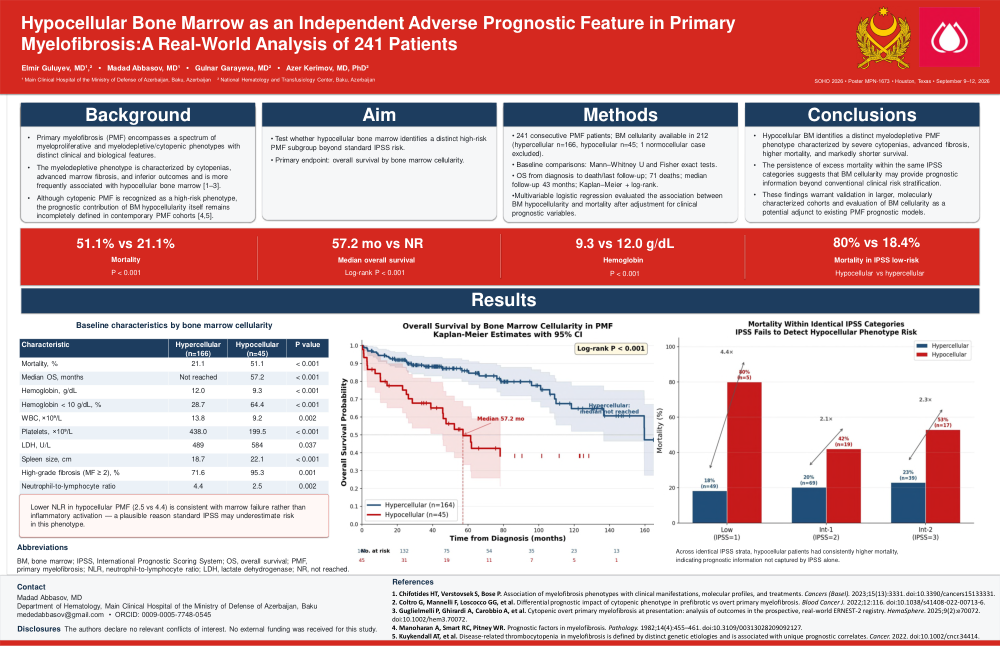
Mortality was 51.1% in hypocellular versus 21.1% in hypercellular
patients (P < 0.001). Median overall survival was 57.2 months in the
hypocellular group and was not reached in the hypercellular group
(log-rank P < 0.001).
Hypocellular patients showed significantly more severe cytopenias and
more advanced disease: median hemoglobin 9.3 versus 12.0 g/dL
(P < 0.001); hemoglobin below 10 g/dL in 64.4% versus 28.7%
(P < 0.001); white blood cell count 9.2 versus 13.8 x10^9/L (P = 0.002);
platelets 199.5 versus 438.0 x10^9/L (P < 0.001); LDH 584 versus
489 U/L (P = 0.037); spleen size 22.1 versus 18.7 cm (P < 0.001);
high-grade fibrosis (MF grade 2 or higher) in 95.3% versus 71.6%
(P = 0.001); neutrophil-to-lymphocyte ratio 2.5 versus 4.4 (P = 0.002).
Within identical IPSS categories, hypocellular patients had consistently
higher mortality: IPSS low risk 80.0% versus 18.4%, IPSS intermediate-1
42.1% versus 20.3%, and IPSS intermediate-2 52.9% versus 23.1%.
The lower neutrophil-to-lymphocyte ratio observed in hypocellular PMF is
consistent with marrow failure rather than inflammatory activation, and
offers a plausible reason why standard IPSS may underestimate risk in
this phenotype.
CONCLUSIONS
Hypocellular bone marrow identifies a distinct myelodepletive PMF
phenotype characterized by severe cytopenias, advanced fibrosis, higher
mortality and markedly shorter survival. The persistence of excess
mortality within the same IPSS categories suggests that bone marrow
cellularity may provide prognostic information beyond conventional
clinical risk stratification. These findings warrant validation in
larger, molecularly characterized cohorts, and evaluation of bone marrow
cellularity as a potential adjunct to existing PMF prognostic models.
KEYWORDS
Primary myelofibrosis; bone marrow cellularity; hypocellular bone
marrow; myelodepletive phenotype; cytopenic myelofibrosis; IPSS; risk
stratification; overall survival; neutrophil-to-lymphocyte ratio;
myeloproliferative neoplasms; real-world data; Azerbaijan