1,267 posters, 47 videos, 13 topics, 4 sessions, 853 authors
ePostersLive by SciGen Technologies S.A. All rights reserved.
SOHO 2026 Annual Meeting
September 9 - 12, 2026 | George R. Brown Convention Center, Houston, Texas

MDS - 1663
Beyond Leukemic Transformation: Excess Cardiovascular Mortality in a Two-Decade SEER Cohort of 84,806 Patients with Myelodysplastic Syndromes
Poster Presenter
Authors
Part of Topic
Myelodysplastic Syndromes (MDS)
Background
Myelodysplastic syndromes (MDS) are clonal hematopoietic neoplasms associated with substantial morbidity and mortality, particularly among older adults. Although leukemic transformation remains a major disease-related outcome, nonleukemic causes of death are increasingly recognized. Cardiovascular disease (CVD) can contribute substantially to mortality in patients with MDS due to advanced age, chronic inflammation, anemia-related physiologic stress, transfusion burden, iron overload, comorbidities, and treatment-related effects. Contemporary population-level estimates of excess cardiovascular mortality in MDS remain limited.
Methods
We conducted a retrospective population-based analysis of patients diagnosed with MDS using the Surveillance, Epidemiology, and End Results (SEER) database from 2000–2021. Cardiovascular mortality was defined using SEER cause-of-death categories, including diseases of the heart, hypertension-related cardiac disease, cerebrovascular disease, atherosclerosis, aortic aneurysm and dissection, and other arterial diseases. Expected cardiovascular deaths were derived from age-, sex-, and race-stratified cardiovascular mortality rates in the general US population. Standardized mortality ratios (SMRs) with 95% confidence intervals (CIs) were calculated overall and across demographic subgroups.
Results
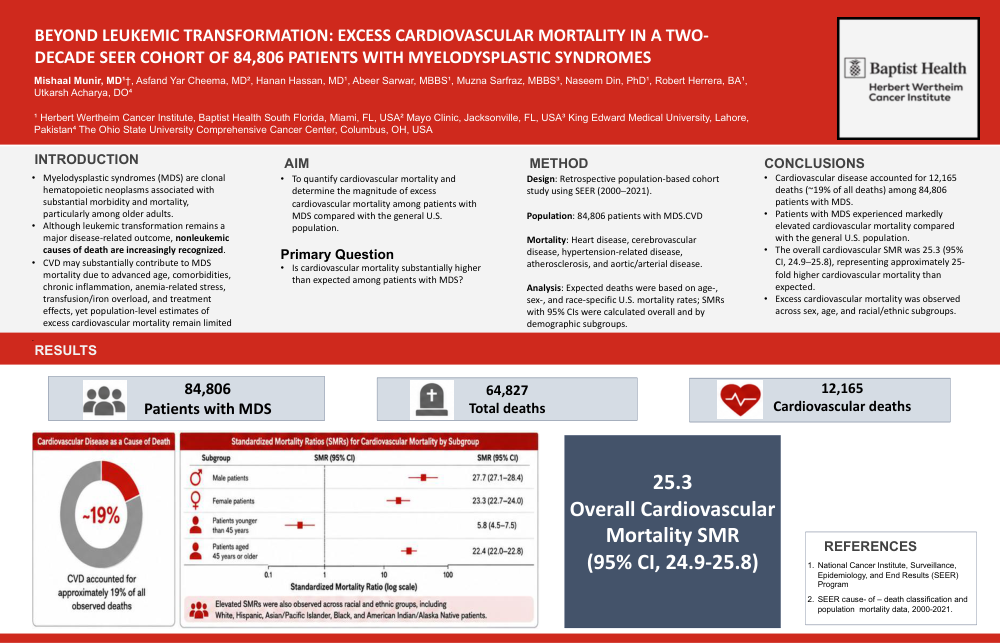
A total of 84806 patients with MDS were included. During the study period, 64827 deaths occurred, representing 76.4% of the cohort. Cardiovascular disease accounted for 12165 deaths, comprising approximately 19% of all observed deaths. Overall, patients with MDS experienced markedly elevated cardiovascular mortality compared with the general US population, with an SMR of 25.3 (95% CI, 24.9–25.8), indicating an approximately 25-fold higher cardiovascular mortality than expected. Excess cardiovascular mortality was observed across demographic subgroups, including male patients (SMR, 27.7; 95% CI, 27.1–28.4) and female patients (SMR, 23.3; 95% CI, 22.7–24.0). Patients younger than 45 years had an SMR of 5.8 (95% CI, 4.5–7.5), while those aged 45 years or older had an SMR of 22.4 (95% CI, 22.0–22.8). By race and ethnicity, elevated SMRs were observed among White, Hispanic, Asian/Pacific Islander, Black, and American Indian/Alaska Native patients.
Conclusion
In this large SEER-based cohort of 84806 patients with MDS, cardiovascular disease represented a major nonleukemic cause of death, accounting for nearly one-fifth of all mortality. These findings highlight the need for proactive cardiovascular risk assessment and cardio-oncology collaboration in MDS care.