1,267 posters, 47 videos, 13 topics, 4 sessions, 853 authors
ePostersLive by SciGen Technologies S.A. All rights reserved.
SOHO 2026 Annual Meeting
September 9 - 12, 2026 | George R. Brown Convention Center, Houston, Texas

CT - 1633
Comparison of Neurological Adverse Effects in 6 FDA approved CAR-T therapies
Poster Presenter
Authors
Part of Topic
Cellular Therapy (CT)
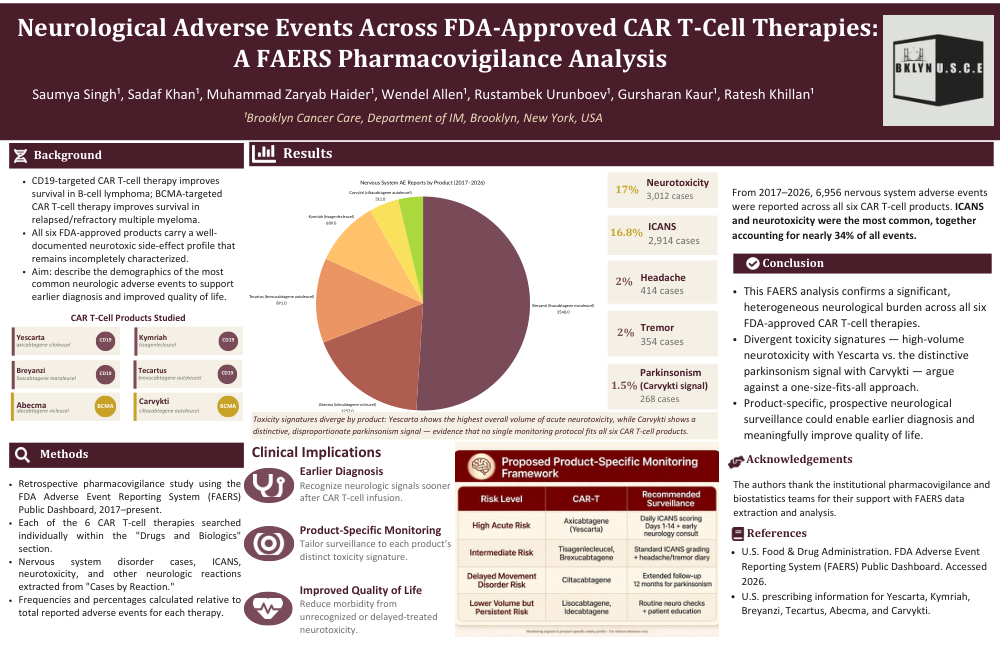
CD19-targeted CAR T-cell therapy improves survival in B-cell lymphoma; BCMA-targeted CAR T-cell therapy improves survival in relapsed/refractory multiple myeloma. All six FDA-approved products carry a welldocumented neurotoxic side-effect profile that remains incompletely characterized. Aim: describe the demographics of the most common neurologic adverse events to support earlier diagnosis and improved quality of life. CAR T-Cell Products Studied Breyanzi lisocabtagene maraleucel CD19 Abecma BCMA idecabtagene vicleucel ciltacabtagene autoleucel Carvykti BCMA brexucabtagene autoleucel CD19 Tecartus axicabtagene ciloleucel CD19 Yescarta Kymriah tisagenlecleucel CD19 Methods Nervous System AE Reports by Product (2017–2026) Breyanzi (lisocabtagene maraleucel) 3548.0 Abecma (idecabtagene vicleucel) 1257.0 Tecartus (brexucabtagene autoleucel) 891.0 Kymriah (tisagenlecleucel) 689.0 Carvykti (ciltacabtagene autoleucel) 311.0 17% Neurotoxicity 3,012 cases 16.8% ICANS 2,914 cases 2% Headache 414 cases 2%Tremor 354 cases 1.5% Parkinsonism (Carvykti signal) 268 cases Toxicity signatures diverge by product: Yescarta shows the highest overall volume of acute neurotoxicity, while Carvykti shows a distinctive, disproportionate parkinsonism signal — evidence that no single monitoring protocol fits all six CAR T-cell products. Conclusion This FAERS analysis confirms a significant, heterogeneous neurological burden across all six FDA-approved CAR T-cell therapies. Divergent toxicity signatures — high-volume neurotoxicity with Yescarta vs. the distinctive parkinsonism signal with Carvykti — argue against a one-size-fits-all approach. Product-specific, prospective neurological surveillance could enable earlier diagnosis and meaningfully improve quality of life. Clinical Implications Earlier Diagnosis Recognize neurologic signals sooner after CAR T-cell infusion. Product-Specific Monitoring Tailor surveillance to each product’s distinct toxicity signature. Improved Quality of Life Reduce morbidity from unrecognized or delayed-treated neurotoxicity. Acknowledgements References Retrospective pharmacovigilance study using the FDA Adverse Event Reporting System (FAERS) Public Dashboard, 2017–present. Each of the 6 CAR T-cell therapies searched individually within the "Drugs and Biologics" section. Nervous system disorder cases, ICANS, neurotoxicity, and other neurologic reactions extracted from "Cases by Reaction." Frequencies and percentages calculated relative to total reported adverse events for each therapy. From 2017–2026, 6,956 nervous system adverse events were reported across all six CAR T-cell products. ICANS and neurotoxicity were the most common, together accounting for nearly 34% of all events. The authors thank the institutional pharmacovigilance and biostatistics teams for their support with FAERS data extraction and analysis. U.S. Food & Drug Administration. FDA Adverse Event Reporting System (FAERS) Public Dashboard. Accessed 2026. U.S. prescribing information for Yescarta, Kymriah, Breyanzi, Tecartus, Abecma, and Carvykti.