1,267 posters, 47 videos, 13 topics, 4 sessions, 853 authors
ePostersLive by SciGen Technologies S.A. All rights reserved.
SOHO 2026 Annual Meeting
September 9 - 12, 2026 | George R. Brown Convention Center, Houston, Texas

CT - 1619
Comparison of Adverse Effects in 6 FDA approved CAR-T therapies
Poster Presenter
Authors
Part of Topic
Cellular Therapy (CT)
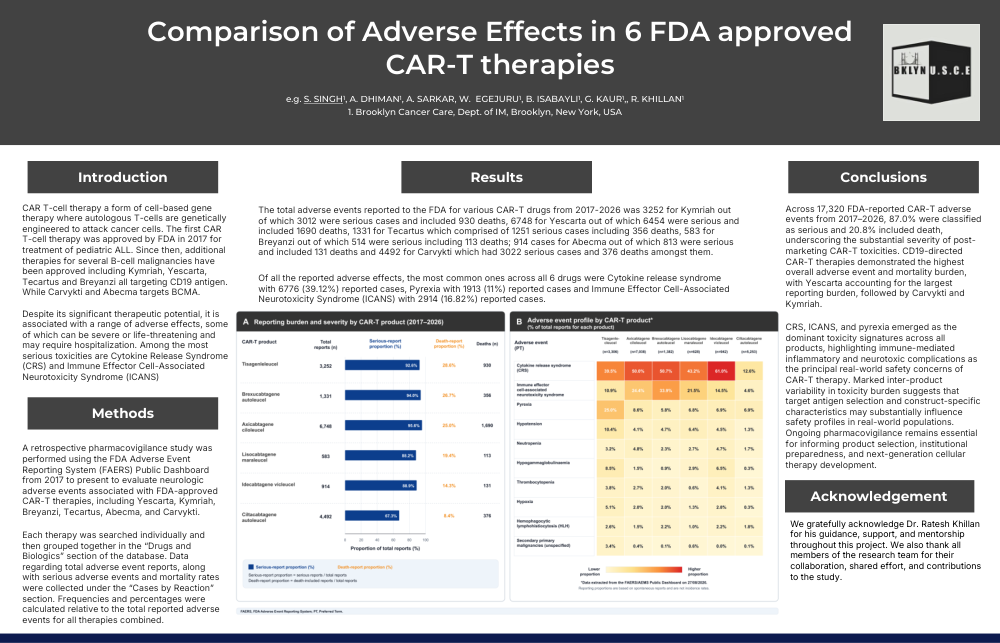
CAR T-cell therapy a form of cell-based gene therapy where autologous T-cells are genetically engineered to attack cancer cells. The first CAR T-cell therapy was approved by FDA in 2017 for treatment of pediatric ALL. Since then, additional therapies for several B-cell malignancies have been approved including Kymriah, Yescarta, Tecartus and Breyanzi all targeting CD19 antigen. While Carvykti and Abecma targets BCMA. Despite its significant therapeutic potential, it is associated with a range of adverse effects, some of which can be severe or life-threatening and may require hospitalization. Among the most serious toxicities are Cytokine Release Syndrome (CRS) and Immune Effector Cell-Associated Neurotoxicity Syndrome (ICANS) Methods A retrospective pharmacovigilance study was performed using the FDA Adverse Event Reporting System (FAERS) Public Dashboard from 2017 to present to evaluate neurologic adverse events associated with FDA-approved CAR-T therapies, including Yescarta, Kymriah, Breyanzi, Tecartus, Abecma, and Carvykti. Each therapy was searched individually and then grouped together in the “Drugs and Biologics” section of the database. Data regarding total adverse event reports, along with serious adverse events and mortality rates were collected under the “Cases by Reaction” section. Frequencies and percentages were calculated relative to the total reported adverse events for all therapies combined. The total adverse events reported to the FDA for various CAR-T drugs from 2017-2026 was 3252 for Kymriah out of which 3012 were serious cases and included 930 deaths, 6748 for Yescarta out of which 6454 were serious and included 1690 deaths, 1331 for Tecartus which comprised of 1251 serious cases including 356 deaths, 583 for Breyanzi out of which 514 were serious including 113 deaths; 914 cases for Abecma out of which 813 were serious and included 131 deaths and 4492 for Carvykti which had 3022 serious cases and 376 deaths amongst them. Of all the reported adverse effects, the most common ones across all 6 drugs were Cytokine release syndrome with 6776 (39.12%) reported cases, Pyrexia with 1913 (11%) reported cases and Immune Effector Cell-Associated Neurotoxicity Syndrome (ICANS) with 2914 (16.82%) reported cases. Across 17,320 FDA-reported CAR-T adverse events from 2017–2026, 87.0% were classified as serious and 20.8% included death, underscoring the substantial severity of postmarketing CAR-T toxicities. CD19-directed CAR-T therapies demonstrated the highest overall adverse event and mortality burden, with Yescarta accounting for the largest reporting burden, followed by Carvykti and Kymriah. CRS, ICANS, and pyrexia emerged as the dominant toxicity signatures across all products, highlighting immune-mediated inflammatory and neurotoxic complications as the principal real-world safety concerns of CAR-T therapy. Marked inter-product variability in toxicity burden suggests that target antigen selection and construct-specific characteristics may substantially influence safety profiles in real-world populations. Ongoing pharmacovigilance remains essential for informing product selection, institutional preparedness, and next-generation cellular therapy development. Acknowledgement We gratefully acknowledge Dr. Ratesh Khillan for his guidance, support, and mentorship throughout this project. We also thank all members of the research team for their collaboration, shared effort, and contributions to the study.