1,267 posters, 47 videos, 13 topics, 4 sessions, 853 authors
ePostersLive by SciGen Technologies S.A. All rights reserved.
SOHO 2026 Annual Meeting
September 9 - 12, 2026 | George R. Brown Convention Center, Houston, Texas

AML - 1536
Transfusion Patterns and Clinical Characteristics According to Treatment Strategy in Acute Myeloid Leukemia: A 5-Year Experience at a National Referral Oncology Center in Mexico
Poster Presenter
Authors
Part of Topic
Acute Myeloid Leukemia (AML)
INTRODUCTION
Acute myeloid leukemia (AML) frequently requires transfusion support due to disease-related cytopenias and treatment-associated myelosuppression. Patients receiving intensive and non-intensive therapies represent distinct clinical populations with different treatment trajectories and supportive care needs. Real-world data from Latin America remain limited.
AIM
To describe transfusion requirements and clinical characteristics according to treatment strategy among adult patients with AML treated at a national referral oncology center.
METHODS
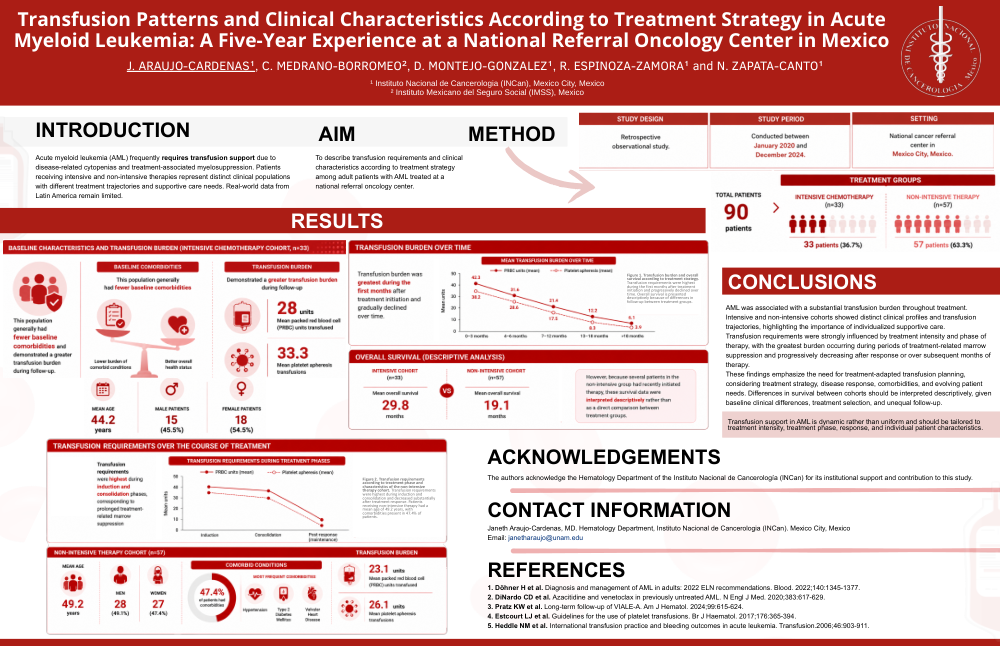
Retrospective observational study conducted between January 2020 and December 2024 at a national cancer referral center in Mexico City, Mexico. Consecutive adults aged ≥18 years diagnosed with AML were included. Clinical characteristics, treatment intensity, transfusion requirements, treatment response, and survival outcomes were analyzed.
RESULTS
Ninety patients were included: 33 received intensive chemotherapy and 57 received non-intensive therapy. The intensive cohort had a mean age of 44.2 years and included 15 men and 18 women. This group had fewer baseline comorbidities and required a mean of 28 packed red blood cell (PRBC) units and 33.3 platelet apheresis transfusions.
Patients receiving non-intensive therapy had a mean age of 49.2 years. Comorbidities were present in 47.4% of patients, with hypertension, type 2 diabetes mellitus, and valvular heart disease among the most frequent conditions. Mean transfusion requirements were 23.1 PRBC units and 26.1 platelet apheresis transfusions.
Transfusion requirements were highest during the early phases of treatment and progressively declined over time. Mean overall survival was 29.8 months in the intensive cohort and 19.1 months in the non-intensive cohort. Survival outcomes were interpreted descriptively because of baseline differences, treatment selection, and unequal follow-up between groups.
CONCLUSIONS
AML was associated with a substantial transfusion burden throughout treatment. Intensive and non-intensive cohorts showed distinct clinical profiles and transfusion trajectories, highlighting the importance of individualized supportive care.
Transfusion requirements were strongly influenced by treatment intensity and phase of therapy, with the greatest burden occurring during periods of treatment-related marrow suppression and progressively decreasing after response or over subsequent months of therapy.
These findings emphasize the need for treatment-adapted transfusion planning considering treatment strategy, disease response, comorbidities, and evolving patient needs. Differences in survival between cohorts should be interpreted descriptively given baseline clinical differences, treatment selection, and unequal follow-up.
Transfusion support in AML is dynamic rather than uniform and should be tailored to treatment intensity, treatment phase, response, and individual patient characteristics.