1,267 posters, 47 videos, 13 topics, 4 sessions, 853 authors
ePostersLive by SciGen Technologies S.A. All rights reserved.
SOHO 2026 Annual Meeting
September 9 - 12, 2026 | George R. Brown Convention Center, Houston, Texas

ABCL - 1515
Divergent Nodal and Extranodal Non-Hodgkin Lymphoma Latency Patterns Following Breast Cancer by Molecular Subtype: A Population-Based SEER Analysis
Poster Presenter
Authors
Part of Topic
Aggressive B-Cell Lymphoma (ABCL)
Breast cancer survivors may experience subsequent lymphoid malignancies, but whether non-Hodgkin lymphoma (NHL) risk differs by breast cancer molecular subtype, anatomic presentation, and latency remains incompletely characterized.
Using SEER Research Plus 17 data from 2010–2022, we evaluated women with a first primary invasive breast cancer and examined subsequent NHL according to nodal versus extranodal presentation, breast cancer molecular subtype, and latency after breast cancer diagnosis. Molecular subtypes included HR+/HER2+, HR−/HER2+, HR+/HER2−, and HR−/HER2−. Standardized incidence ratios (SIRs) with 95% confidence intervals were estimated using MP-SIR methodology across latency intervals of 2–11, 12–59, 60–119, and ≥120 months.
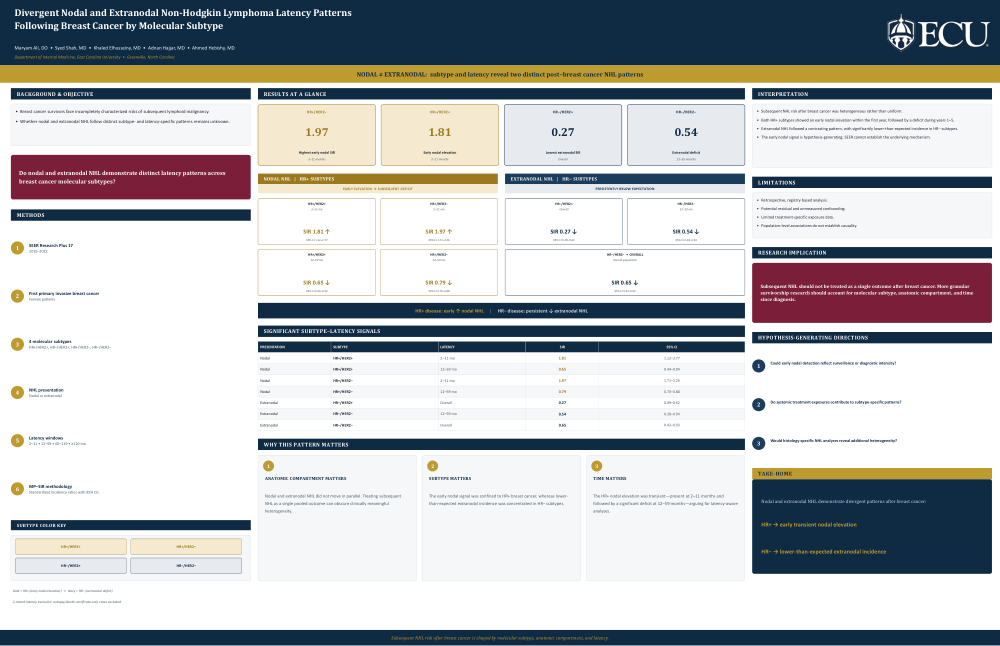
Distinct subtype- and latency-specific patterns emerged. For nodal NHL, both HR+ subtypes demonstrated significantly elevated incidence during the first year after breast cancer diagnosis: HR+/HER2− had the strongest early signal (SIR 1.97, 95% CI 1.71–2.26), while HR+/HER2+ had an SIR of 1.81 (95% CI 1.12–2.77). This early elevation was transient. During 12–59 months, nodal NHL incidence fell below expectation for both HR+/HER2− (SIR 0.79, 95% CI 0.70–0.88) and HR+/HER2+ (SIR 0.65, 95% CI 0.44–0.94).
In contrast, extranodal NHL demonstrated lower-than-expected incidence among HR− subtypes. HR−/HER2+ disease had an overall SIR of 0.27 (95% CI 0.09–0.62), while HR−/HER2− disease demonstrated an SIR of 0.54 (95% CI 0.28–0.94) at 12–59 months and an overall SIR of 0.65 (95% CI 0.43–0.93).
These findings suggest that subsequent NHL after breast cancer is heterogeneous rather than uniform. HR+ breast cancer was characterized by an early, transient elevation in nodal NHL, whereas HR− subtypes demonstrated lower-than-expected extranodal NHL incidence. The findings are hypothesis-generating and do not establish causality. Future survivorship research should consider molecular subtype, anatomic compartment, and time since breast cancer diagnosis rather than treating subsequent NHL as a single pooled outcome