1,267 posters, 47 videos, 13 topics, 4 sessions, 853 authors
ePostersLive by SciGen Technologies S.A. All rights reserved.
SOHO 2026 Annual Meeting
September 9 - 12, 2026 | George R. Brown Convention Center, Houston, Texas

CML - 1365
Reduced Mortality, Cytopenias, and Cardiovascular Events With Asciminib ComparedWith Ponatinib in Previously Treated Chronic Myeloid Leukemia: A Propensity-MatchedReal-World Analysis
Poster Presenter
Authors
Part of Topic
Chronic Myeloid Leukemia (CML)
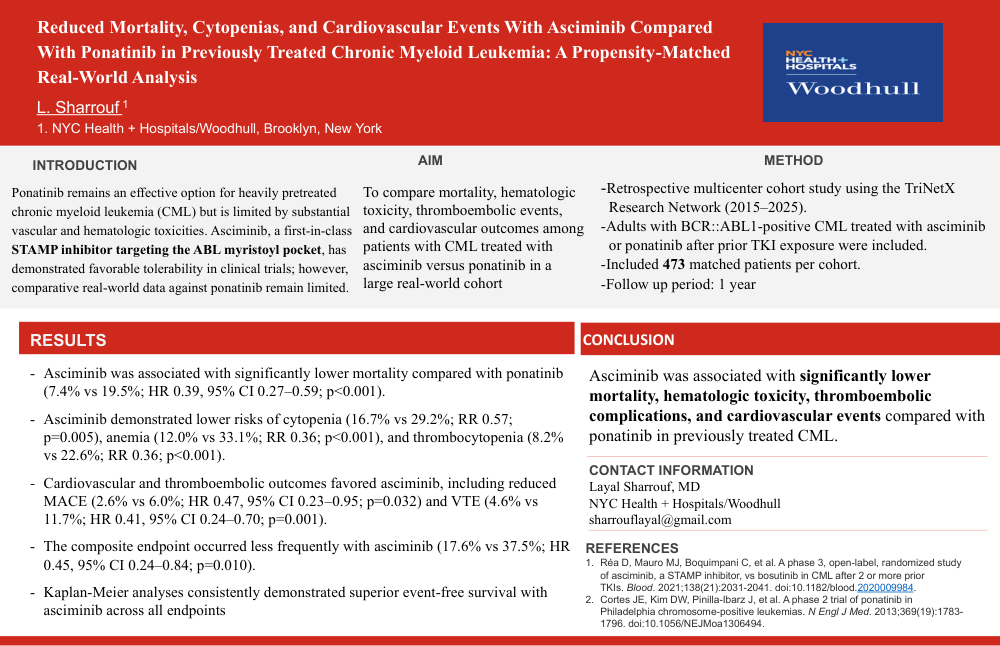
Reduced Mortality, Cytopenias, and Cardiovascular Events With Asciminib Compared With Ponatinib in Previously Treated Chronic Myeloid Leukemia: A Propensity-Matched Real-World Analysis
BACKGROUND: Ponatinib remains an effective option for heavily pretreated chronic myeloid leukemia (CML) but is limited by substantial vascular and hematologic toxicities. Asciminib, a first-in-class STAMP inhibitor targeting the ABL myristoyl pocket, has demonstrated favorable tolerability in clinical trials; however, comparative real-world data against ponatinib remain limited.
OBJECTIVE: To compare mortality, hematologic toxicity, thromboembolic events, and cardiovascular outcomes among patients with CML treated with asciminib versus ponatinib in a large real-world cohort.
METHODS: We performed a retrospective multicenter cohort study using the TriNetX Research Network (2015–2025). Adults with BCR::ABL1-positive CML treated with asciminib or ponatinib after prior tyrosine kinase inhibitor exposure were included. One-to-one propensity score matching was performed using 46 demographic, clinical, cardiovascular, and laboratory variables, yielding 473 matched patients per cohort. Outcomes within 365 days included mortality, cytopenia, anemia, thrombocytopenia, major arterial cardiovascular events (MACE), venous thromboembolism (VTE), and a composite of mortality/cytopenia/emergency visit/hospitalization. Hazard ratios (HR), and Kaplan-Meier analyses were generated.
RESULTS: Asciminib was associated with significantly lower mortality compared with ponatinib (7.4% vs 19.5%; HR 0.39, 95% CI 0.27–0.59; p<0.001). Asciminib also demonstrated lower risks of cytopenia (16.7% vs 29.2%; RR 0.57; p=0.005), anemia (12.0% vs 33.1%; RR 0.36; p<0.001), and thrombocytopenia (8.2% vs 22.6%; RR 0.36; p<0.001). Cardiovascular and thromboembolic outcomes favored asciminib, including reduced MACE (2.6% vs 6.0%; HR 0.47, 95% CI 0.23–0.95; p=0.032) and VTE (4.6% vs 11.7%; HR 0.41, 95% CI 0.24–0.70; p=0.001). The composite endpoint occurred less frequently with asciminib (17.6% vs 37.5%; HR 0.45, 95% CI 0.24–0.84; p=0.010). Kaplan-Meier analyses consistently demonstrated superior event-free survival with asciminib across all endpoints.
CONCLUSIONS: In this large propensity-matched real-world study, asciminib was associated with significantly lower mortality, hematologic toxicity, thromboembolic complications, and cardiovascular events compared with ponatinib in previously treated CML. These findings support asciminib as a potentially safer therapeutic strategy for patients requiring later-line therapy.