1,267 posters, 47 videos, 13 topics, 4 sessions, 853 authors
ePostersLive by SciGen Technologies S.A. All rights reserved.
SOHO 2026 Annual Meeting
September 9 - 12, 2026 | George R. Brown Convention Center, Houston, Texas

AML - 1207
Efficacy and Safety of Venetoclax Plus Azacitidine in Acute Myeloid Leukemia Patients Ineligible for Intensive Chemotherapy
Poster Presenter
Authors
Part of Topic
Acute Myeloid Leukemia (AML)
Title:
Efficacy and Safety of Venetoclax Plus Azacitidine in Acute Myeloid Leukemia Patients Ineligible for Intensive Chemotherapy
Authors:
A. Farheen, F. Nadeem, and Srijamya
Introduction:
Acute myeloid leukemia (AML) is characterized by clonal proliferation of immature myeloid cells and is associated with poor outcomes in elderly and medically unfit patients. Venetoclax, a selective B-cell lymphoma-2 (BCL-2) inhibitor, in combination with azacitidine, has emerged as an effective low-intensity therapeutic strategy, improving remission and survival outcomes in newly diagnosed AML patients unsuitable for intensive chemotherapy.
Aim:
To evaluate the efficacy and safety of venetoclax plus azacitidine in AML patients ineligible for intensive chemotherapy.
Methods:
A review of phase 1b–3 clinical trials, pooled subgroup analyses, and observational studies evaluating venetoclax plus azacitidine in AML patients ineligible for intensive chemotherapy was performed. Outcomes assessed included complete remission/complete remission with incomplete hematologic recovery (CR/CRi), overall survival (OS), measurable residual disease (MRD) negativity, and treatment-related adverse events.
Results:
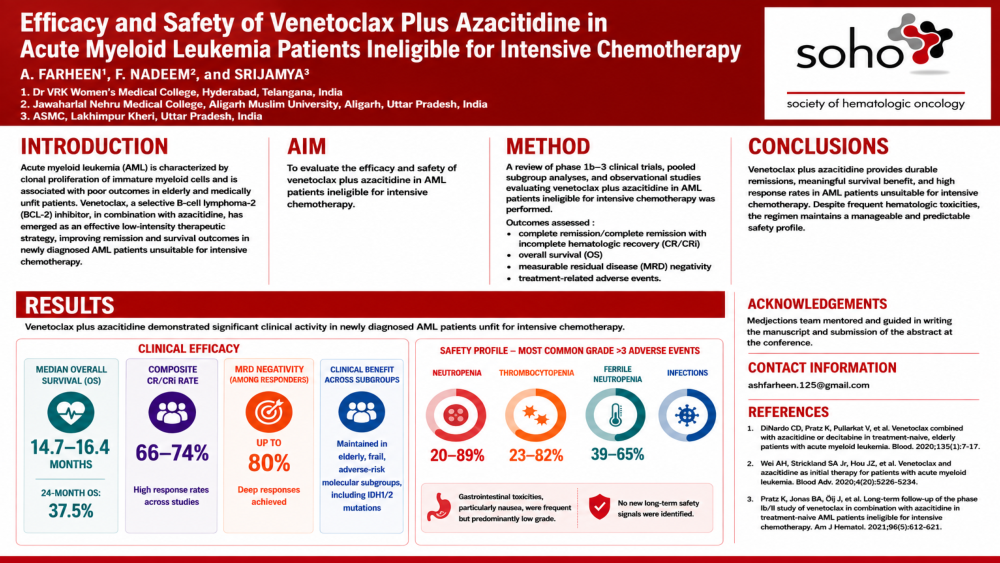
Venetoclax plus azacitidine demonstrated significant clinical activity in newly diagnosed AML patients unfit for intensive chemotherapy. Median overall survival was 14.7–16.4 months, with a 24-month overall survival of 37.5%. Composite CR/CRi rates were 66–74%, while MRD negativity among responders reached up to 80%. Clinical benefit was maintained across elderly, frail, adverse-risk, and molecular subgroups, including IDH1/2 mutations. The most common grade ≥3 adverse events included neutropenia (20–89%), thrombocytopenia (23–82%), febrile neutropenia (39–65%), and infections.
Conclusion:
Venetoclax plus azacitidine provides durable remissions, meaningful survival benefit, and high response rates in AML patients unsuitable for intensive chemotherapy. Despite frequent hematologic toxicities, the regimen maintains a manageable and predictable safety profile.
Acknowledgements:
Medications team mentored and guided in writing the manuscript and submission of the abstract at the conference.
Contact:
ashfarheen.125@gmail.com