1,267 posters, 47 videos, 13 topics, 4 sessions, 853 authors
ePostersLive by SciGen Technologies S.A. All rights reserved.
SOHO 2026 Annual Meeting
September 9 - 12, 2026 | George R. Brown Convention Center, Houston, Texas

ALL - 1176
CALGB 10403 in Latin America: A Single-Center Study with Extended Follow-Up
Poster Presenter
Authors
Part of Topic
Acute Lymphoblastic Leukemia (ALL)
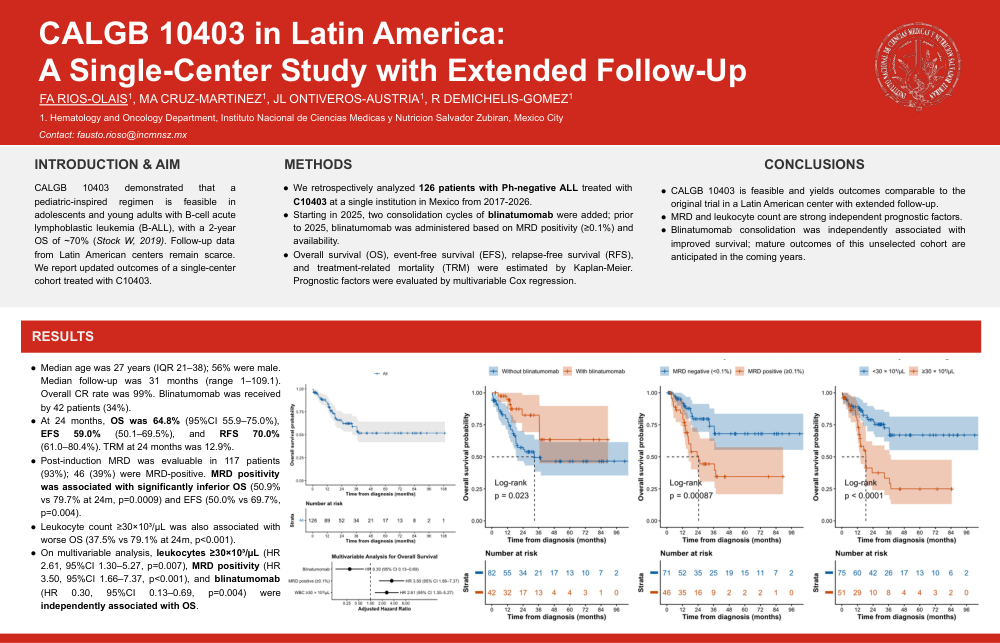
Background: CALGB 10403 demonstrated that a pediatric-inspired regimen is feasible in adolescents and young adults with B-cell acute lymphoblastic leukemia (B-ALL), with a 2-year OS of ~70%. Follow-up data from Latin American centers remain scarce. We report updated outcomes of a single-center cohort treated with C10403.
Methods: We retrospectively analyzed 126 patients with Ph-negative B-ALL treated with C10403 at a single institution in Mexico from 2017-2026. Starting in 2025, two consolidation cycles of blinatumomab were added; prior to 2025, blinatumomab was administered based on MRD positivity (≥0.1%) and availability. Overall survival (OS), event-free survival (EFS), relapse-free survival (RFS), and treatment-related mortality (TRM) were estimated by Kaplan-Meier. Prognostic factors were evaluated by multivariable Cox regression.
Results: Median age was 27 years (IQR 21–38); 56% were male. Median follow-up was 31 months (range 1–109.1). Overall CR rate was 99%. At 24 months, OS was 64.8% (95%CI 55.9–75.0%), EFS 59.0% (50.1–69.5%), and RFS 70.0% (61.0–80.4%). TRM at 24 months was 12.9%. MRD was evaluable in 117 patients (93%); 46 (39%) were MRD-positive. MRD positivity was associated with significantly inferior OS (50.9% vs 79.7% at 24m, p=0.0009) and EFS (50.0% vs 69.7%, p=0.004). Leukocyte count ≥30×10³/µL was also associated with worse OS (37.5% vs 79.1% at 24m, p<0.001). On multivariable analysis, leukocytes ≥30×10³/µL (HR 2.61, 95%CI 1.30–5.27, p=0.007), MRD positivity (HR 3.50, 95%CI 1.66–7.37, p<0.001), and blinatumomab (HR 0.30, 95%CI 0.13–0.69, p=0.004) were independently associated with OS. Blinatumomab was received by 42 patients (34%); given the non-randomized design and shorter follow-up in the 2025+ cohort, this association should be interpreted cautiously.
Conclusions: CALGB 10403 is feasible and yields outcomes comparable to the original trial in a Latin American center with extended follow-up. MRD and leukocyte count are strong independent prognostic factors. Blinatumomab consolidation was independently associated with improved survival; mature outcomes of this unselected cohort are anticipated in the coming years.