1,267 posters, 47 videos, 13 topics, 4 sessions, 853 authors
ePostersLive by SciGen Technologies S.A. All rights reserved.
SOHO 2026 Annual Meeting
September 9 - 12, 2026 | George R. Brown Convention Center, Houston, Texas

ABCL - 1115
HIV-Associated Burkitt Lymphoma in the Modern Era: The Prognostic Impact of CD4 Counts Below 200 Cells/µL
Poster Presenter
Part of Topic
Aggressive B-Cell Lymphoma (ABCL)
HIV-Associated Burkitt Lymphoma in the Modern Era: The Prognostic Impact of CD4 <200 Cells/µL
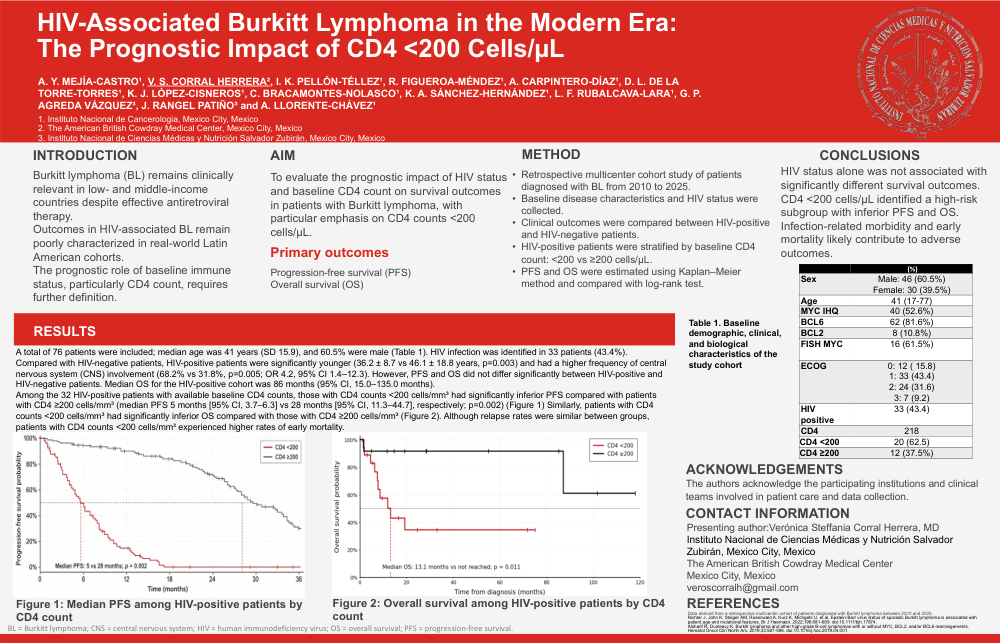
Background: HIV-associated Burkitt lymphoma remains clinically relevant, particularly in low- and middle-income countries. Despite advances in lymphoma-directed and antiretroviral therapies, the prognostic impact of immune status, particularly CD4 count, requires further definition.
Methods: We conducted a retrospective multicenter cohort study including patients diagnosed with Burkitt lymphoma between 2010 and 2025. Baseline clinical characteristics and HIV status were analyzed. HIV-positive patients were stratified according to baseline CD4 count (<200 vs ≥200 cells/µL). Progression-free survival (PFS) and overall survival (OS) were analyzed using the Kaplan–Meier method and compared with the log-rank test.
Results: A total of 76 patients were included; median age was 41 years and 60.5% were male. HIV infection was identified in 33 patients (43.4%). HIV-positive patients were younger and had a higher frequency of CNS involvement. Among HIV-positive patients with available CD4 counts, 20 had CD4 <200 cells/µL and 12 had CD4 ≥200 cells/µL. Patients with CD4 <200 cells/µL demonstrated significantly inferior PFS and OS compared with those with CD4 ≥200 cells/µL. Severe immunosuppression was associated with increased early mortality.
Conclusions: Baseline CD4 count identifies a high-risk subgroup among patients with HIV-associated Burkitt lymphoma. Patients with CD4 <200 cells/µL experienced significantly worse progression-free and overall survival, highlighting immune status at diagnosis as an important prognostic factor.