1,267 posters, 47 videos, 13 topics, 4 sessions, 853 authors
ePostersLive by SciGen Technologies S.A. All rights reserved.
SOHO 2026 Annual Meeting
September 9 - 12, 2026 | George R. Brown Convention Center, Houston, Texas

MPN - 1041
Epetraborole Demonstrates an Exposure-Dependent Effect on Erythropoiesis in Healthy Subjects
Poster Presenter
Authors
Part of Topic
Myeloproliferative Neoplasms (MPN)
INTRODUCTION:
Epetraborole (EBO), a boron-containing small molecule, specifically reduces erythropoiesis in nonhuman primates, healthy human subjects, and non‑polycythemia vera (PV) patients, suggesting its potential utility for oral treatment of PV. The objective of the current analysis is to describe pharmacokinetics (PK), tolerability, safety, and hematological effects of oral EBO administered at 250, 500, 750, or 1000 mg every 24 hours (q24h) or 500 or 1000 mg every 48 hours (q48h) for up to 28 days.
METHODS:
DESIGN: Double-blind, placebo-controlled, dose-ranging Phase 1b study (EBO-101). Healthy males or females, aged 18 to 65 years, randomized to receive EBO (n=39) or placebo (n=12) for up to 28 days.
Subjects were enrolled sequentially into 7 cohorts:
Cohort 1 (6 active : 2 placebo): 250 mg q24h
Cohort 2 (6 active : 3 placebo): 500 mg q48h
Cohort 3 (6 active : 2 placebo): 500 mg q24h
Cohort 4 (6 active : 2 placebo): 750 mg q24h
Cohort 5 (6 active : 2 placebo): 1000 mg q48h
Cohort 6* (1 active : 1 placebo): 1000 mg q24h
Cohort 7 (8 active fed/fasted): 500 mg single dose
* Randomization in Cohort 6 was terminated prematurely due to COVID-19 pandemic restrictions
MAIN OUTCOME MEASURES: EBO/metabolite M3 plasma concentrations, treatment-emergent adverse events (TEAEs), and clinical laboratory tests including hematological parameters. Plasma concentrations of EBO were measured by validated LC-MS/MS. Plasma PK parameters were determined using non‑compartmental methods.
RESULTS:
Of 51 subjects randomized, 48 (94.1%) completed the study and 47 (92.2%) completed administration of EBO or placebo. Of the 39 subjects administered EBO, 3 (7.7%) subjects did not complete treatment due to TEAEs. Of the 12 subjects administered placebo, 1 (8.3%) subject did not complete treatment due to a family issue.
PK Summary for q24h Dose Cohorts 1, 3, and 4: EBO reached Cmax rapidly with a median Tmax of 1 to 1.5 hours without any meaningful accumulation after repeat dosing. Half-life was ~10.5 hours. AUC0-24 and Cmax generally increased in a linear dose-proportional manner (Table 1).
Hematologic Findings:
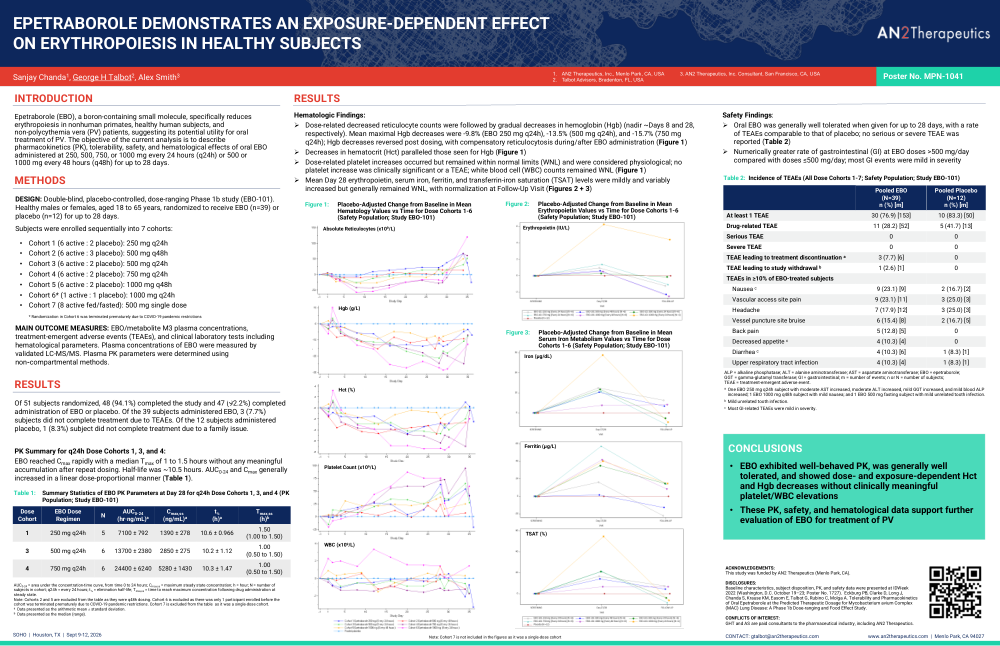
Dose-related decreased reticulocyte counts were followed by gradual decreases in hemoglobin (Hgb) (nadir ~Days 8 and 28, respectively). Mean maximal Hgb decreases were -9.8% (EBO 250 mg q24h), -13.5% (500 mg q24h), and -15.7% (750 mg q24h); Hgb decreases reversed post dosing, with compensatory reticulocytosis during/after EBO administration (Figure 1). Decreases in hematocrit (Hct) paralleled those seen for Hgb (Figure 1). Dose-related platelet increases occurred but remained within normal limits (WNL) and were considered physiological; no platelet increase was clinically significant or a TEAE; white blood cell (WBC) counts remained WNL (Figure 1). Mean Day 28 erythropoietin, serum iron, ferritin, and transferrin-iron saturation (TSAT) levels were mildly and variably increased but generally remained WNL, with normalization at Follow-Up Visit (Figures 2 + 3).
Safety Findings: Oral EBO was generally well tolerated when given for up to 28 days, with a rate of TEAEs comparable to that of placebo; no serious or severe TEAE was reported (Table 2). Numerically greater rate of gastrointestinal (GI) at EBO doses >500 mg/day compared with doses ≤500 mg/day; most GI events were mild in severity.
CONCLUSIONS:
EBO exhibited well-behaved PK, was generally well tolerated, and showed dose- and exposure-dependent Hct and Hgb decreases without clinically meaningful platelet/WBC elevations.
These PK, safety, and hematological data support further evaluation of EBO for treatment of PV.