1,267 posters, 47 videos, 13 topics, 4 sessions, 853 authors
ePostersLive by SciGen Technologies S.A. All rights reserved.
SOHO 2026 Annual Meeting
September 9 - 12, 2026 | George R. Brown Convention Center, Houston, Texas

CLL - 1026
Comparative Analysis of Long-Term Survival between Black and White Patients with Chronic Lymphocytic Leukemia/Small Lymphocytic Lymphoma in the Post-BTKi era using Real-World Data
Poster Presenter
Authors
Part of Topic
Chronic Lymphocytic Leukemia (CLL)
Introduction: Chronic Lymphocytic Leukemia (CLL)/small lymphocytic lymphoma (SLL) have shown a steady decline in mortality rates in the United States largely attributed to the introduction of Bruton Kinase Inhibitors (BTKi) and BCL2 inhibitors. Studies have reported worse outcomes in Black compared to White patients, with lower 5-year and 8-year overall survival. This study aims to evaluate racial differences in 5-year and 10-year outcomes in the post-BTKi era.
Methods: This is a retrospective analysis using data from the US Collaborative Network of TriNetX global health research database. Patients were African American/Black or White CLL or SLL patients diagnosed between January 2014 to December 2025. 1:1 propensity score matching (PSM) was used to balance cohorts by age at diagnosis, sex, independent use of Ibrutinib, Acalabrutinib, Zanubrutinib, and Venetoclax, comorbidities (hypertension, diabetes, and overweight/obesity), and pre-specified categories of baseline hemoglobin (<10 g/dl, ≥10 g/dl), platelet count (<100,000 cells/mm3, ≥100,000 cells/mm3) and leukocyte count (<25,000 cells/mm3, 25,000 to <50,000 cells/mm3, 50,000 to <100,000 cells/mm3, 100,000 to <150,000 cells/mm3, ≥150,000 cells/mm3). The primary outcome was overall survival, and secondary outcome was relapse-free survival, each at 5 and 10 years.
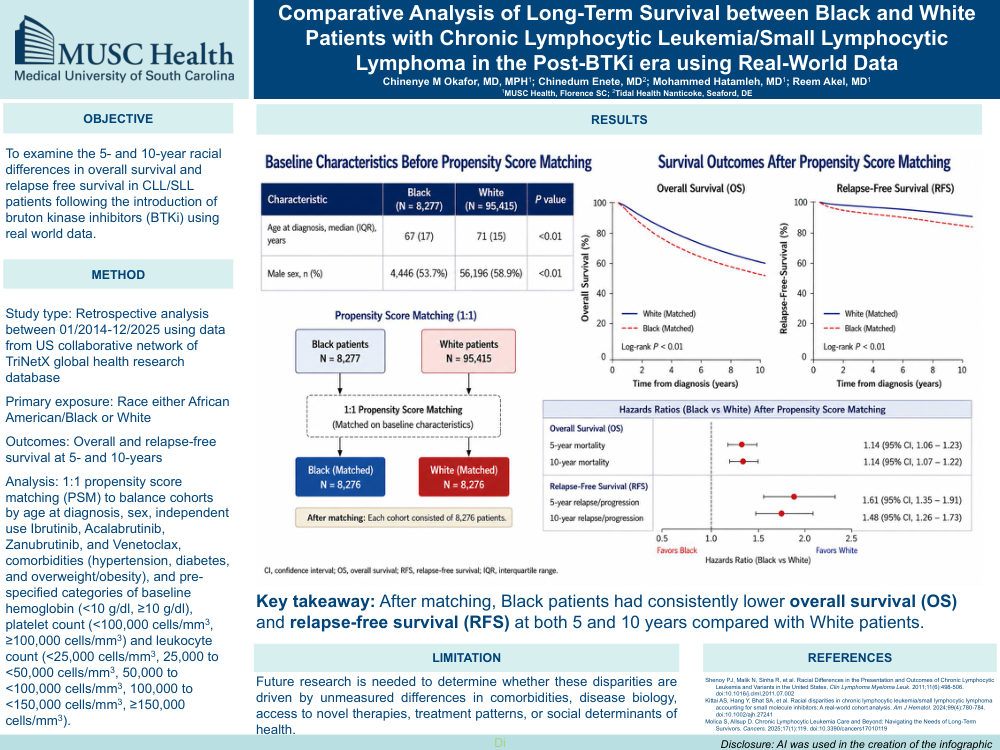
Results: A total of 8,277 Black and 95,415 White patients were identified. Compared to White patients, Black patients had significantly lower proportion of males (53.7% vs 58.9%; p<0.001) and were younger at diagnosis [median (IQR): 67 (17) vs 71 (15) years; p<0.001].
After PSM, each group included 8,276 patients. Compared to White patients, Black patients had lower overall survival at 5-years [75.6% vs 78.3%; HR 1.14 (95% CI; 1.06,1.23)] and 10-years [59.1% vs 62.6%; HR 1.14 (95% CI; 1.07,1.22)]. Black patients also had lower relapse-free survival at 5-years [93.7% vs 96.1%; HR 1.61 (95% CI; 1.35,1.91)] and 10-years [90.3% vs 92.1%; HR 1.48 (95% CI; 1.26,1.73)] when compared to White patients.
Conclusion: In this large real-world study in the post-BTKi era, Black CLL/SLL patients had significantly lower overall and relapse-free survival at 5- and 10-years compared to matched White counterparts. Future research is needed to determine whether these disparities are driven by unmeasured differences in comorbidities, disease biology, access to novel therapies/treatment patterns, or social factors.