1,267 posters, 47 videos, 13 topics, 4 sessions, 853 authors
ePostersLive by SciGen Technologies S.A. All rights reserved.
SOHO 2026 Annual Meeting
September 9 - 12, 2026 | George R. Brown Convention Center, Houston, Texas

TCL - 977
Survival Outcomes in Patients With Dual B-Cell and T-Cell Lymphoma Diagnoses
Poster Presenter
Authors
Part of Topic
T-Cell Lymphoma (TCL)
SURVIVAL OUTCOMES IN PATIENTS WITH DUAL B-CELL AND T-CELL LYMPHOMA DIAGNOSES
S. S. KHAZNADAR¹, C. A. HUMMEL¹, Z. E. HUNZEKER¹, J. W. HILL¹, K. MURPHY¹, A. A. AYERS¹, J. HENDERSON¹, T. SAINZ ZUNIGA², C. R. FLOWERS¹, M. HAMILTON¹, M. GREEN¹, F. VEGA², A. C. LIONEL¹, D. CHIHARA¹
INTRODUCTION
Prior epidemiological data demonstrated a nearly fivefold increased bidirectional risk between B-cell lymphomas (BCL) and T-cell lymphomas (TCL). Sequential dual-lineage lymphomas are rare, with limited outcome data. We report outcomes from a single-center cohort.
METHOD
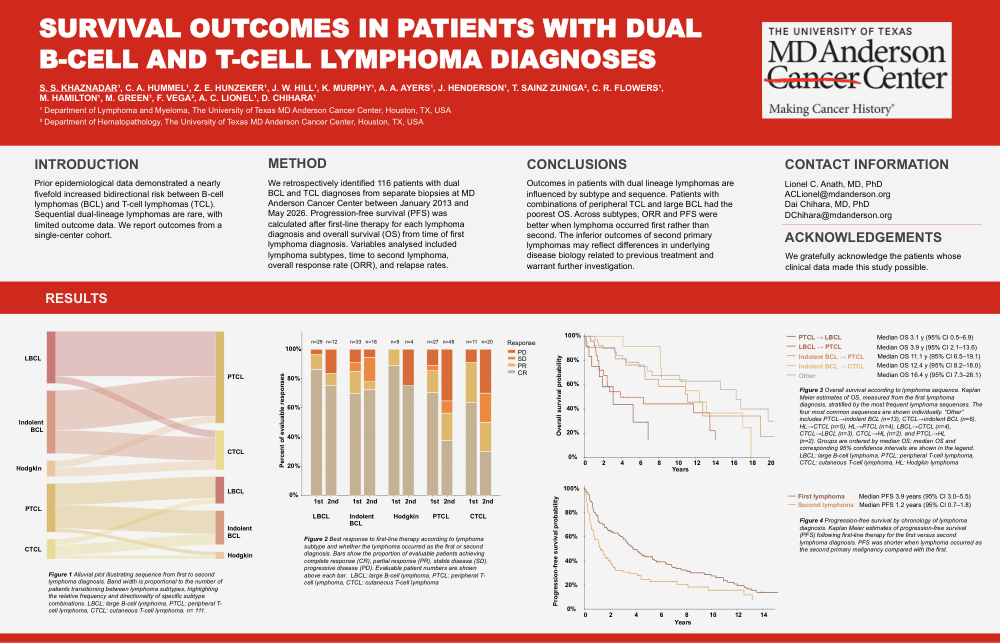
We retrospectively identified 116 patients with dual BCL and TCL diagnoses from separate biopsies at MD Anderson Cancer Center between January 2013 and May 2026.Progression-free survival (PFS) was calculated after first-line therapy for each lymphoma diagnosis and overall survival (OS) from time of first lymphoma diagnosis. Variables analysed included lymphoma subtypes, time to second lymphoma, overall response rate (ORR), and relapse rates.
CONCLUSIONS
Outcomes in patients with dual lineage lymphomas are influenced by subtype and sequence. Patients with combinations of peripheral TCL and large BCL had the poorest OS. Across subtypes, ORR and PFS were better when lymphoma occurred first rather than second. The inferior outcomes of second primary lymphomas may reflect differences in underlying disease biology related to previous treatment and warrant further investigation.