1,267 posters, 47 videos, 13 topics, 4 sessions, 853 authors
ePostersLive by SciGen Technologies S.A. All rights reserved.
SOHO 2026 Annual Meeting
September 9 - 12, 2026 | George R. Brown Convention Center, Houston, Texas

AML - 949
Upfront Triple Therapy With FLAG-Venetoclax Backbone in Intensive Chemotherapy-Eligible FLT3-ITD Patients With AML: Preliminary Results From a Retrospective Cohort
Poster Presenter
Authors
Part of Topic
Acute Myeloid Leukemia (AML)
ABSTRACT
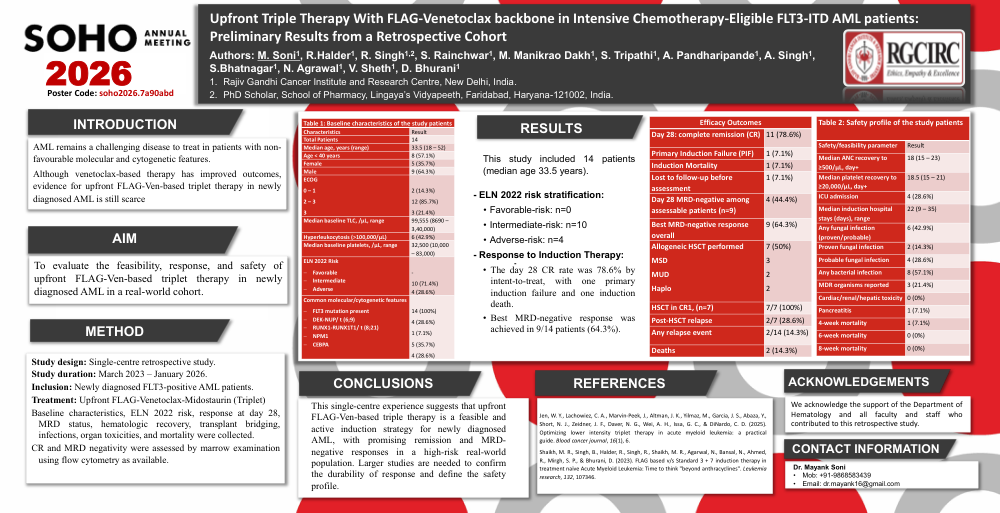
Context: AML remains a challenging disease to treat in patients with non-favourable molecular and cytogenetic features. Although venetoclax-based therapy has improved outcomes, evidence for upfront FLAG-Ven-based triplet therapy in newly diagnosed AML is still scarce.
Objective: To evaluate the feasibility, response, and safety of upfront FLAG-Ven-based triplet therapy in newly diagnosed AML in a real-world cohort.
Design: We performed a single-centre retrospective study of 14 patients with newly diagnosed FLT3-positive AML who were treated with an upfront FLAG-Ven-Midostaurin-based triplet induction from March 2023 to January 2026.
Outcomes Measures: Baseline characteristics, ELN 2022 risk, response at day 28, MRD status, hematologic recovery, transplant bridging, infections, organ toxicities, and mortality were collected. CR and MRD negativity were assessed by marrow examination using flow cytometry as available.
Results: The median age was 33.5 years (range, 18 - 52). By ELN 2022 risk criteria, 71.4% were intermediate-risk and 28.6% adverse-risk. The day 28 CR rate was 78.6% by intent-to-treat, with one primary induction failure and one induction death. Best MRD-negative response was achieved in 9/14 patients (64.3%). Median ANC recovery to ≥500/µL was day +17, and platelet recovery to ≥20,000/µL was day +18. Notably, 50% of patients were successfully bridged to allo-HSCT in CR1. The predominant treatment-related toxicities include infection occurrence, including fungal infections in 6/14 (42%) patients and bacterial infections in 8/14 (57%); however, no cardiac, renal, or hepatic toxicity was observed. Four-week mortality was 7.1%.
Conclusion: This single-centre experience suggests that upfront FLAG-Ven-based triple therapy is a feasible and active induction strategy for newly diagnosed AML, with promising remission and MRD-negative responses in a high-risk real-world population. Larger studies are needed to confirm the durability of response and define the safety profile.
Keywords: AML, Triple-therapy, Flag-Ven, Upfront, Real-world, India