1,267 posters, 47 videos, 13 topics, 4 sessions, 853 authors
ePostersLive by SciGen Technologies S.A. All rights reserved.
SOHO 2026 Annual Meeting
September 9 - 12, 2026 | George R. Brown Convention Center, Houston, Texas

CT - 924
CD19-Directed CAR T-Cell Therapy in Patients with HIV-Associated Relapsed/Refractory Lymphoma: A Systematic Review
Poster Presenter
Authors
Part of Topic
Cellular Therapy (CT)
CD19-Directed CAR T-Cell Therapy in Patients with HIV-Associated Relapsed/Refractory Lymphoma: A Systematic Review
Ritwik Dey1, Virali Gulla1, Harshitha Popuri1, Jesus Gomez2
1Department of Internal Medicine, Texas Tech University Health Sciences Center, El Paso, TX, USA
2Department of Hematology/Oncology, Texas Tech University Health Sciences Center, El Paso, TX, USA
KEYWORDS: CAR T-cell therapy, HIV-associated lymphoma, axicabtagene ciloleucel, immunotherapy, AIDS-related lymphoma
CONTEXT: People living with HIV/AIDS (PLWHA) have a >100-fold increased risk of non-Hodgkin lymphoma (NHL) yet remain systematically excluded from pivotal trials establishing FDA approval of CD19-directed CAR-T cell therapies, leaving critical gaps in knowledge.
OBJECTIVE: To evaluate the safety and efficacy of CAR-T cell therapy in PLWHA with relapsed/refractory (R/R) NHL.
DESIGN: Systematic review of all published studies reporting CAR-T outcomes in PLWHA with Lymphoma (August 2017–April 2026), extracted from PubMed, ClinicalTrials.gov, and conference proceedings.
SETTING: Academic medical centers with established cellular therapy programs across the US and Europe.
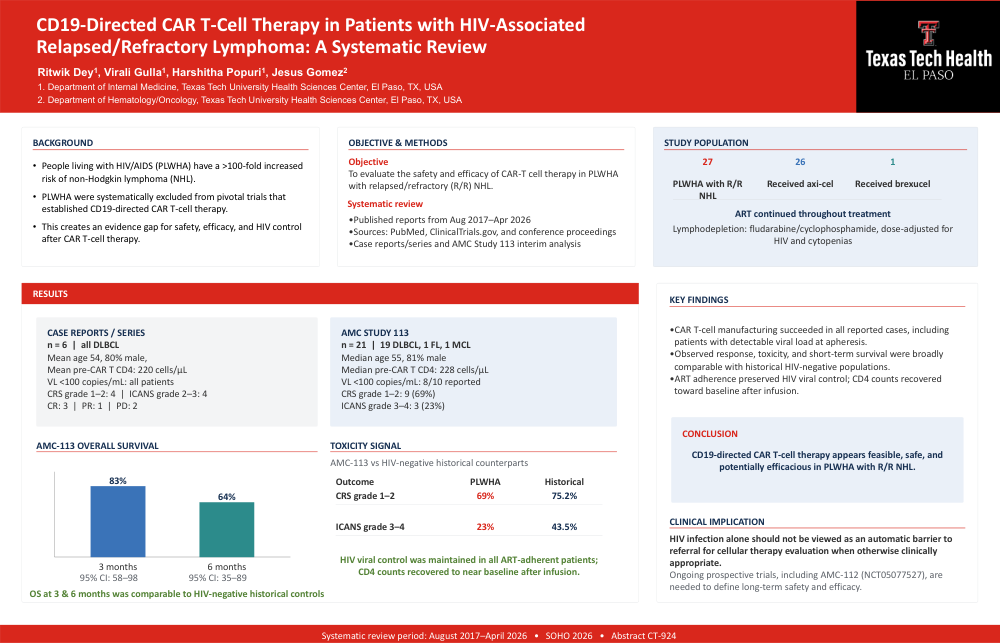
PATIENTS: 27 PLWHA with R/R NHL: 6 from case reports/series and 21 from the AIDS Malignancy Consortium (AMC) Study 113 interim analysis.
INTERVENTIONS: 26 patients received axicabtagene ciloleucel (axi-cel); 1 received brexucabtagene autoleucel. Lymphodepleting fludarabine/cyclophosphamide (dose-adjusted for HIV and cytopenias) preceded infusion. Antiretroviral therapy (ART) was continued throughout.
MAIN OUTCOME MEASURES: Overall survival (OS), complete (CR) and partial response (PR) rate; cytokine release syndrome (CRS) and immune effector cell-associated neurotoxicity syndrome (ICANS) rates; HIV viral load (VL) and CD4 count changes post-infusion.
RESULTS: CAR-T manufacturing succeeded in all cases, including patients with detectable viral loads at apheresis. In the case reports/series (n=6; mean age 54, 80% male, all DLBCL): mean pre-CAR-T CD4 220 cells/µL; VL <100 copies/ml in all; CRS grade 1–2 in 4 and ICANS grade 2–3 in 4. CR in 3, PR in 1, progressive disease in 2. In AMC-113 (n=21; median age 55, 81% male, 19 DLBCL/1 follicular /1 mantle cell): median pre-CAR-T CD4 228 cells/µL; VL <100 copies/ml in 8/10 patients. CRS grade 1-2 in 9 (69%), and ICANS grade 3-4 in 3 (23%), lower than HIV-negative counterparts (75.2% and 43.5%, respectively). OS at 3 and 6 months 83% (95% CI 58–98) and 64% (95% CI 35–89), respectively, comparable to HIV-negative historical controls. HIV viral control was maintained in all ART-adherent patients; CD4 counts recovered to near-baseline post-infusion.
CONCLUSIONS: CAR-T is safe and potentially efficacious in PLWHA with R/R NHL, with toxicity and survival outcomes comparable to HIV-negative populations. Ongoing trials like AMC-112 (NCT05077527) will further define safety and long-term outcomes in this underserved population.